

Sykam S-433D Fully Automated Amino Acid Analyzer
| Brand | Sykam |
|---|---|
| Origin | Germany |
| Model | S-433D |
| Instrument Type | Post-column Derivatization Amino Acid Analyzer |
| Pump Flow Rate | 0.000–9.999 mL/min |
| Maximum Pump Pressure | 40 MPa (400 bar, 6000 psi) |
| Autosampler Injection Volume | 1–500 µL |
| Autosampler Temperature Control | +4 °C to 70 °C (electronic thermostating) |
| Post-column Reactor Temperature Range | Ambient to 180 °C (temperature stability ±0.1 °C) |
| Detection Wavelengths | Simultaneous dual-wavelength detection at 570 nm and 440 nm |
| Flow Cell Volume | 8 µL |
Overview
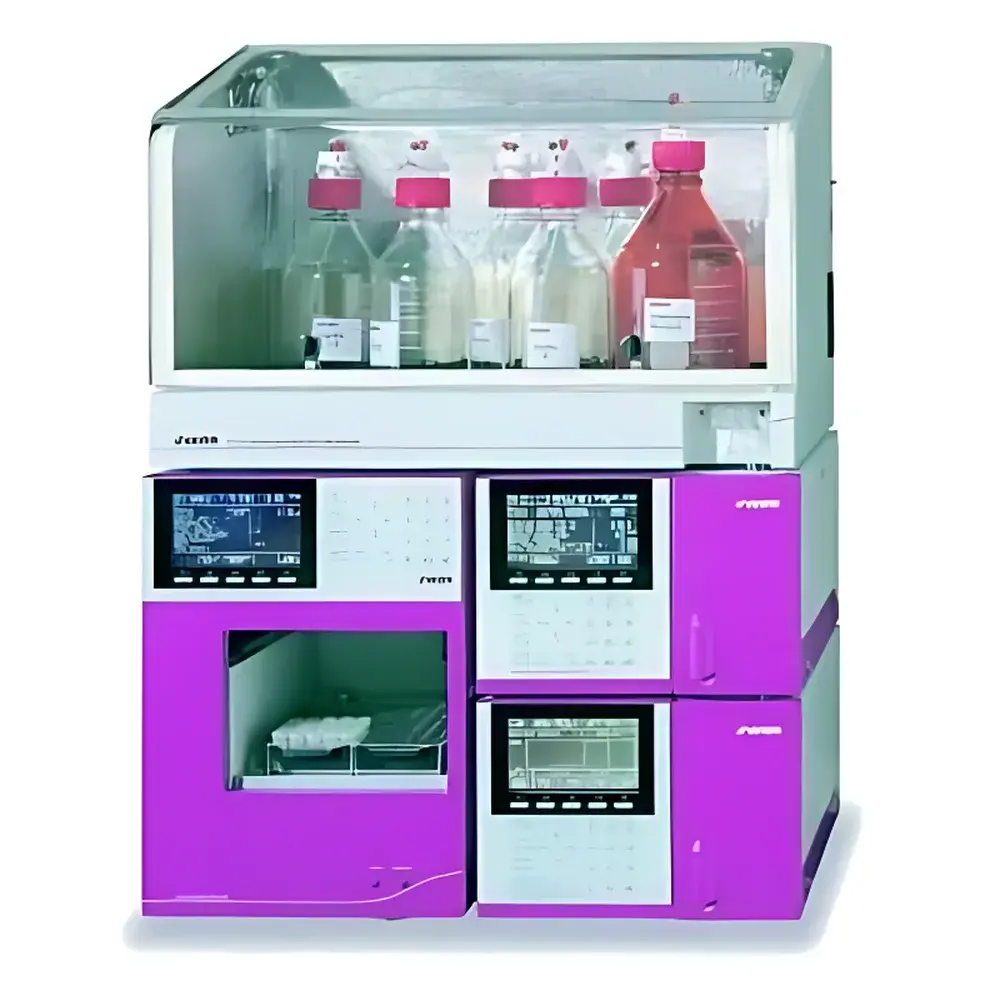
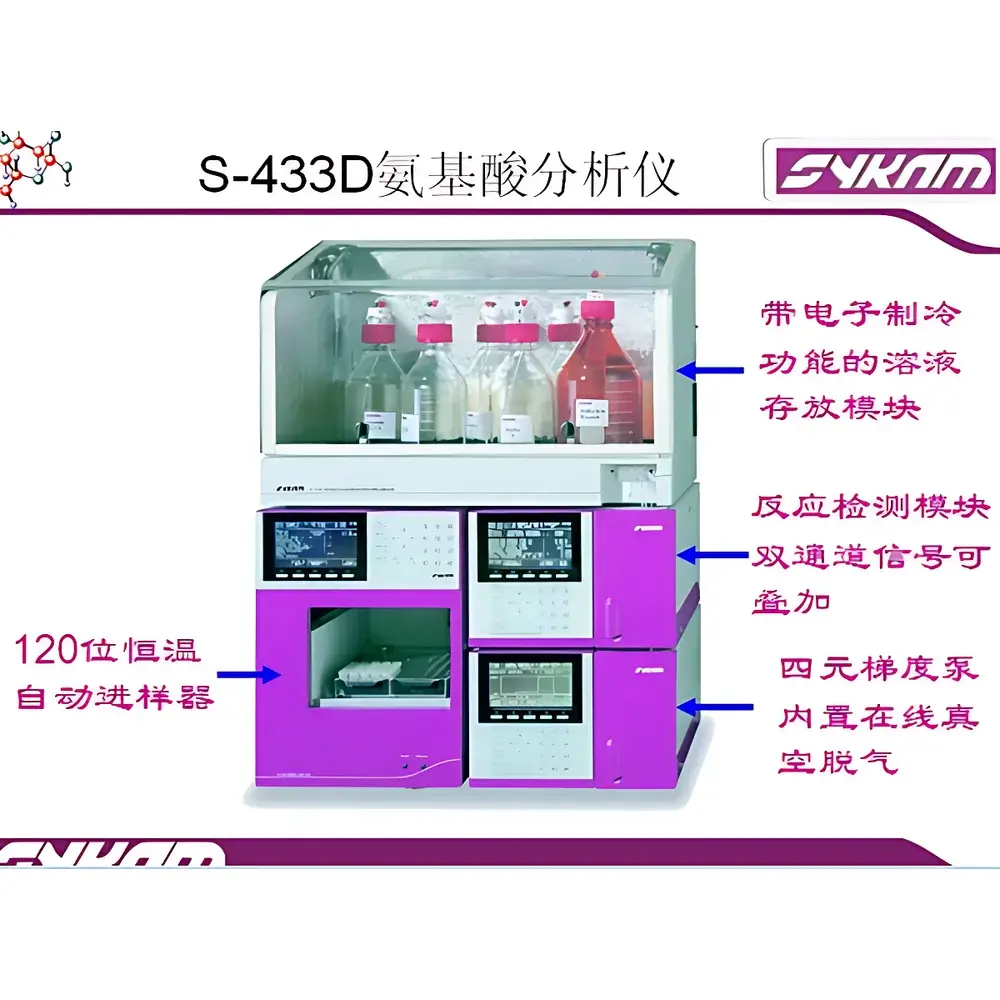
The Sykam S-433D Fully Automated Amino Acid Analyzer is an engineered solution for high-precision, routine quantification and qualification of free and hydrolyzed amino acids in complex biological matrices. Based on the well-established post-column derivatization principle using ninhydrin chemistry, the S-433D delivers robust, reproducible separations under strictly controlled thermal and fluidic conditions. Unlike generic HPLC systems adapted for amino acid analysis, the S-433D is purpose-built: its integrated hardware architecture—including a four-channel gradient pump, refrigerated reagent storage, thermally stabilized separation column oven, and precisely regulated post-column reaction module—is optimized exclusively for the kinetic and stoichiometric demands of ninhydrin-based detection. The system complies with pharmacopeial methods (USP , EP 2.2.46) and is routinely validated for GLP- and GMP-regulated environments where trace-level sensitivity, retention time stability, and long-term column integrity are non-negotiable.
Key Features
- Integrated refrigerated reagent storage unit (S 7130) maintains all ninhydrin reagents, buffers, and wash solutions at +4 °C; each reagent bottle features an inert gas (N₂ or Ar) isolation valve to prevent oxidative degradation.
- High-precision autosampler (S 5200) with XYZ robotic arm enables programmable injection volumes from 1 µL to 500 µL in 1-µL increments; sample tray accommodates two 60-position racks of 1.5-mL vials with electronic temperature control from +4 °C to 70 °C.
- Four-channel low-pulsation gradient pump (S 2100) employs dual PEEK pistons with <1% pulsation; flow accuracy RSD <0.1% and pressure capability up to 40 MPa ensure stable gradient formation using only 2–3 optimized buffer solvents for complete amino acid profiling.
- Dedicated post-column reaction module includes a piston-driven reagent delivery pump (0.000–2.000 mL/min), a thermostatically controlled reactor (ambient to 180 °C, ±0.1 °C), and automated coil flushing to eliminate carryover.
- Dual-wavelength photometer simultaneously monitors absorbance at 570 nm (primary α-amino detection) and 440 nm (secondary imino acid detection); raw or offset-compensated signals are output digitally with selectable integration time constants.
- Column oven (S 4200) provides active heating and cooling across 20–99 °C with ±0.1 °C stability; standard analytical column is PEEK-jacketed, 4.6 × 150 mm, 7 µm, 10% cross-linked resin—specifically formulated for amino acid resolution and longevity.
Sample Compatibility & Compliance
The S-433D is validated for diverse sample types including hydrolyzed proteins (e.g., food, feed, pharmaceutical excipients), physiological fluids (plasma, serum, urine, CSF), and cell culture supernatants. Sample preparation follows standardized acid hydrolysis (6 M HCl, 110 °C, 22–24 h) or enzymatic digestion protocols compatible with ISO 13903, AOAC 994.12, and FDA guidance for amino acid quantitation in biologics. All wetted components—including tubing, valves, pump heads, and reaction coils—are constructed from inert PEEK or PTFE to prevent metal-catalyzed oxidation or adsorption. System compliance extends to regulatory frameworks: audit trail-enabled software supports 21 CFR Part 11 requirements; full electronic records, user access levels, and change control logs meet GLP (OECD 1998) and GMP (ICH Q5C, Q7) documentation standards.
Software & Data Management
The native Sykam Aminotrace® software provides a graphical, icon-driven interface for method development, sequence programming, real-time pressure/temperature monitoring, and peak integration. It features built-in amino acid libraries with retention time indexing, automatic baseline correction, and customizable reporting templates compliant with LIMS export (ASTM E1467). All instrument events—including valve actuations, temperature setpoint changes, and pump flow adjustments—are timestamped and logged with operator ID. Data files are stored in vendor-neutral formats (CSV, PDF, .axd) and support third-party statistical packages (e.g., JMP, SIMCA) for multivariate analysis. Software validation documentation (IQ/OQ/PQ protocols) is available upon request for regulated laboratories.
Applications
- Quantitative quality control of therapeutic proteins and peptides (e.g., confirming amino acid composition post-purification).
- Stability-indicating assays for biopharmaceuticals under accelerated and real-time storage conditions.
- Nutritional labeling of infant formula, sports nutrition products, and clinical enteral feeds per Codex Alimentarius standards.
- Clinical diagnostics of inborn errors of metabolism (e.g., phenylketonuria, maple syrup urine disease) via plasma amino acid profiling.
- Research applications in plant biochemistry (free amino acid pools in drought-stressed tissues) and microbiology (amino acid exudates in rhizosphere studies).
FAQ
What derivatization chemistry does the S-433D employ?
The system uses ninhydrin-based post-column derivatization, which reacts selectively with primary and secondary amino groups under controlled heat and pH to yield chromophores detectable at 570 nm (Ruhemann’s purple) and 440 nm (proline-derived yellow).
Is pre-column derivatization supported?
No—the S-433D is designed exclusively for post-column ninhydrin chemistry; it does not accommodate OPA, FMOC, or other pre-column reagents.
Can the system analyze D-amino acids?
Standard ninhydrin detection is not stereospecific; chiral separation requires coupling with a chiral stationary phase column—not supplied as standard but technically feasible with method adaptation.
What is the typical detection limit for aspartic acid?
Under optimized conditions (S/N = 2), the system achieves a detection limit of 3 pmol for aspartic acid and 8 pmol for most proteinogenic amino acids.
How is system suitability verified?
Daily verification includes retention time repeatability (RSD <0.5% for arginine), peak area precision (RSD 1.2 between critical pairs), and column backpressure stability—all tracked automatically in the software’s QC dashboard.





