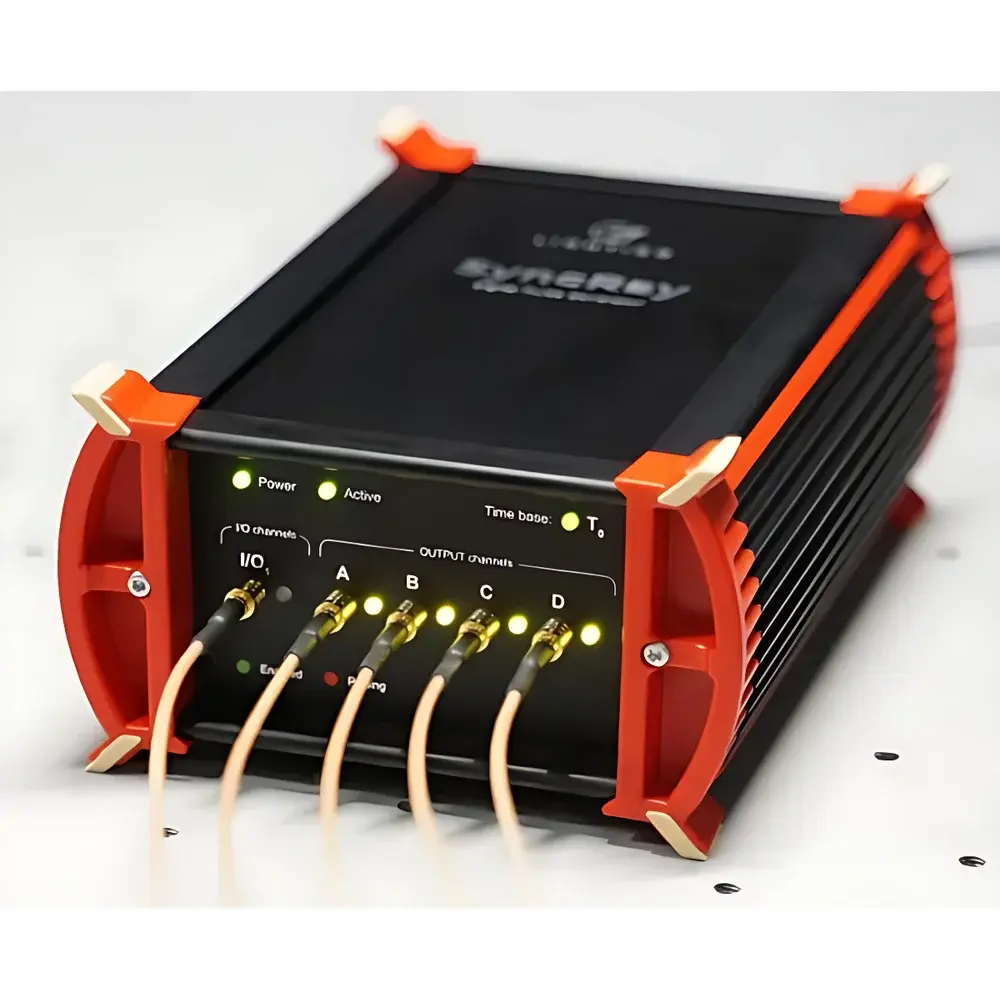
SyncRay LIBS Timing Controller by Lightigo
| Brand | Lightigo |
|---|---|
| Origin | Czech Republic |
| Model | SyncRay |
| Output Channels | 4 × SMB (plus 1 × SMB trigger input) |
| Synchronization Capacity | Up to 5 devices |
| Synchronization Resolution | 10 ns |
| Synchronization Accuracy | ±5 ns |
| Output Voltage Options | 3.3 V / 5 V |
| Clock Sources | Internal (0–5 MHz) or External Trigger (0–5 MHz) |
| Trigger Modes | Single-shot, Continuous, Burst, Duty Cycle |
| Gating | High-/Low-level active, adjustable threshold (level/rising/falling edge) |
| Channel Modes | Continuous, Single-trigger, Burst, Duty Cycle |
| Channel Parameters | Adjustable pulse width and delay |
| Advanced Features | Channel multiplexing, wait counting, configurable sync source, gating per channel |
| Interface Options | USB 2.0 (industrial grade), 10/100 Mbps Ethernet |
| Housing | Anodized aluminum, 130 × 75 × 190 mm, 1.0 kg |
| Mounting | DIN-rail compatible (optional), OEM board version available (100 × 160 mm, 8HP), SDD communication protocol supported |
Overview
The SyncRay LIBS Timing Controller is a precision digital pulse generator engineered specifically for Laser-Induced Breakdown Spectroscopy (LIBS) systems requiring nanosecond-scale temporal coordination between laser excitation, detector gating, and auxiliary instrumentation. Developed by Lightigo — a Czech engineering subsidiary of CEITEC (Central European Institute of Technology) — the SyncRay implements a deterministic, low-jitter timing architecture based on high-stability quartz oscillators and FPGA-controlled delay synthesis. Unlike general-purpose delay generators, SyncRay embeds LIBS-specific operational logic: it supports hierarchical triggering (e.g., external ARM signal initiating internal clock-driven sequencing), sub-5 ns inter-channel synchronization accuracy, and real-time reconfigurability without firmware reload. Its compact form factor and dual-interface design (USB + Ethernet) enable seamless integration into both benchtop analytical setups and industrial inline monitoring platforms where space, thermal stability, and deterministic latency are critical.
Key Features
- Five-device synchronization capability with ±5 ns absolute timing accuracy and 10 ns resolution across all output channels
- Dual-clock architecture: selectable internal oscillator (0–5 MHz) or externally triggered operation with configurable edge sensitivity (rising/falling/level) and programmable threshold
- Four independent SMB-output channels plus one dedicated SMB trigger/ARM/gating/T0 input — optimized for LIBS laser–detector–spectrometer coordination
- Programmable output voltage (3.3 V or 5 V TTL-compatible) to match diverse detector gate inputs, PMT modules, and Q-switch drivers
- Flexible channel modes: continuous, single-shot, burst, and duty-cycle — each supporting independent pulse width and delay assignment
- Gating support with polarity-selectable activation (high/low level) and hardware-based hold-off for signal integrity in noisy EMI environments
- OEM-ready integration options: Eurocard-form-factor board (100 × 160 mm, 8HP) with SDD (Standard Device Description) protocol compliance for SCADA and PLC interoperability
- Robust mechanical design: anodized aluminum housing (130 × 75 × 190 mm), rubberized anti-slip feet, and industrial-grade USB 2.0 + 10/100 Mbps Ethernet interfaces
Sample Compatibility & Compliance
The SyncRay is designed for use with standard LIBS components including Nd:YAG lasers (Q-switched, 1064 nm or frequency-doubled), ICCD or sCMOS gated detectors, Czerny–Turner spectrometers, and auxiliary sensors (e.g., plasma emission monitors, sample stage encoders). It complies with IEC 61326-1 (EMC for laboratory equipment) and meets CE marking requirements for electromagnetic compatibility and low-voltage safety. Its deterministic timing behavior ensures reproducible delay settings across repeated acquisitions — a prerequisite for quantitative LIBS calibration in accordance with ASTM E2926-22 (Standard Practice for LIBS Analysis of Metals). While not a medical device, its traceable timing performance supports GLP-compliant data acquisition workflows when paired with validated software stacks.
Software & Data Management
Lightigo provides a cross-platform configuration utility (Windows/macOS/Linux) with intuitive GUI for channel parameterization, sequence scripting, and real-time status monitoring. All timing parameters — including delays, widths, gating windows, and trigger conditions — are stored in non-volatile memory and persist across power cycles. The Ethernet interface enables remote control via TCP/IP using ASCII command syntax compliant with IEEE 488.2 SCPI subsets, facilitating integration into LabVIEW, Python (PyVISA), or MATLAB automation frameworks. Audit-trail functionality logs all configuration changes with timestamps and user identifiers — supporting 21 CFR Part 11 readiness when deployed in regulated QC/QA laboratories. Firmware updates are delivered via signed binary packages with SHA-256 verification.
Applications
- Time-gated LIBS for elemental mapping of alloys, soils, and geological samples with reduced continuum background
- Synchronization of multi-laser ablation sequences in depth-profiling applications
- Trigger coordination between pulsed lasers and time-of-flight mass spectrometers (TOF-MS) in hybrid LIBS-TOF configurations
- Industrial process monitoring: inline metal sorting, slag analysis in steelmaking, and coating thickness verification
- Academic research: plasma kinetics studies, collisional-radiative modeling validation, and spectral line broadening analysis
- OEM integration into portable or robotic LIBS platforms requiring low-SWaP-C (Size, Weight, Power, and Cost) timing solutions
FAQ
What is the maximum jitter observed between synchronized outputs under typical operating conditions?
Measured RMS jitter is ≤1.2 ns at 25 °C ambient, verified using high-bandwidth oscilloscopes (≥12 GHz) and statistical analysis over 10,000 consecutive triggers.
Can SyncRay be used with non-LIBS applications such as pump-probe spectroscopy or particle image velocimetry (PIV)?
Yes — its sub-5 ns accuracy, flexible trigger modes, and multi-channel independence make it suitable for any application demanding precise temporal orchestration of pulsed sources and detectors.
Is the SDD protocol implementation certified for use in IEC 61850 or OPC UA environments?
The SDD descriptor conforms to IEC 61850-6 Ed. 2 Annex A for device description syntax; native OPC UA mapping requires middleware translation layer — provided upon request for qualified industrial partners.
Does SyncRay support hardware-based interlock or emergency stop signaling?
Not natively — safety-critical interlocks must be implemented externally using the gate input as a hardware enable/disable signal; Lightigo recommends integrating certified safety relays per ISO 13849-1 for Category 3 PLd architectures.
How is calibration traceability maintained for timing parameters?
Each unit ships with a factory calibration certificate referencing NIST-traceable time interval analyzers; annual recalibration services are available through Lightigo’s Brno service center.