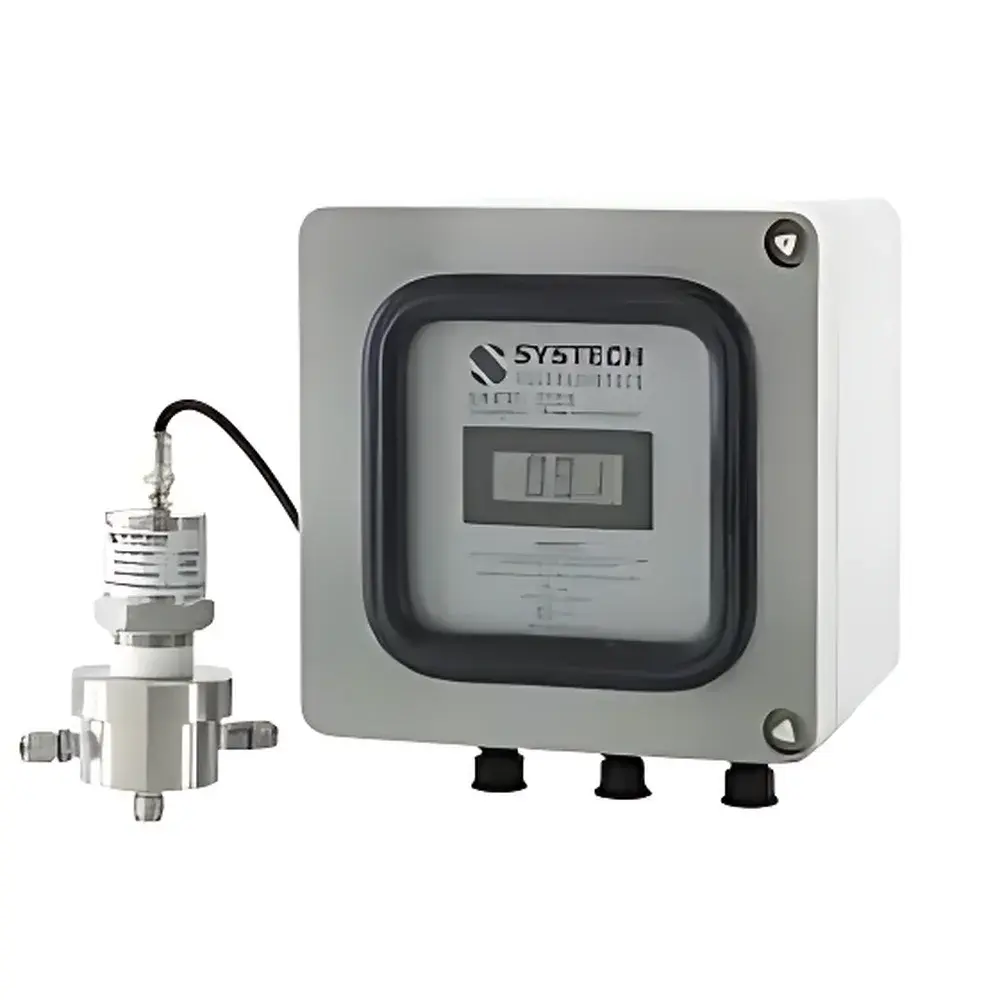
Systech EC91 Oxygen Analyzer
| Origin | UK |
|---|---|
| Manufacturer Type | Authorized Distributor |
| Origin Category | Imported |
| Model | EC91 |
| Price | USD 9,400 (FOB) |
Overview
The Systech EC91 Oxygen Analyzer is a high-stability, electrochemical fuel cell–based oxygen measurement instrument engineered for continuous, real-time monitoring of O₂ concentration across an exceptionally wide dynamic range—from trace-level 0.1 ppm up to 21% (v/v) in gas streams and ambient air. Designed and manufactured in the United Kingdom by Systech Instruments Ltd., a specialist in paramagnetic and electrochemical gas sensing technologies, the EC91 employs a solid-state, temperature-compensated electrochemical sensor with a nominal five-year service life under typical operating conditions. Its measurement principle relies on the diffusion-controlled oxidation of oxygen at a catalytic cathode, generating a linear current output proportional to partial pressure—enabling direct quantification without internal amplification drift or zero-point degradation common in older galvanic cells. The analyzer is purpose-built for integration into industrial process control loops, inerting verification systems, glovebox monitoring, pharmaceutical nitrogen purge validation, and semiconductor purge gas quality assurance—where regulatory compliance, long-term calibration stability, and immunity to background gas interference are critical.
Key Features
- Electrochemical fuel cell sensor with factory-calibrated lifetime of ≥5 years; no routine electrolyte replenishment or membrane replacement required
- Six user-selectable measurement ranges covering ultra-trace (0–1 ppm) through atmospheric (0–21%) O₂ concentrations—each configured via DIP switches or software interface
- High-speed response: T₉₀ ≤ 2 seconds across all ranges, enabling rapid detection of oxygen ingress or purge breakthrough
- Ruggedized polyester enclosure rated IP65—resistant to mechanical impact, acid/alkali splashes, hydrocarbon exposure, and dust ingress
- Isolated 4–20 mA analog output (HART-compatible option available), scalable to any selected range with full galvanic isolation (max. loop resistance: 400 Ω)
- Integrated digital LCD display with backlight; optional remote digital indicator/alarm unit for safe-area mounting
- Wide operational envelope: sample gas temperature –5 °C to +40 °C; ambient temperature –5 °C to +40 °C; RH 0–99% non-condensing
- Intrinsically safe design certified to EEx ia IIC T4 (IEC 60079-0, -11), suitable for Zone 0/1 hazardous locations when powered via approved Zener barrier (24 VDC supply)
Sample Compatibility & Compliance
The EC91 is compatible with dry, non-corrosive, non-solvent-laden process gases including N₂, Ar, He, CO₂, H₂, and compressed air. It is explicitly incompatible with halogenated compounds, strong acids (e.g., HCl, HF), oxidizing agents (e.g., Cl₂, NOₓ), and organic vapors that may poison the fuel cell catalyst. Sample inlet pressure tolerance spans 0.01–0.1 MPa standard; optional external sampling systems extend capability to 17 bar (250 psi). Flow rate requirement is 30 mL/min minimum to 5 L/min maximum—achievable via integrated flow restrictor or external pump/suction module. The analyzer meets CE marking requirements per EMC Directive 2014/30/EU and Low Voltage Directive 2014/35/EU. Sensor calibration traceability follows ISO/IEC 17025-accredited standards using NIST-traceable certified reference gases (e.g., 20.9% O₂ in N₂). Documentation supports GLP/GMP audit readiness, including calibration logs, sensor replacement records, and firmware version tracking.
Software & Data Management
While the EC91 operates as a stand-alone transmitter with local display and analog output, it integrates seamlessly into distributed control systems (DCS), SCADA platforms, and PLC-based architectures via its isolated 4–20 mA signal. Optional Systech ConfigTool software (Windows-based) enables remote configuration of range selection, damping factor, alarm thresholds, and unit scaling via RS-232 interface. All configuration changes are timestamped and stored in non-volatile memory. For regulated environments, the system supports 21 CFR Part 11-compliant data integrity workflows when paired with validated historian software—ensuring electronic signatures, audit trails, and change control for calibration events and parameter adjustments.
Applications
- Pharmaceutical lyophilization chamber O₂ monitoring during nitrogen backfill and storage
- Food packaging headspace analysis (modified atmosphere packaging—MAP)
- Heat treatment furnace atmosphere control (e.g., sintering, brazing, annealing)
- Transformer oil dissolved gas analysis (DGA) support systems
- Chemical reactor blanketing verification and leak detection
- Electronics manufacturing cleanroom inert gas purity assurance
- Environmental emissions monitoring where low-concentration O₂ serves as a dilution indicator
FAQ
What calibration gases are required for field verification?
Ambient air (20.9% O₂) is sufficient for span verification at atmospheric levels; for trace-range validation (<10 ppm), certified zero gas (e.g., 99.999% N₂) and certified span gas (e.g., 5 ppm O₂ in N₂) are recommended.
Can the EC91 be installed directly in-line with high-pressure gas lines?
No—the standard unit accepts only low-pressure sample gas (≤0.1 MPa); for pressures up to 17 bar, a Systech-approved external pressure-reduction sampling system must be used.
Is sensor replacement a field-serviceable procedure?
Yes—the electrochemical cell is a plug-in module; replacement requires no soldering or recalibration—only verification against reference gas post-installation.
Does the EC91 support digital communication protocols beyond analog output?
Standard units provide only 4–20 mA; optional HART 7 protocol integration is available upon request for enhanced diagnostics and remote configuration.
How does temperature variation affect measurement accuracy below 10 ppm?
At <10 ppm, accuracy is specified as ±2% of reading + 0.4 ppm at 20 °C; additional thermal drift is compensated at ±0.15 ppm/°C deviation from reference temperature.