
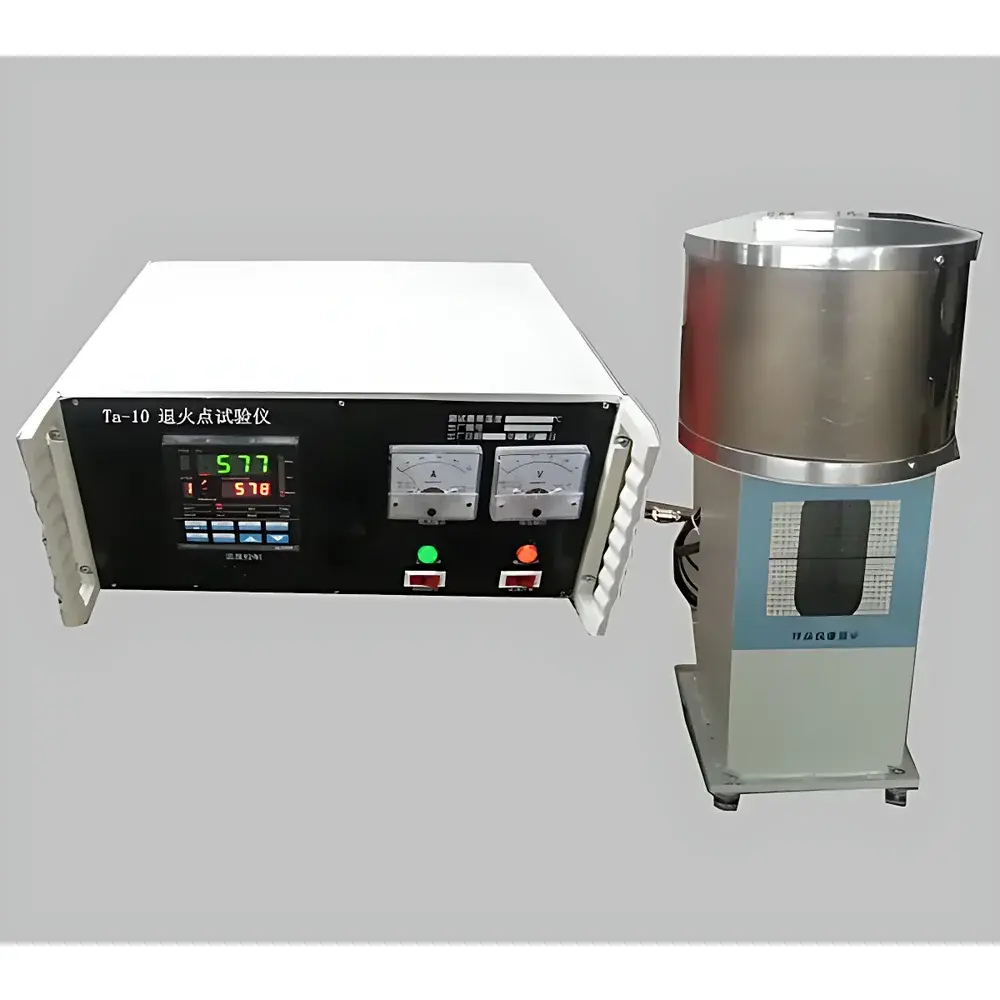
Ta-10 Glass Annealing Point and Strain Point Tester
| Origin | Hunan, China |
|---|---|
| Manufacturer Type | Authorized Distributor |
| Origin Category | Domestic (China) |
| Model | TA-10 |
| Pricing | Upon Request |
| Max Operating Temperature | 1000 °C |
| Temperature Resolution | 0.1 °C |
| Temperature Accuracy | <1% of reading |
| Heating Rate Control | 5 ± 1 °C/min (PID-regulated, fully automated) |
| Test Method | Fiber Draw Method (ASTM C336, SJT 11039–1996, JC/T 752–1996) |
Overview
The Ta-10 Glass Annealing Point and Strain Point Tester is a precision thermal-mechanical instrument engineered for the standardized determination of two critical viscoelastic transition temperatures in amorphous silicate materials: the annealing point and the strain point. These temperatures define the upper limits of practical thermal stability for glass components subjected to prolonged service or subsequent processing steps. The instrument operates on the fiber draw (or filament elongation) principle—where a vertically suspended glass fiber of nominal 0.65 mm diameter is subjected to a constant tensile load while the furnace temperature is linearly decreased at a controlled rate of 4 °C/min. The annealing point is identified as the temperature at which the fiber elongates at a rate of 0.14 mm/min under this condition; the strain point is derived by extrapolating the elongation curve to the temperature where the elongation rate drops to 0.0316 times that value—corresponding to a relaxation time of approximately 2 hours (104 s) under standard load conditions. This methodology aligns with fundamental rheological models of glassy polymer and oxide network behavior, enabling direct correlation with structural relaxation kinetics.
Key Features
- Fully automated PID-controlled heating and cooling system with programmable ramp rates (5 ± 1 °C/min typical for heating; 4 °C/min fixed for annealing point measurement per ASTM C336)
- High-stability vertical furnace assembly rated for continuous operation up to 1000 °C, featuring dual-zone insulation and low thermal gradient (< ±2 °C over 50 mm test zone)
- Digital temperature readout with 0.1 °C resolution and calibrated accuracy better than ±1% of full-scale reading across the operational range
- Integrated optical displacement sensor with sub-micron resolution for real-time fiber elongation monitoring (0–5 mm range, 0.01 mm repeatability)
- Pre-configured test protocols compliant with ASTM C336 (Standard Test Method for Annealing Point and Strain Point of Glass), SJT 11039–1996 (Electronic Glass), and JC/T 752–1996 (Fused Quartz)
- Modular load application system supporting standardized weights (e.g., 24.4 g for 0.65 mm fiber per ASTM), with quick-change fixtures for reproducible tension alignment
Sample Compatibility & Compliance
The Ta-10 accommodates cylindrical glass specimens—including soda-lime, borosilicate, aluminosilicate, fused quartz, and specialty optical glasses—with diameters ranging from 0.5 to 0.8 mm and minimum lengths of 120 mm. Specimen preparation follows strict dimensional tolerances outlined in referenced standards to ensure mechanical uniformity and minimize bending moment effects. All test procedures are traceable to NIST-calibrated thermocouples (Type S) and certified reference weights. Data acquisition and reporting support audit-ready documentation aligned with GLP (Good Laboratory Practice) frameworks. While not inherently 21 CFR Part 11–compliant out-of-the-box, the system architecture allows integration with validated LIMS or ELN platforms for regulated environments requiring electronic signature and audit trail capabilities.
Software & Data Management
The Ta-10 includes embedded firmware with real-time temperature/elongation synchronization, automatic inflection point detection, and on-device curve fitting using least-squares regression of the log(ε̇) vs. 1/T plot. Raw data (time, T, ΔL) are exportable via USB to CSV format for post-processing in MATLAB, Origin, or Excel. Optional PC-based software provides advanced features: multi-curve overlay, ISO/IEC 17025 uncertainty budgeting per GUM (Guide to the Expression of Uncertainty in Measurement), batch report generation with customizable headers (lab ID, operator, calibration date), and PDF export with embedded digital signatures. All software modules adhere to IEC 62304 Class B safety requirements for medical device-related testing applications.
Applications
- Quality control of container glass, display substrates, optical fibers, and semiconductor encapsulation glasses
- R&D of low-expansion and high-Tg glass compositions for aerospace and laser optics
- Thermal history validation for glass-to-metal sealing processes
- Supporting ISO 10110–7 surface stress evaluation through correlation with fictive temperature
- Material qualification per MIL-G-17465C, DIN 1255–1, and JIS R3102
- Academic research into structural relaxation, viscosity-temperature relationships (Fulcher equation fitting), and fictive temperature modeling
FAQ
What standards does the Ta-10 comply with for annealing point measurement?
ASTM C336 is the primary reference method; additional compliance includes SJT 11039–1996 (electronic glass) and JC/T 752–1996 (fused quartz).
Can the instrument measure strain point without manual extrapolation?
Yes—the firmware performs automated logarithmic extrapolation of the elongation rate curve to determine the strain point at ε̇ = 0.0316 × ε̇anneal.
Is calibration traceable to national metrology institutes?
Temperature calibration uses NIST-traceable Type S thermocouples; force calibration employs ISO/IEC 17025-accredited deadweight standards.
What maintenance intervals are recommended for long-term accuracy?
Furnace thermocouple verification every 6 months; optical sensor alignment check before each daily session; full system calibration annually or after any mechanical impact.
Does the system support custom heating/cooling profiles beyond ASTM C336?
Yes—user-defined multi-segment ramps and dwell steps are programmable via the front panel interface or optional PC software.



