
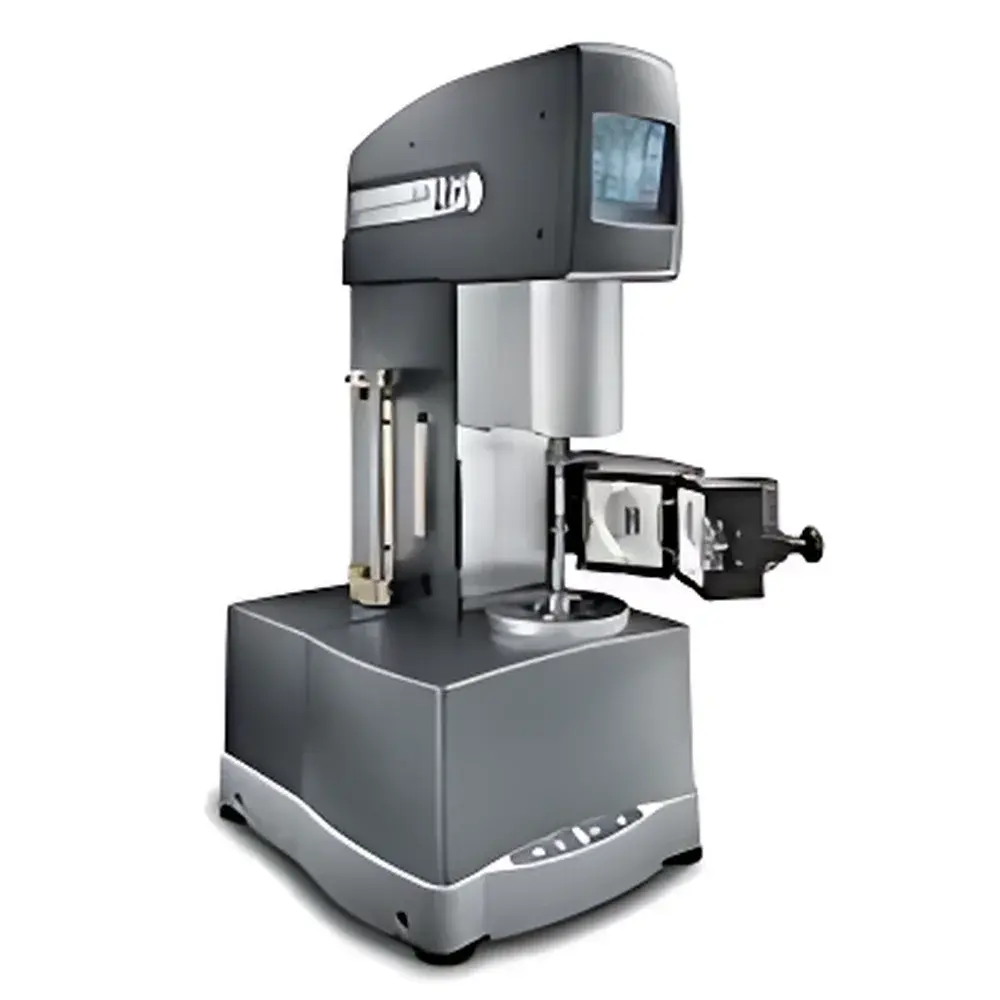
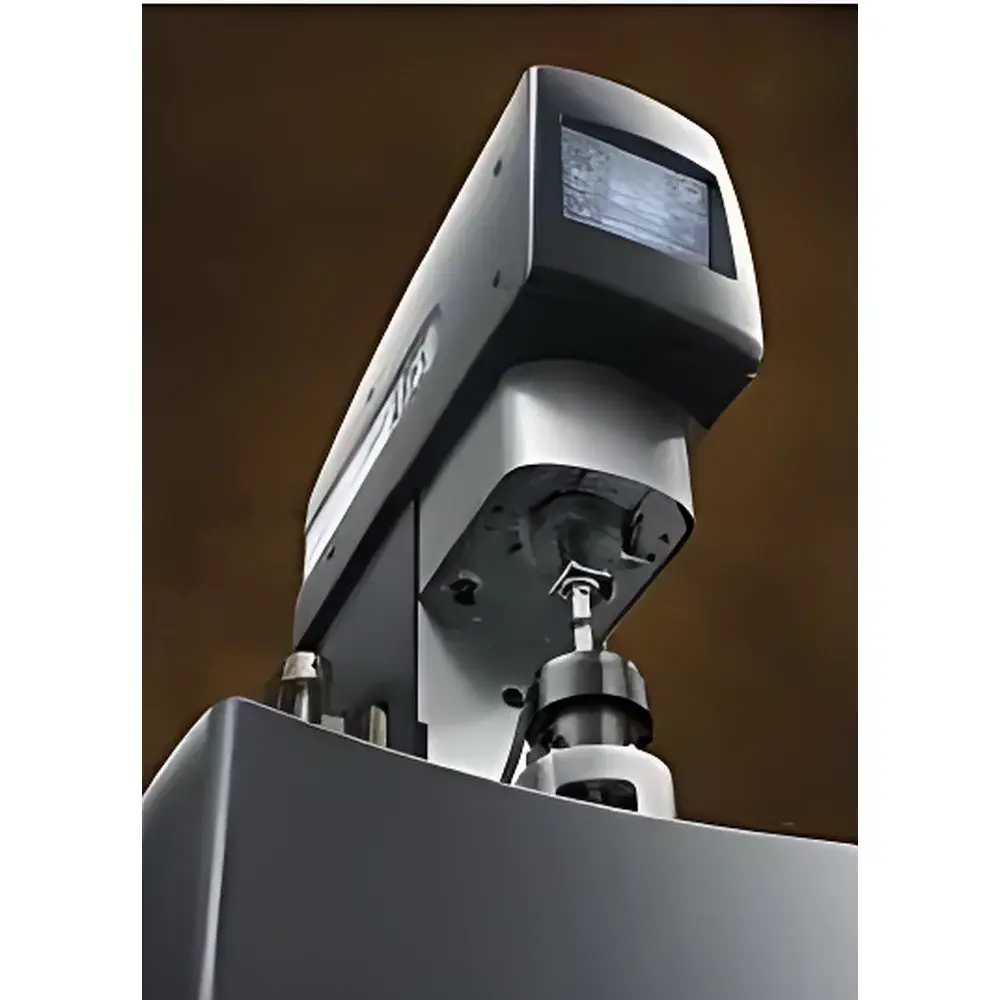
TA Instruments ARES-G2 Advanced Rotational Rheometer
| Brand | TA Instruments |
|---|---|
| Origin | USA |
| Model | ARES-G2 |
| Instrument Type | Rotational Rheometer |
| Sample Type | High-Viscosity & Solid-State Materials |
| Motor Bearing | Sapphire Air Bearing |
| Temperature Range | −40 °C to 180 °C |
| Minimum Rotational Speed | 0 rpm |
| Frequency Range | 1 × 10⁻⁷ to 628 rad/s |
| Maximum Torque | 200 mN·m |
| Torque Resolution | 1 nN·m |
Overview
The TA Instruments ARES-G2 Advanced Rotational Rheometer is a high-performance, force-balanced torque transducer-based rheological measurement system engineered for precision characterization of complex fluids and soft solids under controlled thermal and mechanical conditions. Utilizing a true dual-sensor architecture—separate force/torque transducers for stress/strain control and independent normal force sensing—the ARES-G2 enables direct, real-time measurement of sample stress without reliance on motor back-EMF estimation. This architecture conforms to the fundamental principles of Couette and parallel-plate rheometry, supporting both controlled-stress (CS) and controlled-strain (CR) modes with exceptional fidelity across an ultra-broad dynamic range. Designed for research-grade viscoelasticity analysis, the instrument delivers high reproducibility in oscillatory shear, transient extensional flow, and time-resolved creep/recovery testing—making it suitable for polymer melt processing, pharmaceutical formulation development, food texture profiling, and advanced material science applications where microstructural response must be resolved at sub-microradian strain and nanonewton-meter torque levels.
Key Features
- True force-balanced torque transducer with direct stress measurement capability—eliminating model-dependent torque inference.
- Sapphire air bearing motor assembly ensuring near-frictionless rotation, minimal thermal drift, and long-term mechanical stability.
- Dual independent servo systems: brushless DC torque motor for rotational actuation and brushless DC normal force motor for axial positioning and load control.
- Ultra-low torque detection limit: 0.05 µN·m in oscillatory mode and 0.1 µN·m in steady shear—enabling characterization of weak gels and dilute biopolymer solutions.
- Exceptional angular resolution: 0.04 µrad strain resolution via optical encoder feedback; minimum oscillatory angular displacement of 1 µrad.
- Wide operational frequency range: 1 × 10⁻⁷ rad/s to 628 rad/s (0.0159 mHz to 100 Hz), supporting both ultra-slow relaxation studies and high-frequency dynamic moduli mapping.
- Integrated temperature control options: standard forced convection oven (FCO, −150 °C to 600 °C), Peltier-based APS stage (−10 °C to 150 °C), and sealed fluid bath (−10 °C to 150 °C).
- Normal force range: 0.001 N to 20 N with 1 µN resolution—critical for interfacial rheology, adhesion studies, and solid-state deformation analysis.
Sample Compatibility & Compliance
The ARES-G2 accommodates a broad spectrum of sample states—including molten thermoplastics, uncured elastomers, hydrogels, pastes, suspensions, and rigid thermosets—via interchangeable geometries (cone-plate, parallel-plate, concentric cylinder, and extensional fixtures). Its robust mechanical architecture supports ASTM D4440 (dynamic mechanical analysis of plastics), ISO 6721 (polymeric materials—determination of dynamic mechanical properties), and USP (uniformity of dosage units) compliant test protocols. The system is fully compatible with GLP/GMP environments when configured with TriOS software’s 21 CFR Part 11-compliant audit trail, electronic signature, and user access control modules. All hardware components are CE-marked and meet IEC 61000-6-3 electromagnetic compatibility standards.
Software & Data Management
TriOS™ rheology software provides a unified platform for experiment design, real-time data acquisition, advanced modeling (e.g., Maxwell, Kelvin-Voigt, Cox-Merz, Winter-Chambon), and export-ready reporting. Raw torque, normal force, angular displacement, and temperature data streams are captured at up to 1 kHz sampling rate and stored in vendor-neutral HDF5 format. Batch processing workflows support automated QA/QC checks, master curve construction via time–temperature superposition (TTS), and compliance reporting templates aligned with internal SOPs or regulatory submissions. Data integrity is preserved through immutable metadata tagging, version-controlled method files, and secure network deployment options for multi-user lab environments.
Applications
- Polymer processing: Melt elasticity quantification, die swell prediction, and rheological fingerprinting of polyolefins and engineering resins.
- Pharmaceuticals: Gelation kinetics of injectables, viscosity profiling of ophthalmic solutions, and viscoelastic assessment of topical semisolids per FDA guidance.
- Food science: Structure recovery after shear breakdown, yield stress determination in sauces and dairy spreads, and starch gelatinization monitoring.
- Biomaterials: Viscoelastic mapping of extracellular matrix mimics, fibrin clot formation dynamics, and cell-laden hydrogel mechanical maturation.
- Coatings & inks: Thixotropic recovery evaluation, sag resistance modeling, and pigment dispersion stability under oscillatory shear.
FAQ
What distinguishes the ARES-G2’s force-balanced transducer from conventional motor-sensor rheometers?
Unlike motor back-EMF inferred torque systems, the ARES-G2 employs a dedicated, isolated torque transducer that directly measures applied stress—ensuring accuracy independent of motor inertia, thermal effects, or drive electronics nonlinearity.
Can the ARES-G2 perform extensional rheology?
Yes—when equipped with the optional SER (Sentmanat Extensional Rheometer) or UXF (Universal Extensional Fixture), it supports uniaxial, planar, and biaxial extensional deformation protocols per ASTM D8250 and ISO 11443 Annex E.
Is the system compatible with inert atmosphere or solvent vapor control?
Yes—integrated environmental chambers (e.g., nitrogen-purged glovebox adapters) and solvent-trap accessories enable testing under controlled humidity or volatile organic environments.
How does the ARES-G2 handle thermal calibration traceability?
All temperature modules include NIST-traceable calibration certificates; TriOS software supports user-defined calibration curves using certified reference materials (e.g., indium, zinc, and tin standards).
What level of cybersecurity compliance does the TriOS software support?
TriOS v5.5+ supports FIPS 140-2 validated encryption, role-based access control (RBAC), and full 21 CFR Part 11 audit trail generation—including operator ID, timestamp, parameter changes, and raw data modification history.



