
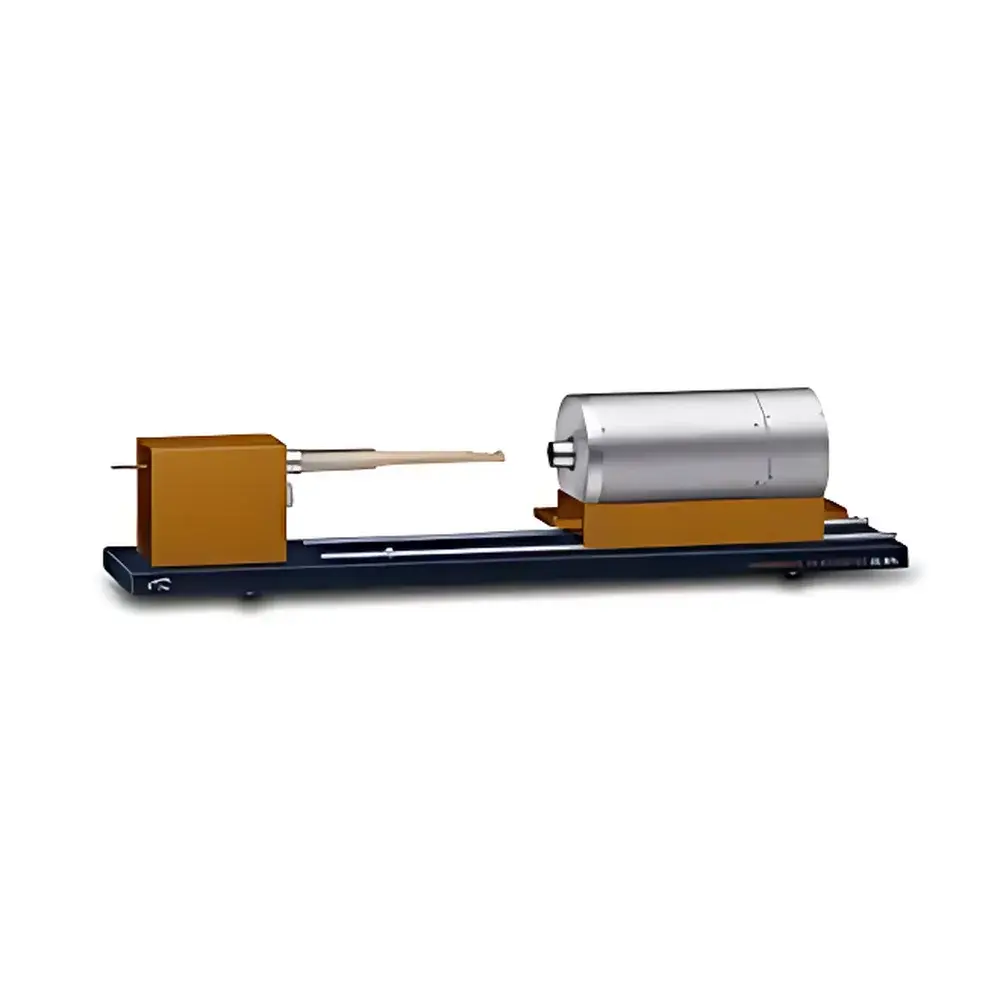
TA Instruments DIL 801 / DIL 801L Horizontal Single-Sample Thermal Dilatometer
| Brand | TA Instruments |
|---|---|
| Origin | USA |
| Model | DIL 801 / DIL 801L |
| Configuration | Horizontal, single-sample dilatometer |
| Operating Atmosphere | Air, vacuum, or inert gas (N₂, Ar) |
| Temperature Range | −150 °C to 1600 °C (dependent on furnace and sensor option) |
| Force Control | User-adjustable contact force from 0.02 N to 1.00 N |
| Sensor Type | High-stability LVDT with digital signal conditioning |
| Compliance | ASTM E228, ISO 11359-1/-2, DIN 51045-1, USP <671> |
Overview
The TA Instruments DIL 801 and DIL 801L are horizontal, single-sample thermal dilatometers engineered for high-fidelity measurement of linear dimensional changes in solid materials as a function of temperature. Based on the principle of contact-based mechanical displacement detection, these instruments quantify thermal expansion and contraction through precise tracking of sample length variation under controlled thermal conditions. The DIL 801 supports operation across the broadest practical temperature range—from cryogenic conditions (−150 °C with liquid nitrogen cooling) up to 1600 °C (with high-temperature furnace and appropriate sensor configuration)—in air, vacuum, or inert atmospheres. The DIL 801L variant is optimized for high-accuracy measurements specifically under ambient air conditions, making it particularly suitable for ceramic sintering studies, phase transition analysis in refractory oxides, and quality control of structural ceramics where reproducible, low-drift baseline performance is critical.
Key Features
- Horizontal furnace architecture ensures superior axial temperature uniformity along the sample length—minimizing thermal gradients that compromise expansion coefficient accuracy.
- High-stability Linear Variable Differential Transformer (LVDT) sensor with integrated digital signal amplification delivers sub-micrometer resolution and long-term drift stability, even during extended isothermal holds or multi-cycle thermal programs.
- User-defined contact force control (0.02 N to 1.00 N) enables adaptive mechanical coupling between probe and sample surface; this maintains consistent probe–sample interface integrity throughout thermal contraction events, preventing loss of contact and ensuring data continuity.
- Vibration-damped mechanical design—including isolated optical encoder mounts and reinforced frame construction—reduces environmental noise sensitivity and enhances measurement repeatability across laboratory environments.
- Modular furnace options support seamless transitions between low-, mid-, and high-temperature applications without hardware reconfiguration; interchangeable sensor cartridges accommodate different expansion ranges and thermal stability requirements.
Sample Compatibility & Compliance
The DIL 801/801L accommodates cylindrical or rectangular solid samples up to 25 mm in length and 12 mm in diameter (standard configuration), with optional fixtures available for thin films, powders (via sintered pellet), and fiber specimens. Sample holders are constructed from high-purity alumina or graphite, selected per atmospheric and temperature constraints. Instrument compliance includes full alignment with ASTM E228 (Standard Test Method for Linear Thermal Expansion of Solid Materials With a Push-Rod Dilatometer), ISO 11359-1 (General principles) and ISO 11359-2 (Determination of linear coefficient of thermal expansion), as well as DIN 51045-1 and USP for pharmaceutical excipient characterization. Data acquisition and reporting workflows support GLP/GMP environments through audit-trail-enabled software logging and user-access controls.
Software & Data Management
Operation is managed via TRIOS™ Thermal Analysis Software—a platform compliant with FDA 21 CFR Part 11 for electronic records and signatures. The software provides real-time visualization of displacement vs. temperature curves, automated calculation of mean and instantaneous coefficients of thermal expansion (CTE), inflection point detection for phase transitions, and customizable reporting templates exportable to PDF, CSV, or XML. All raw sensor voltage, temperature, force, and time stamps are retained with metadata (operator ID, calibration certificate ID, instrument serial number), enabling full traceability for regulatory submissions and inter-laboratory comparison studies.
Applications
- Characterization of CTE in advanced ceramics (e.g., Al₂O₃, ZrO₂, SiC) for aerospace and electronics packaging.
- Sintering behavior analysis of metal and ceramic powder compacts, including densification onset temperature and shrinkage kinetics.
- Thermal stability assessment of composite materials, including polymer matrix composites subjected to thermal cycling.
- Phase transition detection in shape-memory alloys, ferroelectrics, and multiferroic oxides via anomalous expansion discontinuities.
- Validation of thermal expansion models used in finite element analysis (FEA) of microelectronic devices and MEMS structures.
FAQ
What is the maximum operating temperature for the DIL 801 with standard configuration?
The standard DIL 801 achieves up to 1200 °C in air or inert gas; with optional high-temperature furnace and sensor package, operation extends to 1600 °C.
Can the DIL 801L be used under vacuum or inert gas?
No—the DIL 801L is mechanically and thermally optimized exclusively for ambient air operation to maximize signal-to-noise ratio and baseline stability.
Is automatic force compensation available during sample shrinkage?
Yes—the system maintains user-specified contact force dynamically throughout thermal cycles using closed-loop electromechanical actuation.
Does the instrument support ASTM E228-compliant reporting?
Yes—TRIOS software includes preconfigured report templates aligned with ASTM E228 requirements, including uncertainty propagation and statistical validation of CTE linearity.
How is calibration traceability maintained?
Each instrument ships with NIST-traceable calibration certificates for both temperature (PtRh/Pt thermocouple) and displacement (LVDT linearity and hysteresis), updated annually per ISO/IEC 17025 laboratory practice.



