
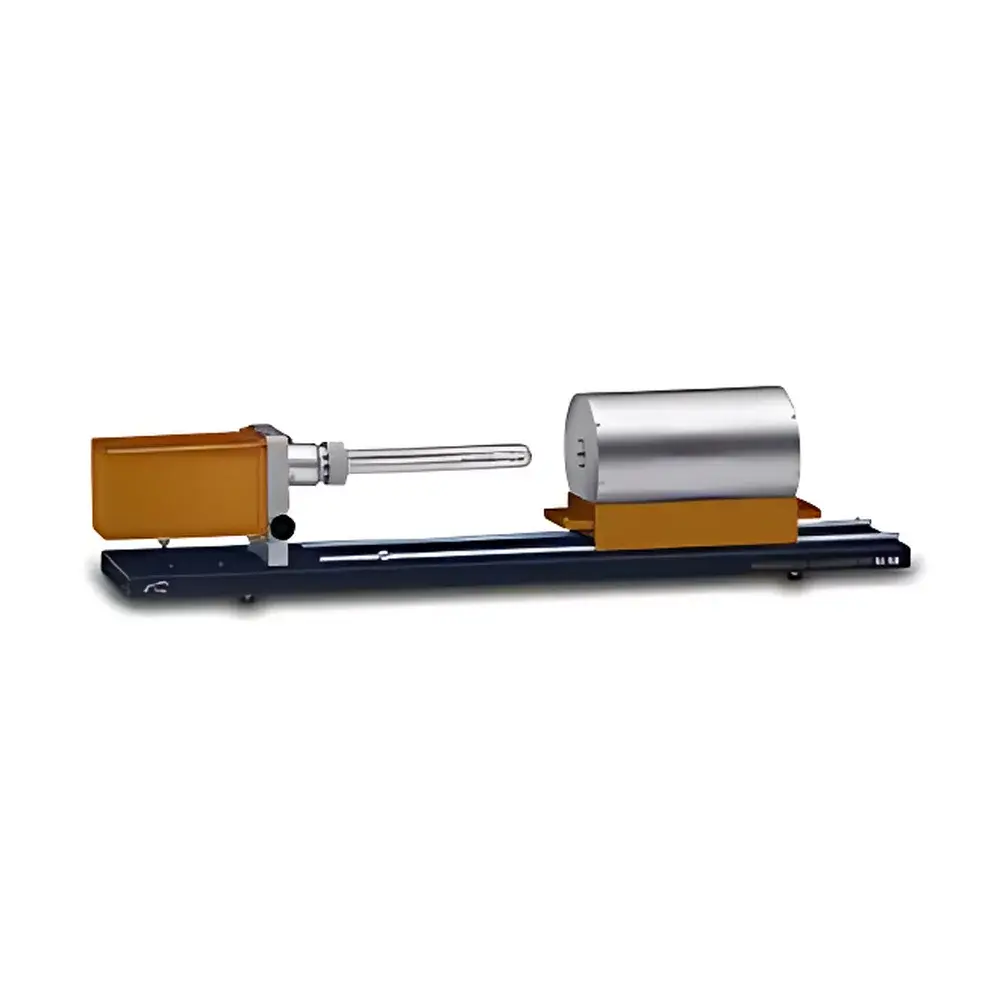
TA Instruments DIL 802/802L Horizontal Differential Dilatometer
| Brand | TA Instruments |
|---|---|
| Origin | USA |
| Model | DIL 802/802L |
| Measurement Principle | True Mechanical Differential Expansion Detection |
| Sensor Type | High-Stability LVDT with Digital Amplification |
| Contact Force Range | 0.02–1.00 N (User-Adjustable) |
| Configuration | Convertible Between Differential and Single-Sample Modes |
| Thermal Uniformity | Optimized Horizontal Furnace Design |
| Vibration Resistance | Integrated Mechanical Isolation Architecture |
| Compliance Ready | Designed for GLP/GMP environments with audit-trail-capable software integration |
Overview
The TA Instruments DIL 802/802L is a horizontal, mechanically differential dilatometer engineered for high-accuracy linear thermal expansion measurement across solid materials—including ceramics, metals, polymers, composites, and refractory compounds. Unlike conventional dual-sensor “software-differential” systems that subtract two independent displacement signals post-acquisition, the DIL 802/802L implements a true hardware-based differential architecture: a single high-resolution Linear Variable Differential Transformer (LVDT) is physically coupled to both the sample and an inert reference specimen within a shared mechanical frame. As the furnace temperature changes, the reference specimen expands or contracts in unison with the instrument’s structural components; only the *relative* dimensional change between sample and reference is transduced—effectively nullifying systematic thermal drift of the sensor housing, furnace supports, and drive mechanism. This principle delivers intrinsic compensation for instrumental expansion artifacts, enabling sub-micrometer resolution and long-term baseline stability essential for kinetic studies such as rate-controlled sintering (RCS), phase-transition characterization, and low-temperature contraction analysis down to –150 °C (with optional cryogenic accessory).
Key Features
- True mechanical differential measurement using a single LVDT with coaxial coupling to sample and reference—eliminating cross-sensor calibration drift and signal misalignment errors.
- User-definable contact force (0.02–1.00 N) maintained dynamically during thermal cycling, ensuring consistent probe-sample interface even during significant shrinkage or softening events.
- Horizontally oriented furnace with optimized radial and axial temperature uniformity (< ±0.5 °C over 50 mm zone), minimizing thermal gradient-induced bending artifacts in rod- or disc-shaped specimens.
- Vibration-damped optical-mechanical platform integrated with passive isolation feet and reinforced sensor mounting—critical for high-sensitivity measurements under laboratory ambient conditions.
- Modular configuration: field-convertible between differential and single-sample modes without hardware replacement, supporting method development and validation workflows.
- Digital LVDT signal conditioning with real-time noise suppression algorithms and 24-bit analog-to-digital conversion, delivering reproducible resolution better than 10 nm over full stroke.
Sample Compatibility & Compliance
The DIL 802/802L accommodates cylindrical, rectangular, or disc-shaped specimens up to 25 mm in length and 12 mm in diameter. Standard fixtures support sintered ceramics, metallic alloys, glass-ceramics, and polymer composites; optional quartz or alumina reference rods ensure chemical inertness and matched CTE ranges for specific material classes. The system complies with ASTM E228, ISO 11359-1/-2, and DIN 51045 standards for linear thermal expansion testing. When operated with TRIOS software under validated configurations, it supports 21 CFR Part 11 compliance through electronic signatures, audit trails, and role-based access control—enabling use in regulated QC laboratories subject to FDA, ISO 17025, or ICH Q5C requirements.
Software & Data Management
Controlled via TA Instruments’ TRIOS Thermal Analysis Software, the DIL 802/802L enables fully automated method definition—including multi-step heating/cooling ramps, isothermal holds, dwell times, and force modulation profiles. Real-time displacement, temperature, and contact force data are acquired synchronously at up to 10 Hz. Data export supports CSV, ASCII, and universal .qse formats compatible with MATLAB, Python (NumPy/Pandas), and statistical process control (SPC) platforms. Raw signal archives include metadata tags for instrument ID, calibration certificate version, operator ID, and environmental logs—facilitating traceability in GLP/GMP audits. Optional Advanced Kinetics Module enables model-free activation energy calculation from RCS-derived expansion-rate data.
Applications
- Quantification of coefficient of linear expansion (CTE) across broad temperature ranges for aerospace-grade superalloys and thermal barrier coatings.
- In-process monitoring of densification kinetics during ceramic sintering, including identification of onset temperatures for grain-boundary diffusion and pore elimination.
- Characterization of thermal contraction hysteresis in shape-memory alloys and polymer-based actuators.
- Low-temperature expansion behavior of cryogenic materials (e.g., NbTi superconductors, carbon-fiber-reinforced composites) using liquid nitrogen-cooled furnace variants.
- Validation of thermomechanical simulation inputs for finite element modeling (FEM) of packaging integrity, solder joint reliability, and MEMS device packaging.
FAQ
How does the DIL 802/802L differ from “dual-sensor” dilatometers?
It employs a single LVDT with mechanically linked sample and reference arms—measuring only relative displacement. Dual-sensor systems acquire two independent signals and compute their difference digitally, introducing potential offset drift and gain mismatch errors.
Can the DIL 802/802L be used for soft or viscoelastic materials?
Yes—its adjustable contact force (as low as 0.02 N) and active force feedback loop prevent indentation or creep-induced signal distortion during measurement of polymers, gels, or low-melting-point metals.
Is furnace calibration traceable to NIST standards?
All DIL 802/802L furnaces ship with individual calibration certificates traceable to NIST SRM 735a (indium) and SRM 736a (aluminum), with uncertainty budgets documented per ISO/IEC 17025.
What sample preparation guidelines apply?
Specimens must have parallel, flat end faces (surface roughness < 0.8 µm Ra); minimum aspect ratio (length/diameter) of 2:1 is recommended to minimize buckling effects under axial load.
Does the system support automated sample loading?
Not natively—but third-party robotic sample changers (e.g., STS-200 series) can be integrated via RS-232 or Ethernet API for unattended multi-sample runs in quality control environments.



