
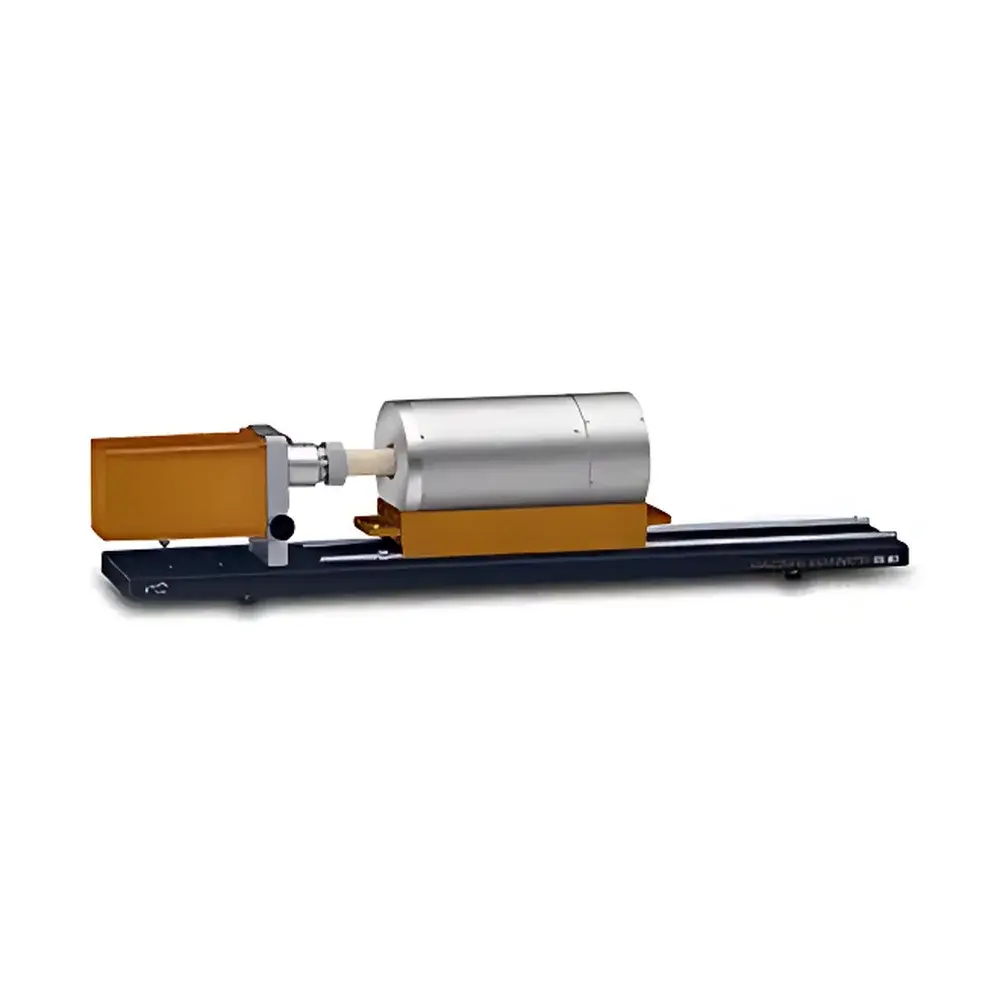
TA Instruments DIL 803/803L Dual-Sample Horizontal Dilatometer
| Brand | TA Instruments |
|---|---|
| Origin | USA |
| Model | DIL 803/803L |
| Configuration | Dual-sample horizontal dilatometer with differential capability |
| Sensor Type | High-stability LVDT with digital amplifier |
| Contact Force Range | User-adjustable from 0.02 N to 1.00 N |
| Furnace Compatibility | Interchangeable TA furnace modules |
| Operating Mode | Simultaneous dual-sample or differential (sample vs. inert reference) |
| Compliance | Designed for ASTM E228, ISO 11359-2, and USP <640> thermal expansion testing |
Overview
The TA Instruments DIL 803/803L is a high-precision horizontal dilatometer engineered for quantitative measurement of linear dimensional changes in solid materials as a function of temperature. It operates on the principle of contact-based mechanical displacement detection using a Linear Variable Differential Transformer (LVDT) sensor coupled with a digitally stabilized amplifier—ensuring nanometer-level resolution and exceptional thermal drift suppression. Unlike vertical or push-rod configurations, the horizontal design minimizes gravitational effects on sample alignment and probe contact, enhancing reproducibility across heterogeneous or low-modulus materials. The instrument supports two operational modes: simultaneous dual-sample analysis for throughput optimization, and differential mode—where one channel measures the test specimen while the other monitors an inert reference (e.g., fused quartz or sapphire) to compensate for furnace and fixture thermal expansion. This dual-channel architecture is critical for applications requiring high accuracy under dynamic thermal ramps (e.g., ±0.1°C/min to ±20°C/min), especially in polymer vitrification, ceramic sintering, and metallic phase transition studies.
Key Features
- Dual-sample capability enables parallel analysis of two independent specimens under identical thermal conditions—reducing total experiment time by up to 50% compared to sequential single-sample runs.
- Differential measurement mode eliminates systematic thermal expansion artifacts from the furnace assembly and push-rod system, improving absolute accuracy in coefficient of linear expansion (CTE) determination.
- User-defined contact force control (0.02–1.00 N) ensures consistent probe-sample interaction across diverse material classes—from brittle ceramics to viscoelastic polymers—even during contraction events.
- Modular furnace interchangeability allows rapid switching between standard air, inert gas (N₂, Ar), or vacuum-compatible heating modules without recalibration, supporting method flexibility per ASTM E228 and ISO 11359-2.
- LVDT sensor system features active thermal compensation and vibration-damped mounting, delivering long-term baseline stability (< ±0.1 µm over 24 h at 100°C) and sub-micrometer displacement resolution.
- Robust mechanical architecture includes precision-ground stainless-steel sample holders, low-thermal-expansion ceramic guide rods, and rigid baseplate construction to maintain alignment integrity across thermal cycles.
Sample Compatibility & Compliance
The DIL 803/803L accommodates cylindrical or rectangular specimens ranging from 5 mm to 25 mm in length and up to 10 mm in diameter/thickness. It is routinely deployed for metals, alloys, glasses, technical ceramics, composites, and thermosetting/thermoplastic polymers—including filled systems and fiber-reinforced matrices. Sample mounting requires minimal preparation: end-face polishing is recommended for optimal contact geometry, but no bonding or embedding is necessary. The system complies with key international standards for thermal expansion measurement, including ASTM E228 (linear thermal expansion of solids), ISO 11359-2 (polymers), and USP (pharmaceutical excipient characterization). Its hardware and firmware architecture support GLP/GMP-aligned workflows, with optional audit trail logging and electronic signature capabilities when integrated with TRIOS software.
Software & Data Management
Control, acquisition, and analysis are performed via TA Instruments’ TRIOS software platform—a validated, FDA 21 CFR Part 11–ready application for regulated environments. TRIOS provides real-time visualization of displacement, temperature, and contact force; automated CTE calculation across user-defined temperature intervals; and multi-curve overlay for comparative analysis. Raw data export is supported in ASCII, CSV, and universal .qdx formats. Calibration routines include zero-offset verification, force calibration, and thermal expansion standard validation (e.g., SRM 735a Invar). All instrument parameters—including ramp rate, dwell time, force setpoint, and gas flow—are fully scriptable for unattended overnight runs or DoE-based thermal profiling.
Applications
- Determination of coefficient of linear expansion (CTE) in aerospace alloys and turbine blade materials under simulated service temperatures (−100°C to 1600°C, depending on furnace).
- Characterization of glass transition (Tg) and softening behavior in optical glasses and packaging polymers.
- Monitoring sintering kinetics and densification onset in powder metallurgy and ceramic green bodies.
- Evaluation of thermal mismatch stresses in multilayer electronic substrates and MEMS packaging assemblies.
- Stability assessment of pharmaceutical tablet excipients during accelerated aging protocols per ICH Q1A(R2).
- Validation of thermal interface material (TIM) compliance under cyclic thermal loading.
FAQ
What temperature range is supported by the DIL 803/803L?
Standard configurations cover −120°C to 1600°C, depending on selected furnace module and sensor calibration. Cryogenic operation requires liquid nitrogen cooling; high-temperature modules use SiC or MoSi₂ heating elements.
Can the instrument measure both expansion and contraction in the same run?
Yes—the LVDT-based transduction system is bidirectional and captures net dimensional change regardless of direction, enabling full thermal cycle analysis including cooling-phase contraction.
Is differential mode mandatory for accurate CTE reporting?
Not mandatory, but strongly recommended for measurements above 400°C or when absolute dimensional accuracy is required. For relative comparisons below 300°C, single-sample mode delivers sufficient precision.
How is contact force maintained during large thermal contractions?
The electromechanical force actuator continuously adjusts probe position within the 0.02–1.00 N window to preserve nominal contact pressure, preventing loss of signal or sample damage.
Does the system support purge gas control and monitoring?
Yes—integrated mass flow controllers and pressure sensors enable programmable inert gas purging (N₂, Ar, He) with real-time flow logging and alarm thresholds for out-of-spec conditions.



