
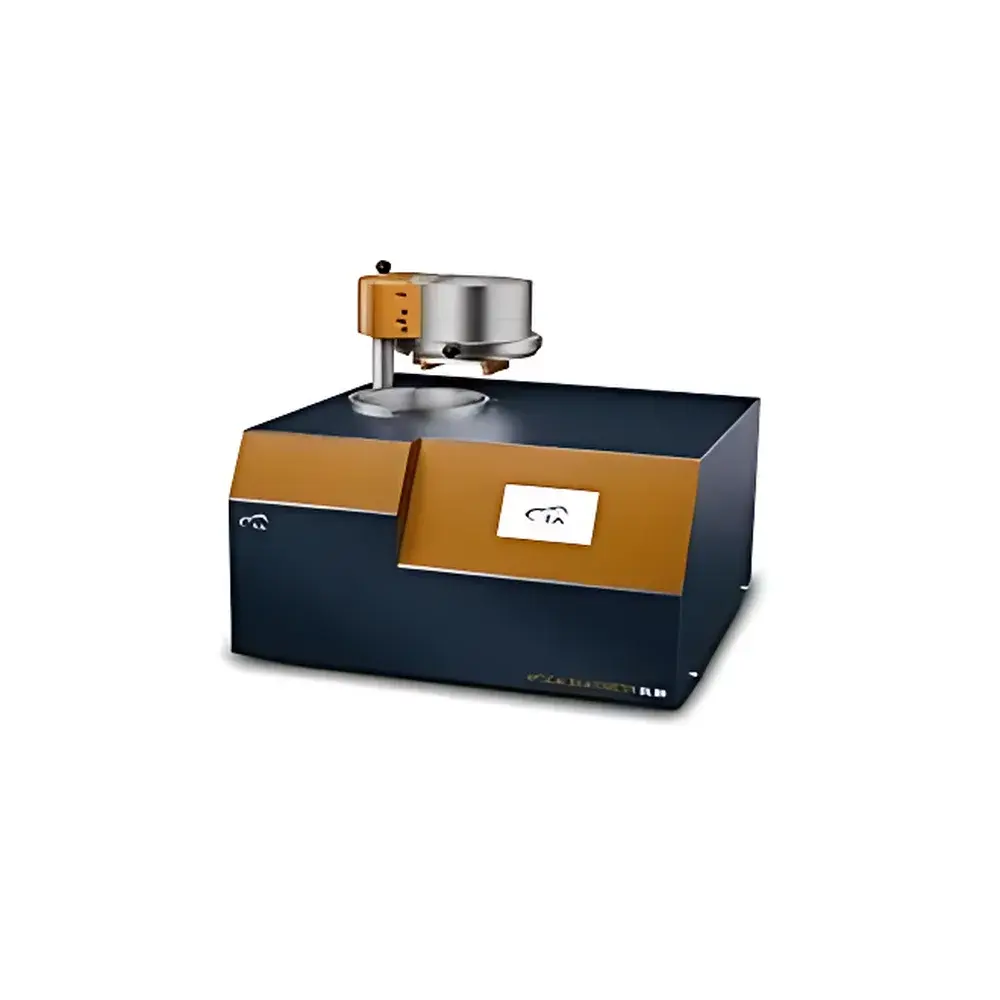
TA Instruments DIL 806 Optical Dilatometer
| Brand | TA Instruments |
|---|---|
| Origin | USA |
| Model | DIL 806 |
| Measurement Principle | Non-contact shadow-edge optical imaging |
| Light Source | High-intensity GaN LED with collimated short-wavelength planar illumination |
| Detection | High-resolution CCD sensor with digital edge detection |
| Temperature Range | Ambient to 1400 °C |
| Heating Rate | Up to 100 °C/min |
| Cooling Rate | 1400 °C → 50 °C in ≤10 min |
| Furnace Design | Dual-zone planar heating (top + bottom) for minimized axial and radial thermal gradients |
| Sample Area | 30 mm wide field-of-view with position-insensitive measurement |
| Compliance | ASTM E228, ISO 11359-1, USP <632>, GLP/GMP-ready data audit trail (via TRIOS software) |
Overview
The TA Instruments DIL 806 Optical Dilatometer is a high-precision, non-contact thermal expansion measurement system engineered for absolute dimensional change quantification across solid, semi-crystalline, and amorphous materials. Unlike conventional push-rod dilatometers—whose mechanical contact introduces parasitic thermal drift, load-dependent deformation, and surface preparation constraints—the DIL 806 employs a patented shadow-edge optical metrology principle (U.S. Patent No. 7,524,105). This method relies on collimated short-wavelength illumination from a GaN LED source, projected through a diffusion unit and precision collimating lens to generate a highly uniform planar light sheet. As the sample intercepts this beam, its shadow is imaged via a telecentric optical path onto a high-resolution CCD detector. Real-time digital edge detection algorithms compute the absolute width of the shadow, directly correlating to the sample’s physical dimension along the optical axis—without calibration against reference standards or correction for instrument thermal expansion. Because only the sample undergoes thermal cycling while the optical train and detector remain thermally isolated, measurements are inherently absolute and traceable to SI length units.
Key Features
- Non-contact optical measurement eliminates mechanical loading artifacts—enabling accurate characterization of soft, fragile, thin-film, or low-modulus materials (e.g., polymers, gels, aerogels, and sintering green bodies) without risk of creep or surface indentation.
- Dual-zone planar furnace architecture minimizes both radial and axial temperature gradients: a large-area bottom heater envelops the sample laterally, while a co-planar top heater suppresses vertical thermal stratification—ensuring ±0.5 °C uniformity across typical 10–25 mm samples at 1200 °C.
- Thermal ramp capability up to 100 °C/min and rapid cooling (1400 °C → 50 °C in ≤10 min) supports high-throughput screening and kinetic studies of phase transitions, sintering, and glass relaxation.
- 30 mm-wide field-of-view eliminates strict sample positioning requirements; reproducible results are obtained regardless of lateral placement within the optical window—reducing operator dependency and accelerating workflow.
- Simultaneous multi-directional analysis: by rotating the sample stage or repositioning, orthogonal expansions (e.g., in-plane vs. thickness direction) can be acquired on a single specimen—critical for anisotropic composites, fiber-reinforced ceramics, and textured metallurgical samples.
Sample Compatibility & Compliance
The DIL 806 accommodates opaque, translucent, and transparent materials—including glasses, oxides, metals, polymers, biomaterials, and ceramic precursors—without requiring surface polishing, parallelism, or rigid mounting. Irregular geometries (e.g., irregular shards, porous preforms, or curved substrates) are measured directly. Film specimens as thin as 5 µm can be analyzed in either longitudinal or transverse orientation. The system conforms to ASTM E228 (Linear Thermal Expansion of Solid Materials), ISO 11359-1 (Plastics — Thermomechanical Analysis), and USP (Thermal Expansion of Pharmaceutical Containers). When operated with TRIOS software under validated configurations, it supports 21 CFR Part 11-compliant electronic records, including full audit trails, user access controls, and immutable raw-data archiving for GLP and GMP environments.
Software & Data Management
Control and analysis are performed using TA Instruments’ TRIOS platform—a modular, Windows-based application designed for thermal analysis instrumentation. TRIOS provides real-time visualization of dimensional change (ΔL/L₀), coefficient of linear expansion (CTE), inflection points, and sintering kinetics. Its Rate-Controlled Sintering (RCS) module enables closed-loop thermal programming: users define target shrinkage rates (e.g., 0.1 %/min), and the software dynamically adjusts heating rate to maintain that rate—essential for optimizing densification profiles in advanced ceramics and powder metallurgy. All raw CCD image sequences, edge-detection logs, temperature/time stamps, and metadata are stored in encrypted .trios binary format, exportable to CSV, ASCII, or HDF5 for third-party statistical modeling or LIMS integration.
Applications
The DIL 806 serves laboratories engaged in materials development, quality assurance, and regulatory submission across aerospace, electronics packaging, nuclear fuels, pharmaceutical container validation, and additive manufacturing. Specific use cases include CTE matching for multilayer ceramic capacitors (MLCCs), sintering optimization of tungsten carbide tooling, glass transition and softening point determination in optical glasses, thermal mismatch assessment in metal-ceramic brazes, and thermal stability evaluation of battery electrode coatings during cycling simulations. Its compatibility with inert, oxidizing, and reducing atmospheres (via optional gas purging) extends applicability to reactive systems such as silicon carbide synthesis and lithium-ion cathode decomposition.
FAQ
Does the DIL 806 require calibration with standard reference materials?
No—its optical shadow-edge methodology delivers absolute length measurement independent of thermal drift in the instrument structure. Calibration is not required for routine operation, though NIST-traceable dimensional standards may be used for verification.
Can the DIL 806 measure anisotropic expansion in composite laminates?
Yes—by rotating the sample between runs or using custom fixtures, expansion coefficients can be determined separately along fiber, matrix, and through-thickness directions.
Is vacuum or controlled-atmosphere operation supported?
Yes—the furnace chamber accepts optional quartz or alumina tube inserts with sealed gas inlet/outlet ports, enabling tests under Ar, N₂, H₂, or forming gas up to 1 bar absolute pressure.
What is the minimum measurable dimensional change?
Resolution is limited by CCD pixel pitch and optical magnification; typical system resolution is <0.1 µm over a 10 mm gauge length, corresponding to ~10 ppm strain resolution.
How does the DIL 806 compare to laser interferometric dilatometers?
Unlike interferometers—which require reflective surfaces and are sensitive to vibration and air turbulence—the DIL 806 operates robustly in standard lab environments and measures all material optical densities without surface treatment.



