
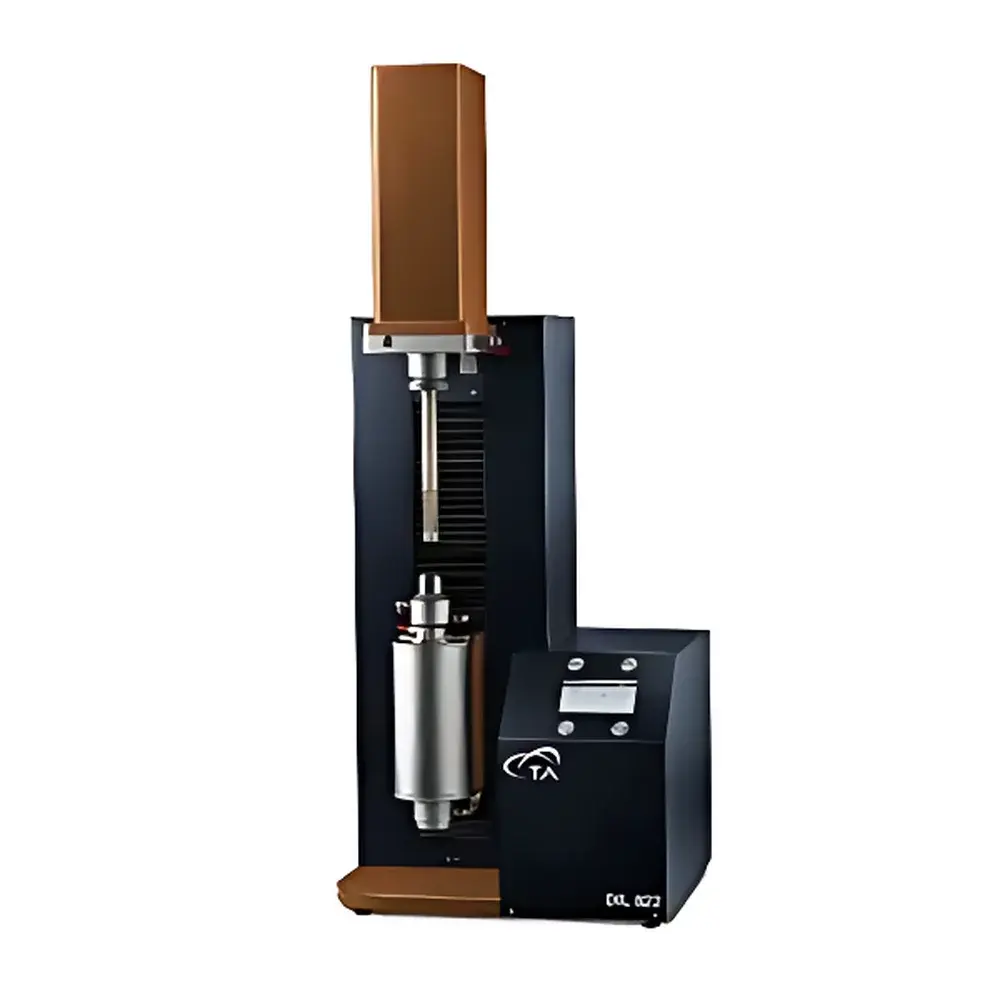
TA Instruments DIL 821/822 Vertical Dilatometer
| Brand | TA Instruments |
|---|---|
| Origin | USA |
| Model | DIL 821 / DIL 822 |
| Measurement Principle | Contact-based linear thermal expansion measurement using optical encoder and linear motor actuation |
| Resolution | 1 nm |
| Configuration | Vertical sample orientation |
| Force Control | Constant low-force contact via linear motor |
| Differential Capability | True differential measurement (DIL 822 only) |
| Compliance | ASTM E228, ISO 11359-1/-2, DIN 51045 |
Overview
The TA Instruments DIL 821 and DIL 822 are high-precision vertical dilatometers engineered for accurate, reproducible measurement of linear dimensional changes in solid materials as a function of temperature. Operating on the principle of contact-based thermal dilatometry, these instruments utilize a vertically oriented sample configuration to eliminate gravitational sag effects—particularly critical for softening, sintering, or low-modulus materials. The core measurement architecture integrates a high-resolution optical encoder (1 nm resolution) with a brushless linear motor that delivers constant, programmable contact force throughout the entire thermal cycle. Unlike traditional spring-loaded or gravity-fed systems, this active force control ensures consistent probe-sample interaction regardless of sample shrinkage, expansion, or creep behavior—enabling reliable data acquisition from room temperature up to 1600 °C (depending on furnace option). The DIL 822 variant further incorporates true differential measurement capability, allowing simultaneous tracking of both sample and reference rod expansions to cancel out system-related thermal drift and mechanical artifacts.
Key Features
- Vertical sample orientation minimizes bending, slumping, or settling artifacts during high-temperature transitions such as sintering, glass transition, or softening.
- Linear motor–driven probe delivers stable, adjustable contact force (typically 1–50 mN range) independent of sample length change—critical for maintaining signal fidelity during rapid dimensional shifts.
- Optical encoder with 1 nm resolution enables detection of sub-micron dimensional changes, supporting precise determination of onset temperatures for sintering, softening, and phase transformations.
- DIL 822’s true differential mode measures relative expansion between sample and matched reference rod, effectively compensating for furnace expansion, support rod drift, and thermal lag—enhancing baseline stability and measurement accuracy.
- Modular furnace options cover operating ranges from ambient to 1600 °C (SiC, Pt/Rh, or Mo configurations), with programmable heating/cooling rates up to 100 K/min.
- Integrated digital motion control and real-time position feedback ensure high repeatability across multi-cycle experiments under identical thermal protocols.
Sample Compatibility & Compliance
The DIL 821/822 accommodates cylindrical or rectangular solid samples (typically 10–25 mm in length, 2–10 mm in diameter/thickness), including ceramics, metals, glasses, polymers, composites, and powder compacts. Sample holders are available in quartz, alumina, graphite, or molybdenum to match thermal and chemical compatibility requirements. The system complies with key international standards for thermal expansion testing, including ASTM E228 (linear thermal expansion of solids), ISO 11359-1 (general principles) and ISO 11359-2 (determination of linear coefficient of thermal expansion), as well as DIN 51045. Data integrity meets GLP and GMP-aligned documentation practices; audit trails, user access controls, and electronic signatures can be implemented via optional TRIOS software modules compliant with FDA 21 CFR Part 11 requirements.
Software & Data Management
Instrument operation and data analysis are managed through TA Instruments’ TRIOS Thermal Analysis Software—a platform designed for method development, real-time monitoring, and post-run evaluation. Users define multi-step temperature programs (isothermal holds, ramped segments, cooling cycles), set force profiles, and configure data acquisition parameters (sampling rate, filtering, averaging). The software supports automated peak detection for softening temperature (Ts), sintering onset (Tonset), and coefficient of linear expansion (CTE) calculation over user-defined temperature intervals. Raw displacement vs. temperature curves are exportable in ASCII or CSV format; derivative (dL/dT) plots aid in identifying inflection points associated with structural transitions. All raw and processed data files include embedded metadata (instrument ID, operator, date/time, calibration status) to support traceability and regulatory reporting.
Applications
- Quantification of sintering kinetics and densification behavior in ceramic and metal powder compacts.
- Determination of softening point and deformation temperature in glasses and refractory materials (e.g., ASTM C372).
- Measurement of linear CTE in aerospace alloys, battery electrode materials, and encapsulation compounds across wide temperature ranges.
- Rate-Controlled Sintering (RCS) studies where dimensional change is used as feedback to modulate heating rate and optimize microstructural development.
- Evaluation of thermal mismatch stresses in multilayer devices (e.g., SOFCs, LTCC substrates) via comparative expansion profiling.
- Validation of thermomechanical models used in finite element simulation of thermal cycling reliability.
FAQ
What distinguishes the DIL 822 from the DIL 821?
The DIL 822 features true differential measurement capability—using two independent optical encoders to track both sample and reference rod expansion simultaneously—whereas the DIL 821 performs single-sample absolute displacement measurement.
Can the system measure negative thermal expansion materials?
Yes—the high-resolution encoder and bidirectional linear motor support accurate tracking of contraction events, including anomalous negative expansion regimes observed in zirconium tungstate or certain MOFs.
Is calibration traceable to NIST standards?
Yes—TA Instruments provides factory calibration certificates traceable to NIST SRM 735 (Invar) and SRM 736 (fused silica), with optional on-site verification using certified reference materials.
How is probe contact force verified and maintained over time?
Force calibration is performed using precision dead-weight loading during installation; real-time motor current monitoring ensures consistent force delivery, with periodic verification recommended per ISO/IEC 17025 maintenance schedules.
Does the system support automated sample changers?
No—the DIL 821/822 is configured for single-sample, high-fidelity measurements; automation is not supported due to the mechanical sensitivity required for low-force contact and vertical alignment integrity.



