
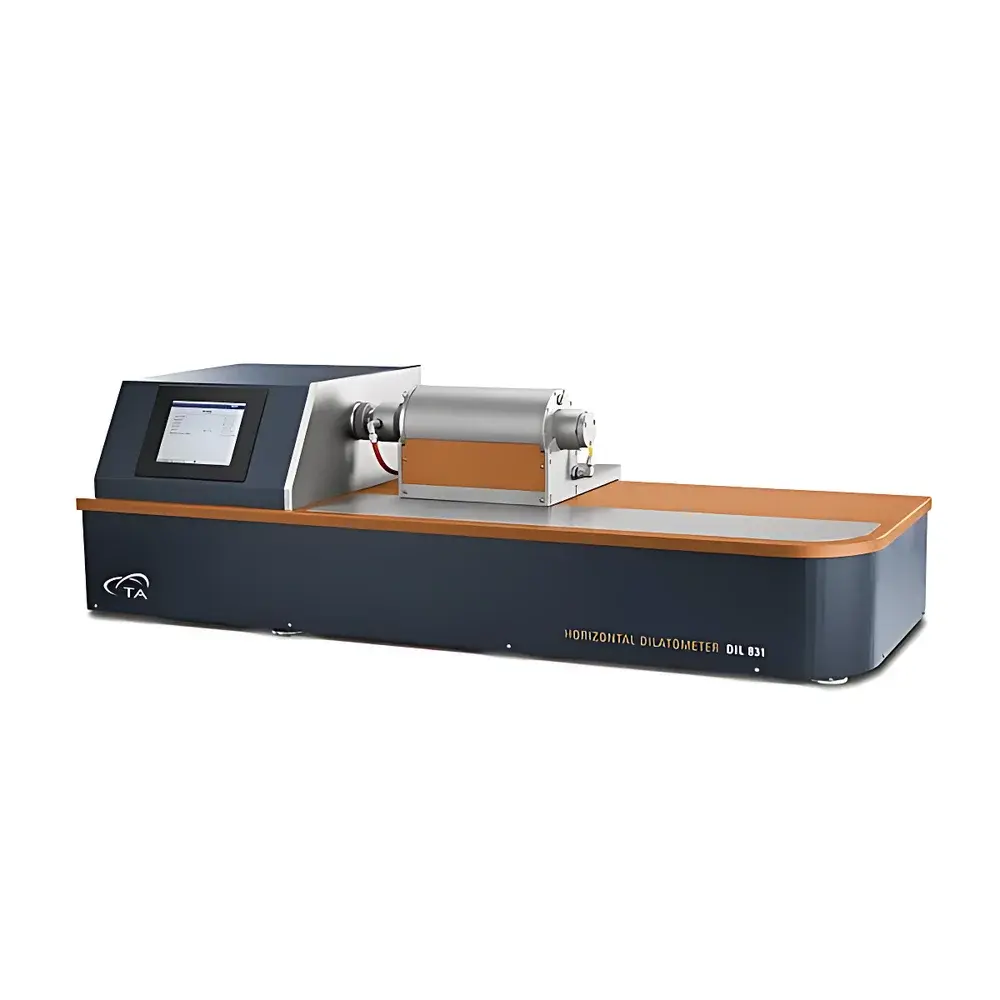
TA Instruments DIL 831 High-Resolution Horizontal Dilatometer
| Brand | TA Instruments |
|---|---|
| Origin | Germany |
| Model | DIL 831 |
| Temperature Range | RT to 1700 °C |
| Heating Rate | Up to 50 °C/min |
| Temperature Accuracy | ±0.05 °C |
| Sample Length | 0–25 mm (standard), 12 mm (optimal) |
| Length Resolution | 1 nm |
| Force Range | 0.01–1.00 N |
| Force Resolution | 0.01 N |
| CTE Accuracy | ±0.03 × 10⁻⁶ K⁻¹ |
Overview
The TA Instruments DIL 831 is a high-precision, horizontal push-rod dilatometer engineered for absolute dimensional stability and nanoscale displacement resolution under controlled thermal conditions. It operates on the fundamental principle of contact-based linear thermal expansion measurement: a precisely calibrated quartz or ceramic push-rod transmits minute dimensional changes from a thermally cycled sample to a patented incremental optical encoder. Unlike interferometric or laser-based systems, the DIL 831 maintains traceable, force-controlled mechanical coupling—ensuring direct correlation between measured ΔL and true sample strain. Designed for R&D laboratories requiring metrological-grade CTE data across extreme temperature regimes (RT to 1700 °C), it delivers ISO 11359-1 compliant measurements for ceramics, refractory metals, optical glasses, sintered composites, and high-performance polymers. Its horizontal configuration eliminates gravitational sag effects inherent in vertical designs, while active thermal stabilization of the measurement head ensures sub-micron drift suppression over multi-hour runs.
Key Features
- Patented 1 nm resolution incremental optical encoder—highest displacement resolution available in commercial horizontal dilatometers, enabling reliable CTE determination on sub-5 mm samples without signal averaging.
- Motor-driven linear force actuator with programmable load control (0.01–1.00 N) and 0.01 N force resolution; linearity deviation <0.01 N ensures consistent, material-independent contact pressure.
- Water-cooled furnace with dynamic thermal programming: 50 °C/min heating rate and rapid cooling (1000 °C → RT in 13 min), reducing cycle time by up to 93% versus conventional air-cooled systems.
- Zero-temperature-gradient furnace design—achieved via symmetric dual-zone heating and optimized thermal shielding—minimizes axial thermal gradients (<0.1 K/mm), directly contributing to CTE accuracy of ±0.03 × 10⁻⁶ K⁻¹.
- Integrated 7-inch capacitive touchscreen interface with real-time parameter visualization, test progress tracking, and local method storage—eliminating dependency on external PCs for routine operation.
- Embedded Ethernet connectivity supporting remote monitoring, data export via FTP/SFTP, and integration into centralized LIMS or MES environments.
Sample Compatibility & Compliance
The DIL 831 accommodates cylindrical or prismatic specimens ranging from 0 to 25 mm in length (12 mm recommended for optimal signal-to-noise ratio), with diameters up to 12 mm. Compatible sample materials include oxide and non-oxide ceramics (Al₂O₃, SiC, ZrO₂), borosilicate and fused silica glasses, nickel-based superalloys, titanium alloys, carbon-carbon composites, and semi-crystalline thermoplastics (e.g., PEEK, polyimides). All hardware and firmware comply with IEC 61000-6-3 (EMC) and IEC 61010-1 (safety). Measurement protocols align with ASTM E228, ISO 11359-1/2, and DIN 51045-1. Data integrity meets FDA 21 CFR Part 11 requirements through audit-trail-enabled software (TRIOS™), including electronic signatures, user access controls, and immutable raw-data archiving.
Software & Data Management
Controlled exclusively via TA Instruments’ TRIOS™ Thermal Analysis Software (v6.0+), the DIL 831 supports fully automated method sequencing—including auto-initialization of reference length, multi-step isothermal holds, ramp-and-hold profiles, and derivative (dL/dT) analysis. Raw displacement vs. temperature datasets are stored in vendor-neutral .tdf format with embedded metadata (operator ID, calibration timestamp, furnace serial number, encoder gain settings). Batch processing tools enable CTE calculation across user-defined temperature intervals (e.g., α₁₅₋₁₀₀, α₂₀₀₋₈₀₀), with uncertainty propagation based on ISO/IEC Guide 98-3 (GUM). Export options include CSV, Excel, and PDF reports compliant with GLP/GMP documentation standards.
Applications
- Determination of coefficient of thermal expansion (CTE) for qualification of ceramic-to-metal seals in aerospace actuators.
- Phase transition detection in shape-memory alloys via discontinuity analysis in dL/dT curves at martensitic transformation temperatures.
- Sintering shrinkage kinetics modeling for powder metallurgy process optimization.
- Thermal stress prediction in multilayer ceramic capacitors (MLCCs) using differential CTE profiling across temperature-dependent domains.
- Validation of thermal aging behavior in fiber-reinforced polymer matrix composites under simulated service conditions (−55 °C to +200 °C).
- Reference-standard certification for NIST-traceable thermal expansion artifacts (e.g., Invar, fused quartz rods).
FAQ
What is the maximum allowable sample mass for DIL 831 measurements?
The instrument imposes no explicit mass limit; however, thermal inertia considerations recommend samples ≤15 g for optimal temperature homogeneity during rapid heating/cooling cycles.
Can the DIL 831 operate under controlled atmosphere or vacuum?
Yes—equipped with standard quartz tube furnace and gas inlet/outlet ports, it supports inert (N₂, Ar), reducing (H₂/N₂), or oxidizing (air, O₂) atmospheres up to 1 bar; optional vacuum package enables operation down to 10⁻³ mbar.
Is calibration traceable to national standards?
All displacement and temperature calibrations are performed using NIST-traceable reference artifacts: certified quartz dilatometer standards (SRM 735) and PtRh10/Pt thermocouples calibrated per ASTM E230.
How does the DIL 831 handle thermal drift during long-term isothermal holds?
Active thermal stabilization of the encoder housing—via Peltier-regulated heat sinks and low-CTE Invar structural framing—limits drift to <5 nm/hour over 24-hour holds at 1200 °C.
Does TRIOS software support custom CTE calculation algorithms?
Yes—TRIOS includes a built-in scripting engine (Python API) allowing users to implement proprietary models for anisotropic expansion, viscoelastic correction, or multi-phase composite CTE deconvolution.



