
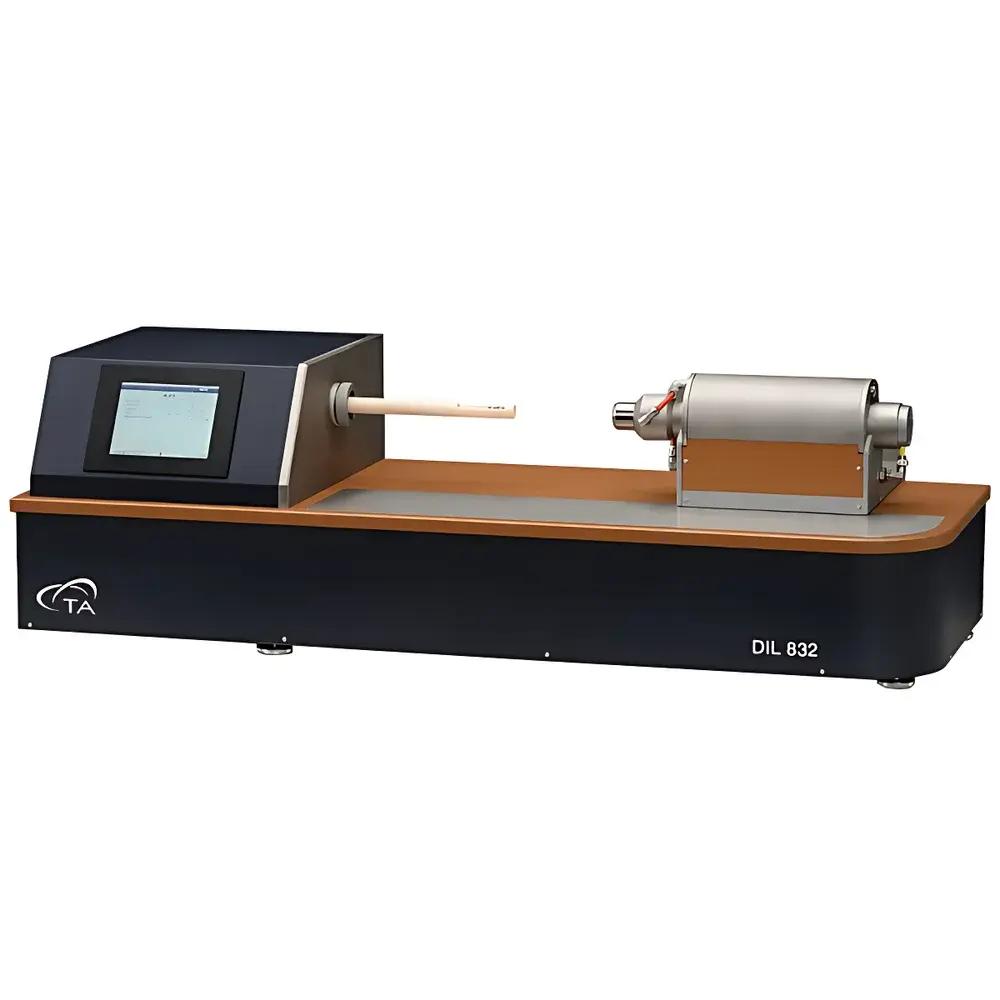
TA Instruments DIL 832 True Differential High-Resolution Dilatometer
| Brand | TA Instruments |
|---|---|
| Origin | Germany |
| Model | DIL 832 |
| Temperature Range | RT to 1700 °C |
| Heating Rate | Up to 50 °C/min |
| Temperature Accuracy | ±0.05 °C |
| Sample Length | 0–25 mm |
| Sample Diameter | ≤6 mm |
| Length Resolution | 1 nm |
| Force Range | 0.01–1.00 N |
| Force Resolution | 0.01 N |
| CTE Accuracy | ±0.01 × 10⁻⁶ K⁻¹ |
| Total Measurement Range | 5000 µm |
| Cooling Time (1000 °C → RT) | 13 min |
Overview
The TA Instruments DIL 832 True Differential High-Resolution Dilatometer is a horizontal push-rod dilatometer engineered for precision measurement of dimensional changes in solid materials as a function of temperature. It operates on the principle of contact-based linear displacement detection, integrating a patented true differential measurement architecture that eliminates parasitic thermal expansion artifacts from the furnace, support structure, and push-rod assembly. This design enables direct quantification of sample-specific length change (ΔL), decoupled from instrumental drift — a critical requirement for high-fidelity coefficient of thermal expansion (CTE), sintering kinetics, phase transition onset, and glass transition analysis. The instrument is optimized for R&D environments where reproducibility, traceability, and compliance with international thermal analysis standards (e.g., ASTM E228, ISO 11359-1/2, DIN 51045) are mandatory. Its operational envelope spans ambient to 1700 °C, supporting both inert and controlled-atmosphere applications via optional gas purging modules.
Key Features
- True Differential™ Technology: Proprietary dual-sensor architecture isolates sample expansion from system thermal drift, delivering CTE accuracy of ±0.01 × 10⁻⁶ K⁻¹ — among the highest in commercial horizontal dilatometers.
- 1 nm Optical Encoder: Patented incremental optical encoder with sub-nanometer resolution ensures exceptional sensitivity across the full 5000 µm measurement range, enabling reliable detection of minute dimensional changes in thin films, ceramics, and low-expansion alloys.
- Dynamic Water-Cooled Furnace: Enables rapid heating up to 50 °C/min and accelerated cooling (1000 °C to RT in 13 minutes), reducing cycle time by >85% compared to conventional air-cooled systems — essential for high-throughput screening and kinetic studies.
- Precision Linear Motor Load System: Applies programmable axial force between 0.01 N and 1.00 N with 0.01 N resolution and linearity <0.01 N, minimizing creep-induced error and accommodating fragile or compliant samples without mechanical overload.
- Active Thermal Stability Architecture: Thermally shielded measurement head housing with active temperature regulation maintains isothermal conditions at the transducer interface, suppressing noise from thermal gradients during long-duration isotherms or slow ramp experiments.
- Integrated Touchscreen & Ethernet Interface: Onboard 7-inch capacitive touchscreen supports standalone method setup, real-time parameter visualization, and status monitoring; embedded TCP/IP stack enables remote control, data streaming, and integration into centralized LIMS or MES platforms.
Sample Compatibility & Compliance
The DIL 832 accommodates cylindrical or prismatic solid specimens up to 25 mm in length and 6 mm in diameter, including metals, oxides, carbides, polymers, composites, and geological specimens. Its low-force loading capability allows characterization of brittle ceramics and sintered powders without cracking. All thermal protocols comply with GLP/GMP documentation requirements when used with TRIOS software v5.3+ and optional 21 CFR Part 11 audit trail module. Data output conforms to ASTM E831 and ISO 11359 reporting conventions, including automatic baseline correction, derivative CTE calculation, and event annotation (e.g., dilatometric softening point, crystallization onset). Optional quartz or alumina sample holders support corrosive or reducing atmospheres per ISO 80000-5.
Software & Data Management
Controlled exclusively via TA Instruments’ TRIOS software platform, the DIL 832 supports fully automated method definition, calibration management (length, temperature, force), and multi-step thermal programs (ramp-hold-ramp, step-isotherms, cyclic heating). Raw displacement vs. temperature datasets are stored in vendor-neutral .tdf format with embedded metadata (operator ID, timestamp, instrument serial, calibration certificate ID). Advanced post-processing includes polynomial baseline fitting, CTE windowing, coefficient derivation over user-defined intervals, and export to CSV, Excel, or ASCII for third-party statistical analysis. Audit trail functionality logs all user actions, parameter modifications, and calibration events — meeting FDA 21 CFR Part 11 and EU Annex 11 requirements for regulated laboratories.
Applications
- Determination of linear CTE across wide temperature ranges for aerospace superalloys and nuclear-grade graphite.
- Quantification of sintering shrinkage kinetics and densification onset temperatures in powder metallurgy and ceramic processing.
- Characterization of glass transition (Tg) and softening behavior in specialty glasses and amorphous polymers.
- Analysis of phase transformation temperatures (e.g., martensitic start, austenite formation) in shape-memory alloys.
- Thermal stability assessment of battery electrode materials and solid electrolytes under inert or dry-air atmospheres.
- Interlaboratory round-robin studies requiring inter-instrument comparability per ISO/IEC 17025 accreditation criteria.
FAQ
What distinguishes True Differential™ technology from conventional single-push-rod dilatometers?
True Differential™ employs two independent optical encoders — one measuring sample displacement relative to a fixed reference, the other tracking thermal expansion of the push-rod/furnace assembly — enabling real-time subtraction of instrumental drift. Conventional systems rely on mechanical compensation or post-acquisition correction, introducing uncertainty in absolute ΔL.
Can the DIL 832 measure samples shorter than 5 mm with meaningful resolution?
Yes. The 1 nm encoder resolution and low-force motor enable stable contact and high signal-to-noise ratio even for samples as short as 1 mm, provided surface flatness meets ISO 11359-1 specification (Ra < 0.8 µm).
Is furnace atmosphere control supported?
Standard configuration includes purge ports for inert (N₂, Ar) or reducing (5% H₂/95% N₂) gases. Optional sealed quartz tube kits and vacuum-compatible furnace variants are available for ultra-low partial pressure applications.
How is temperature calibration verified?
Traceable calibration uses certified ITS-90 reference materials (e.g., In, Sn, Zn, Al, Ag) measured in accordance with ASTM E796. Calibration certificates include uncertainty budgets per ISO/IEC 17025.
Does the system support unattended overnight operation?
Yes. Integrated thermal runaway protection, door interlock, and automatic cooldown sequencing enable safe execution of extended thermal cycles. TRIOS software supports scheduled shutdown and email notification upon completion.



