
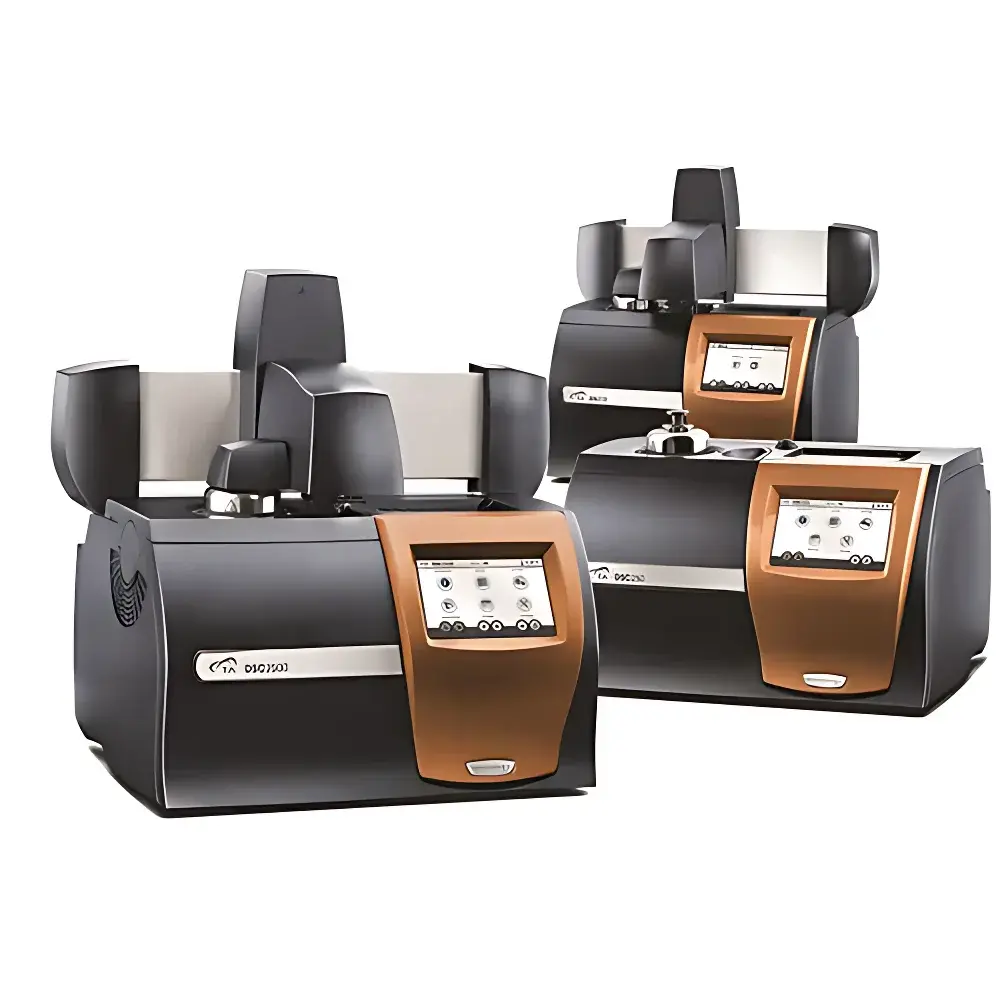
TA Instruments Discovery DSC2500 Differential Scanning Calorimeter
| Brand | TA Instruments |
|---|---|
| Origin | USA |
| Model | Discovery DSC2500 |
| Temperature Range | –180 to 725 °C |
| Temperature Accuracy | ±0.025 °C |
| Temperature Precision | ±0.005 °C |
| Baseline Flatness (–50 to 300 °C) | <5 μW |
| Baseline Repeatability (–50 to 300 °C) | <10 μW |
| Enthalpy Accuracy | ±0.04 % |
| Heating/Cooling Rate | 0.1–100 K/min |
| Modulated DSC | Standard |
| Tzero® Technology | Advanced (T4P) |
| Direct Cp Measurement | Supported |
| User-Replaceable Furnace | Yes |
| 54-Position Autosampler | Standard |
| Dual-Gas Delivery Module | Standard |
| Color Touchscreen Interface | Standard |
| Optical Accessory Compatibility | Optional |
Overview
The TA Instruments Discovery DSC2500 is a high-performance differential scanning calorimeter engineered for precision thermal analysis in research, quality control, and regulatory-compliant environments. Based on heat-flux DSC architecture with proprietary Tzero® technology (four-point calibration, T4P), it delivers exceptional baseline stability, temperature fidelity, and enthalpic resolution across an extended operating range of –180 to 725 °C. The instrument employs dual-sensor thermocouple arrays and active furnace temperature control to minimize thermal lag and ensure true sample-isothermal response. Its modular design supports direct specific heat capacity (Cp) measurement without external calibration standards, enabling traceable, first-principles quantification of thermal transitions—including glass transitions, crystallization, melting, curing, oxidative induction time (OIT), and reaction enthalpies—in compliance with ASTM E794, ISO 11357, and USP <1640>.
Key Features
- Advanced Tzero® four-point calibration (T4P) system for sub-millikelvin temperature accuracy and drift-compensated baseline stability
- User-replaceable furnace assembly enabling rapid maintenance and long-term calibration integrity
- Standard 54-position autosampler with programmable thermal equilibration and purge gas sequencing per run
- Dual independent gas delivery module supporting simultaneous inert (N2, Ar) and reactive (O2, air) atmospheres with mass-flow control
- High-resolution color capacitive touchscreen interface with intuitive app-style navigation and real-time curve overlay
- Modulated DSC (MDSC®) capability for separation of reversing and non-reversing thermal events—critical for complex polymer blends and pharmaceutical amorphous systems
- Optical access port compatible with optional UV/Vis or FTIR coupling for in-situ spectroscopic correlation during thermal events
Sample Compatibility & Compliance
The DSC2500 accommodates standard hermetic and vented aluminum pans (40 µL), high-pressure stainless-steel cells (up to 100 bar), and custom crucibles for volatile, corrosive, or reactive samples. All thermal protocols are fully compliant with GLP/GMP documentation requirements: audit trails, electronic signatures, and 21 CFR Part 11–ready software configuration are supported via TRIOS Enterprise Edition. Data files include embedded metadata (operator ID, instrument serial, calibration certificate ID, environmental conditions) and conform to ASTM E1952 and ISO/IEC 17025 traceability frameworks. Baseline flatness (<5 µW over –50 to 300 °C) and repeatability (<10 µW) meet or exceed requirements for ICH Q5C stability studies and USP general chapter <1640> for thermal analysis of biologics.
Software & Data Management
TRIOS software provides unified control, real-time analysis, and reporting across all TA Instruments thermal analyzers. The DSC2500 integrates natively with TRIOS Cloud for secure, role-based data sharing, version-controlled method libraries, and automated report generation (PDF, CSV, XML). Advanced analytics include kinetic modeling (ASTM E698, Ozawa-Flynn-Wall), phase diagram construction, and Cp-derived thermal conductivity estimation. All raw data are stored in open-format .q2d files, ensuring long-term readability without proprietary viewer dependency. Audit trail logs record every parameter change, calibration event, and user action with timestamp, IP address, and digital signature—fully auditable for FDA pre-approval inspections and ISO 9001 surveillance audits.
Applications
- Polymers: Crystallinity quantification, melt flow index correlation, degradation onset (Td), crosslink density via enthalpy recovery
- Pharmaceuticals: Polymorph screening, excipient compatibility, amorphous content determination, lyophilized product stability
- Electronics: Curing kinetics of encapsulants, glass transition of underfills, solder reflow profile validation
- Metals & Alloys: Solidus/liquidus mapping, precipitation heat effects, aging behavior in Al- and Ni-based superalloys
- Battery Materials: SEI formation enthalpy, cathode decomposition pathways, electrolyte thermal runaway thresholds
FAQ
Does the DSC2500 support direct Cp measurement without calibration standards?
Yes—the instrument implements patented heat-flux Cp methodology using dynamic furnace modulation and sensor symmetry correction, eliminating reliance on sapphire reference runs for routine Cp quantification.
Can the autosampler operate under controlled humidity or vacuum conditions?
No—the standard 54-position autosampler is rated for ambient lab atmosphere only; low-humidity or vacuum operation requires manual loading with glovebox integration.
Is Tzero® calibration traceable to NIST standards?
Yes—each T4P calibration uses certified reference materials (e.g., high-purity indium, tin, zinc) with NIST-traceable certificates; calibration reports include uncertainty budgets per ISO/IEC 17025 Annex A.
What level of cybersecurity compliance does TRIOS software meet?
TRIOS Enterprise Edition conforms to IEC 62443-3-3 SL2 requirements for industrial control systems, including encrypted local storage, TLS 1.2+ network communication, and Windows Defender Application Control policy enforcement.
Are optical accessories validated for quantitative spectral-DSC correlation?
Optional fiber-optic couplers and transmission cells are factory-aligned and supplied with wavelength-specific responsivity curves; full spectral-DSC validation kits (including NIST-traceable thermal/spectral references) are available as add-on modules.



