
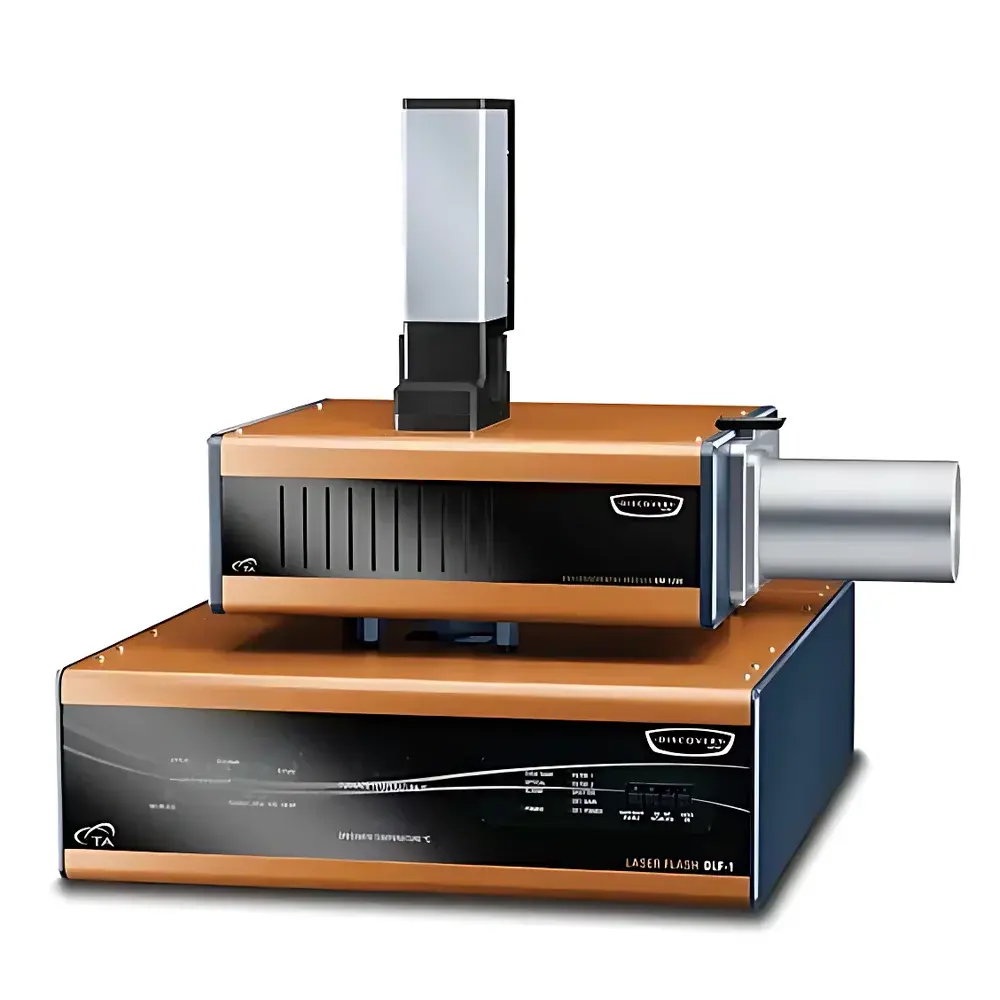
TA Instruments Discovery Laser Flash Thermal Conductivity Analyzer DLF-1200
| Brand | TA Instruments |
|---|---|
| Origin | USA |
| Model | DLF-1200 |
| Temperature Range | RT to 1200 °C |
| Laser Pulse Width | 300–400 µs |
| Atmosphere Options | Air, Inert Gas, Vacuum (down to 10⁻³ torr) |
| Detection | Liquid Nitrogen-Cooled IR Detector |
| Heating System | Resistive Furnace |
| Measurement Principle | Laser Flash Analysis (LFA) |
Overview
The TA Instruments Discovery Laser Flash Thermal Conductivity Analyzer DLF-1200 is a high-precision, benchtop laser flash apparatus engineered for the determination of thermal diffusivity (α), thermal conductivity (λ), and specific heat capacity (Cp) of solid materials across an extended temperature range—from ambient to 1200 °C. Based on the standardized laser flash analysis (LFA) method (ASTM E1461, ISO 13826, DIN EN 821-2), the system delivers traceable, reproducible thermophysical property data essential for advanced materials development, ceramic formulation, aerospace component qualification, and nuclear fuel research. The DLF-1200 employs a proprietary Class I neodymium-doped glass laser source, generating collimated, monochromatic pulses with precisely controlled durations of 300–400 µs. This pulse stability ensures consistent energy deposition and minimizes thermal gradient artifacts during transient heating—critical for accurate α calculation via the Cowan or Parker models. A liquid nitrogen-cooled infrared detector enables high-sensitivity, non-contact surface temperature monitoring with sub-millisecond temporal resolution, capturing the full thermal rise profile without physical interference or sensor-induced thermal mass effects.
Key Features
- Integrated resistive furnace with closed-loop PID temperature control, enabling stable isothermal holds and precise ramping (±0.5 °C accuracy) from room temperature to 1200 °C
- Hermetically sealed sample chamber compatible with ambient air, inert purge gases (Ar, N₂), and high-vacuum environments (down to 10⁻³ torr) to eliminate convective and oxidative artifacts
- Optimized optical path with beam homogenization and real-time pulse energy monitoring for inter-run consistency
- Automated sample positioning and alignment verification via integrated camera-assisted setup routine
- Robust mechanical architecture with vibration-damped optical table integration and electromagnetic shielding for signal integrity in shared lab environments
- Compliance-ready design supporting audit trails, user access levels, and electronic signature protocols aligned with FDA 21 CFR Part 11 and GLP/GMP documentation requirements
Sample Compatibility & Compliance
The DLF-1200 accommodates disk-shaped specimens ranging from 6 mm to 25.4 mm in diameter and 0.5 mm to 5 mm in thickness—including ceramics, metals, composites, refractory oxides, graphite, and thin-film coated substrates. Sample surfaces require minimal preparation: optical flatness (Ra < 0.8 µm) and uniform emissivity are recommended for optimal IR detection fidelity. The system conforms to ASTM E1461 for thermal diffusivity measurement, ISO 22007-2 for polymer thermal conductivity, and USP for pharmaceutical excipient characterization. All firmware and calibration routines are validated per IQ/OQ protocols; factory-installed reference standards (NIST-traceable sapphire, stainless steel 304, and pyrolytic graphite) support in-house performance verification.
Software & Data Management
Operation is managed through TRIOS™ Thermal Analysis Software v6.x, a modular platform supporting instrument control, real-time data acquisition, multi-step thermal profiling, and automated post-processing. The software implements standard LFA algorithms—including direct curve-fitting of temperature vs. time traces, thickness-corrected α derivation, and λ calculation using concurrent Cp data from optional DSC coupling. Raw datasets are stored in vendor-neutral HDF5 format with embedded metadata (operator ID, timestamp, atmosphere, pulse energy, furnace setpoint). Audit logs record all parameter changes, calibration events, and report generation actions. Export options include CSV, XML, and PDF reports compliant with laboratory information management systems (LIMS) integration requirements.
Applications
- High-temperature thermal property mapping of turbine blade superalloys and thermal barrier coatings
- Thermal interface material (TIM) screening under simulated operational vacuum and inert conditions
- Quality control of sintered ceramic insulators used in fusion reactor first-wall components
- Development of low-conductivity aerogels and nanostructured insulation for space-grade applications
- Thermophysical validation of nuclear fuel pellet candidates (UO₂, MOX, SiC composites) across burnup-relevant temperature regimes
- Correlation studies between microstructure (via SEM/EBSD) and bulk thermal transport behavior in additively manufactured metal parts
FAQ
What standards does the DLF-1200 comply with for thermal diffusivity measurement?
ASTM E1461, ISO 13826, DIN EN 821-2, and ISO 22007-2 are fully supported through embedded calculation methods and certified reference materials.
Can the system measure specific heat capacity independently?
No—Cp must be supplied externally (e.g., from DSC or literature) for thermal conductivity derivation; however, the DLF-1200 can be synchronized with TA’s Q2000 DSC for simultaneous Cp acquisition.
Is vacuum operation required for all high-temperature measurements?
Vacuum (≤10⁻³ torr) is recommended above 800 °C for oxide ceramics and reactive metals to prevent oxidation and ensure radiative-only heat transfer assumptions hold.
How frequently does the laser require recalibration?
The Nd:glass laser module is factory-aligned and requires no user recalibration; annual verification against pulse energy meter and beam profiler is advised as part of preventive maintenance.
Does the system support unattended overnight testing?
Yes—TRIOS software enables scheduled multi-step temperature ramps with automatic shutdown, data archiving, and email alerts upon completion or fault detection.



