
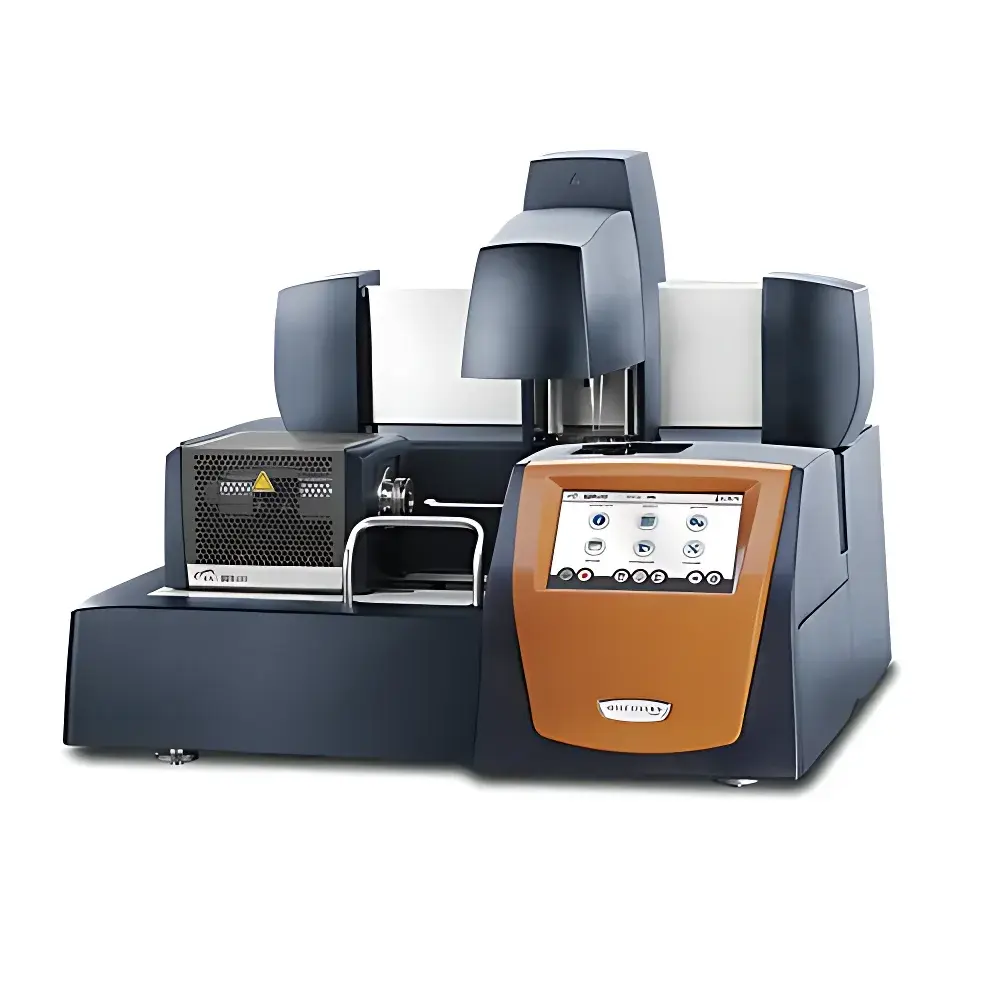
TA Instruments Discovery SDT 650 Simultaneous Thermal Analyzer
| Brand | TA Instruments |
|---|---|
| Origin | USA |
| Model | Discovery SDT 650 |
| Heating Rate | 0.1–100 °C/min |
| Temperature Range | Ambient to 1500 °C |
| Temperature Stability | ±2% |
| Maximum Sample Mass | 200 mg |
| Base Pressure | 50 μTorr |
Overview
The TA Instruments Discovery SDT 650 is a high-performance simultaneous thermal analyzer engineered for precise, real-time measurement of both differential scanning calorimetry (DSC) and thermogravimetric analysis (TGA) signals in a single, integrated furnace platform. Based on the principle of concurrent heat flow and mass change detection under controlled temperature programs, the SDT 650 enables rigorous characterization of thermal transitions—including melting, crystallization, glass transitions, decomposition, oxidation, and volatilization—alongside quantitative mass loss kinetics. Its dual-sensor architecture ensures strict signal synchronization, eliminating temporal misalignment between DSC and TGA data streams—a critical requirement for mechanistic interpretation of complex solid-state reactions. Designed for research laboratories and industrial quality control environments, the instrument operates across an extended temperature range (ambient to 1500 °C), supporting high-temperature ceramic, metallurgical, and advanced material studies under inert, oxidative, or reducing atmospheres.
Key Features
- Ultra-low drift balance system with <1 µg baseline stability over 60 minutes, ensuring exceptional signal-to-noise ratio for low-mass samples and subtle enthalpic events.
- Modulated DSC® (MDSC®) capability for separation of reversing and non-reversing heat flow components—enabling accurate heat capacity determination and resolution of overlapping transitions.
- Hi-Res™ TGA mode with dynamic heating rate modulation to deconvolute superimposed weight-loss steps, particularly valuable for polymer blends, pharmaceutical co-crystals, and multi-step decomposition pathways.
- Modulated TGA™ (MTGA™) functionality for enhanced kinetic analysis via periodic temperature oscillation, improving activation energy estimation accuracy in solid-state reaction modeling.
- Linear autosampler with programmable tray positioning and full sequence scheduling—supports unattended operation for up to 24 samples per run, compliant with GLP documentation requirements.
- Proprietary One-Touch-Away™ touchscreen interface with application-specific workflows, intuitive calibration wizards, and context-sensitive help—reducing operator training time and minimizing procedural errors.
- Furnace assembly backed by a limited five-year warranty, reflecting structural robustness and long-term thermal uniformity assurance.
Sample Compatibility & Compliance
The SDT 650 accommodates standard platinum, alumina, and gold crucibles (including hermetic and vented variants), supporting sample masses from 0.1 mg to 200 mg. It complies with ASTM E1131 (standard test method for compositional analysis by TGA), ASTM E1269 (heat capacity by DSC), ISO 11357 (plastics—DSC), and USP <1227> for pharmaceutical thermal profiling. Data integrity meets FDA 21 CFR Part 11 requirements through secure user authentication, electronic audit trails, and immutable raw data archiving. The system supports IQ/OQ/PQ validation protocols and integrates seamlessly into enterprise LIMS environments via ASTM E1384-compliant data export.
Software & Data Management
TRIOS™ software provides unified acquisition, analysis, and reporting for SDT data. It includes automated baseline correction, kinetic modeling (e.g., Ozawa-Flynn-Wall, Kissinger, Friedman), phase diagram construction, and custom report generation with embedded metadata (operator, timestamp, instrument ID, method version). All processing steps are fully traceable, with version-controlled method templates and parameter locking for regulated workflows. Raw data files (.q5) are stored in vendor-neutral HDF5 format, enabling third-party interoperability and long-term archival compliance.
Applications
- Thermal stability assessment of battery cathode materials (e.g., NMC, LFP) under air and argon up to 1000 °C.
- Quantification of residual solvents and hydrate/dehydrate behavior in active pharmaceutical ingredients (APIs).
- Decomposition onset and char yield evaluation of flame-retardant polymers and carbon composites.
- Phase transformation kinetics in shape-memory alloys and high-entropy ceramics.
- Multi-step catalytic decomposition analysis of metal-organic frameworks (MOFs) under controlled gas switching sequences.
FAQ
What atmosphere control options are available on the SDT 650?
The system supports manual and automated gas switching between up to three gases (e.g., N₂, O₂, Ar) with mass flow controllers and optional vacuum capability down to 50 μTorr.
Can the SDT 650 perform isothermal TGA or DSC measurements?
Yes—both isothermal hold and dynamic ramp-hold-ramp profiles are fully programmable within TRIOS software.
Is MDSC® supported on all SDT 650 configurations?
MDSC® requires optional firmware licensing and compatible sensor calibration; it is not enabled by default on base systems.
How is temperature calibration performed?
Calibration uses certified reference materials (e.g., indium, zinc, aluminum) with automated peak detection and linear correction across the full operating range.
Does the autosampler support custom crucible types?
The linear autosampler accepts standard 70 mm tall crucibles; non-standard geometries require mechanical adapters and manual loading.



