
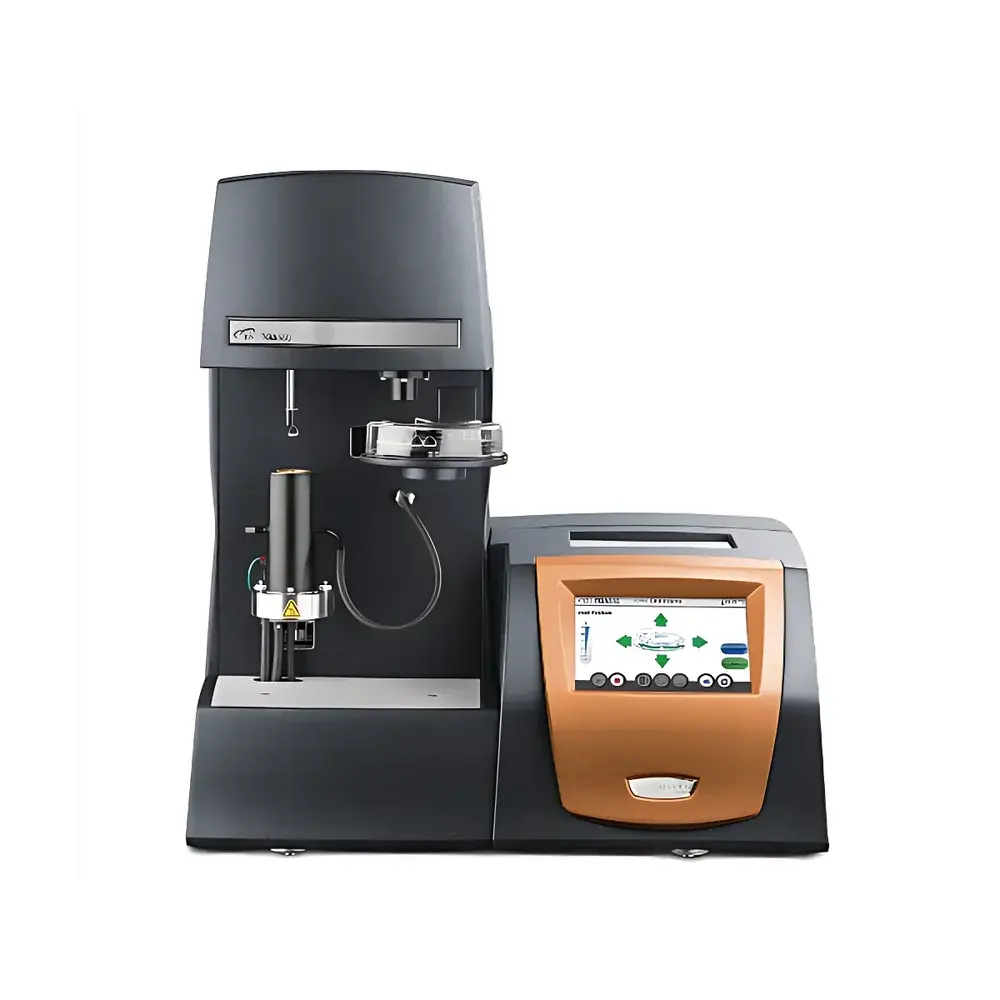
TA Instruments Discovery TGA 550 Thermogravimetric Analyzer
| Brand | TA Instruments |
|---|---|
| Origin | USA |
| Model | Discovery TGA 550 |
| Temperature Range | Ambient to 1000 °C |
| Balance Sensitivity | 0.1 µg |
| Heating/Cooling Rate | 0.1–100 °C/min |
| Maximum Sample Mass | 1 g |
| Baseline Drift | <25 µg |
Overview
The TA Instruments Discovery TGA 550 is a high-performance thermogravimetric analyzer engineered for precision mass-change measurement as a function of temperature or time under controlled atmospheric conditions. Utilizing a patented Symmetric Dual-Balance design with electromagnetic force restoration (EMFR) technology, the system delivers exceptional mass resolution and thermal stability across its full operating range from ambient to 1000 °C. This architecture minimizes mechanical drift and enables real-time compensation for buoyancy effects, ensuring high reproducibility in quantitative decomposition, oxidation, dehydration, and volatilization studies. The instrument is widely deployed in polymer science, pharmaceutical development, battery materials R&D, catalysis, and geochemical characterization—where accurate quantification of mass loss events, residual ash content, and kinetic parameter derivation (e.g., activation energy via ASTM E1641 or ISO 11358) are critical.
Key Features
- Symmetric Dual-Balance EMFR sensor with 0.1 µg mass resolution and <25 µg baseline drift over 24-hour operation
- Modular furnace assembly supporting rapid heating/cooling rates from 0.1 to 100 °C/min with programmable linear and non-linear ramps
- Integrated gas delivery system with dual mass flow controllers (MFCs) for precise switching between inert (N₂, Ar), oxidizing (air, O₂), and reactive (H₂, CO) atmospheres
- Auto-sampling capability with optional 25-position carousel for unattended analysis of multiple samples or replicate runs
- Hermetically sealed sample chamber with quartz or alumina crucibles (standard 70 µL, optional micro- and high-pressure variants)
- Patented Q5000 IR furnace technology for improved temperature uniformity and reduced thermal lag during dynamic scans
Sample Compatibility & Compliance
The Discovery TGA 550 accommodates solid powders, granules, thin films, fibers, and small metallic specimens up to 1 g total mass. Crucible options include platinum, alumina, and ceramic variants optimized for corrosive, reducing, or high-temperature environments. The system complies with ASTM E1131 (standard test method for compositional analysis by TGA), ISO 11358-1 (polymer thermogravimetry), and USP <467> for residual solvent quantification. Data acquisition and reporting support 21 CFR Part 11 compliance when configured with Trios Software v5.2+ and appropriate audit trail settings, meeting GLP/GMP requirements for regulated pharmaceutical and medical device laboratories.
Software & Data Management
Controlled exclusively via TA Instruments’ Trios Software platform, the Discovery TGA 550 provides intuitive method setup, real-time data visualization, and automated post-processing workflows. Trios includes built-in kinetic analysis modules (e.g., Friedman, Ozawa-Flynn-Wall, ASTM E698), derivative thermogravimetry (DTG) peak deconvolution, and multi-curve comparison tools. All raw and processed data are stored in a secure, timestamped database with user-access controls, electronic signatures, and full audit trail logging. Export formats include ASCII, CSV, XML, and PDF reports compatible with LIMS integration and enterprise data repositories.
Applications
- Quantitative determination of filler content, polymer degradation onset, and char yield in composites per ASTM D3850
- Moisture, solvent, and volatile organic compound (VOC) profiling in active pharmaceutical ingredients (APIs) and excipients
- Thermal stability assessment of cathode/anode materials in lithium-ion batteries under air and argon
- Decomposition kinetics of metal-organic frameworks (MOFs) and catalyst supports
- Residue ash analysis in food packaging polymers and environmental particulate matter (PM10)
- Multi-step reaction modeling for cement hydration and clay mineral transformation
FAQ
What is the maximum recommended sample mass for optimal resolution and thermal response?
For best mass sensitivity and temperature homogeneity, TA Instruments recommends loading ≤500 mg in standard alumina crucibles. Full 1 g capacity is supported but may reduce effective resolution in low-mass-loss regimes.
Can the Discovery TGA 550 operate under vacuum or high-pressure conditions?
Standard configuration supports atmospheric and positive-pressure gas flows up to 5 bar. Vacuum operation requires optional vacuum-compatible furnace and sealing kit (Q5000-VAC); high-pressure (>5 bar) configurations must be custom-engineered and validated per ASME B31.3 guidelines.
Is calibration traceable to NIST standards?
Yes—mass calibration uses certified NIST-traceable weights, and temperature calibration employs high-purity reference materials (e.g., Ni, Cu, Al, KCl) aligned with ASTM E967 and ISO/IEC 17025 accredited procedures.
How does the Symmetric Dual-Balance design improve measurement fidelity compared to single-beam systems?
It actively compensates for thermal expansion-induced stress on the balance mechanism and eliminates asymmetrical convection currents within the furnace zone—reducing apparent drift and improving signal-to-noise ratio during slow-heating or isothermal holds.
Does Trios Software support automated pass/fail criteria for release testing?
Yes—customizable QC templates allow definition of acceptance windows for onset temperature, mass loss %, residue %, and DTG peak position, with automatic flagging and report generation compliant with pharmaceutical release protocols.



