
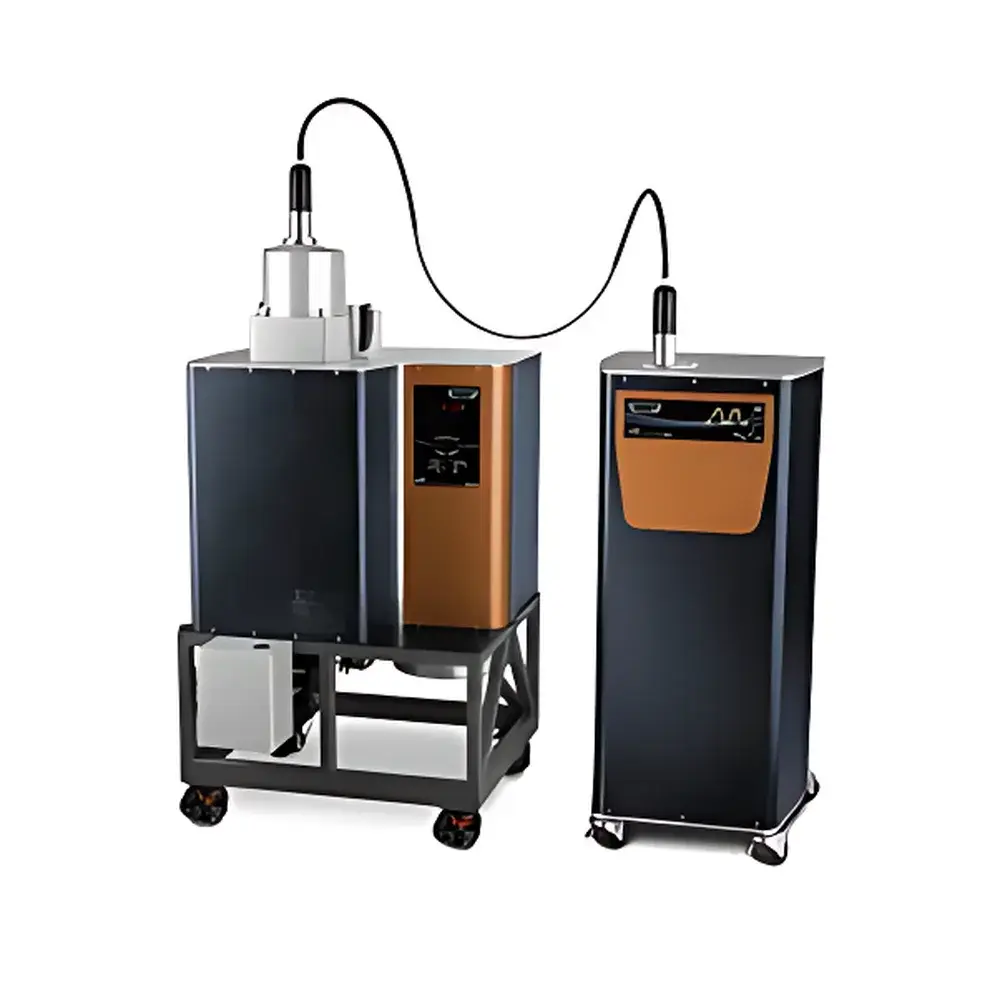
TA Instruments DLF 1600 Laser Flash Analyzer
| Brand | TA Instruments |
|---|---|
| Origin | USA |
| Model | DLF 1600 |
| Measurement Principle | Laser Flash Method (LFA) |
| Maximum Operating Temperature | 1600 °C |
| Laser Pulse Energy | 1.35 J (Nd:Glass) |
| Pulse Width | 300–400 µs |
| Atmosphere Options | Air, Inert Gas, Vacuum (down to 10 Torr) |
| Furnace Heating Element | MoSi₂ |
| Insulation | High-Purity Alumina Hot Zone |
| Sample Capacity | Up to 6 positions with rotating carousel |
| Detector | Liquid Nitrogen-Cooled Infrared Detector |
| Beam Delivery | Patented Fiber-Optic Light Pipe (99% uniform transmission) |
| Compliance | ASTM E1461, ISO 22007-4, DIN EN 821-2 |
Overview
The TA Instruments DLF 1600 Laser Flash Analyzer is a high-temperature, research-grade thermal diffusivity and thermal conductivity measurement system engineered for precision under extreme thermal conditions. It operates on the laser flash method (LFA), a standardized transient technique in which a thin, disk-shaped sample is subjected to a short, uniform energy pulse on its front surface, and the resulting temperature rise on the rear surface is recorded over time. From this thermogram—typically captured by a liquid nitrogen-cooled infrared detector—the thermal diffusivity (α) is calculated using established mathematical models (e.g., Cowan or Parker corrections). When combined with measured specific heat capacity (Cp) and bulk density (ρ), thermal conductivity (λ = α·ρ·Cp) is derived with traceable uncertainty. The DLF 1600 extends this capability to temperatures up to 1600 °C, making it suitable for advanced ceramics, refractory metals, nuclear fuels, and next-generation thermal barrier coatings where conventional LFA systems reach operational limits.
Key Features
- High-energy Nd:glass laser source delivering 1.35 J per pulse with precisely controlled pulse width (300–400 µs), optimized for signal-to-noise ratio and minimal thermal penetration artifacts.
- Patented fiber-optic light pipe delivery system ensures >99% spatial uniformity of incident laser irradiance across the sample surface—critical for eliminating edge effects and improving reproducibility.
- MoSi₂-heated furnace with high-purity alumina insulation and axisymmetric hot zone geometry enables stable, repeatable temperature control from ambient to 1600 °C.
- Multi-sample carousel accommodates up to six standard 12.7 mm diameter disks; automated positioning minimizes operator intervention and improves throughput in R&D and QC environments.
- Dual-mode atmosphere control supports operation in air, inert gas (Ar/N₂), or vacuum (down to 10 Torr), mitigating oxidation, convection, and radiative interference during high-temperature measurements.
- Integrated baffle structure suppresses convective turbulence within the furnace chamber, preserving thermogram fidelity—especially vital above 1000 °C where natural convection dominates.
- Liquid nitrogen-cooled mercury cadmium telluride (MCT) infrared detector provides high sensitivity and fast temporal response (<10 µs rise time), enabling accurate capture of rapid rear-surface temperature transients.
Sample Compatibility & Compliance
The DLF 1600 accepts solid, isotropic, non-transparent disk specimens (typically 6–12.7 mm in diameter, 1–3 mm thick) including oxides (Al₂O₃, ZrO₂), carbides (SiC, WC), nitrides (Si₃N₄), graphite, and metallic alloys. Samples must exhibit sufficient opacity to near-infrared radiation and minimal lateral heat loss. The system complies with ASTM E1461 (Standard Test Method for Thermal Diffusivity of Solids), ISO 22007-4 (Plastics — Determination of Thermal Conductivity and Thermal Diffusivity — Part 4: Laser Flash Method), and DIN EN 821-2 (Advanced Technical Ceramics — Thermal Diffusivity — Part 2: Laser Flash Method). Its design supports GLP-compliant workflows, with full audit trail capabilities when integrated with TA Instruments’ TRIOS software.
Software & Data Management
Control, acquisition, and analysis are managed via TRIOS Software—a modular, validated platform supporting instrument calibration, pulse parameter optimization, thermogram fitting (including multi-layer and anisotropic corrections), and uncertainty propagation. Raw IR detector signals are digitized at ≥1 MHz sampling rate and stored in HDF5 format for long-term archival integrity. The software includes built-in compliance tools for 21 CFR Part 11 readiness, including electronic signatures, role-based access control, and immutable audit logs. Export options include CSV, Excel, and XML formats compatible with LIMS and enterprise data systems.
Applications
- Development and qualification of aerospace-grade thermal barrier coatings (TBCs) and environmental barrier coatings (EBCs).
- Thermal property mapping of sintered ceramic components used in fusion reactor first-wall materials.
- High-temperature validation of CMCs (ceramic matrix composites) for turbine blade applications.
- Quality assurance of refractory bricks, crucibles, and kiln furniture in metallurgical and glass manufacturing.
- Fundamental studies of phonon scattering mechanisms in nanostructured ceramics and MAX phases.
- Thermal stability assessment of nuclear fuel forms (UO₂, UN, SiC-clad fuel pellets) under simulated accident conditions.
FAQ
What standards does the DLF 1600 comply with for thermal diffusivity measurement?
ASTM E1461, ISO 22007-4, and DIN EN 821-2 are fully supported through hardware configuration and software algorithms.
Can the DLF 1600 measure anisotropic materials?
Yes—TRIOS software includes optional anisotropic analysis modules for orthotropic and transversely isotropic samples, provided orientation and crystallographic alignment are documented.
Is vacuum operation required for all high-temperature measurements?
No—vacuum (≤10 Torr) is recommended above ~1200 °C in oxidizing atmospheres to suppress convection and surface reactions; inert gas purging is sufficient for many ceramic systems.
How is calibration performed for absolute thermal diffusivity accuracy?
NIST-traceable reference materials (e.g., NIST SRM 736a, sapphire) are used for multi-point temperature calibration; laser energy is monitored in real time via calibrated photodiode feedback.
Does the system support unattended overnight operation?
Yes—fully programmable temperature ramps, pulse sequences, and auto-shutdown protocols enable extended unattended runs with continuous data logging and fault detection.



