
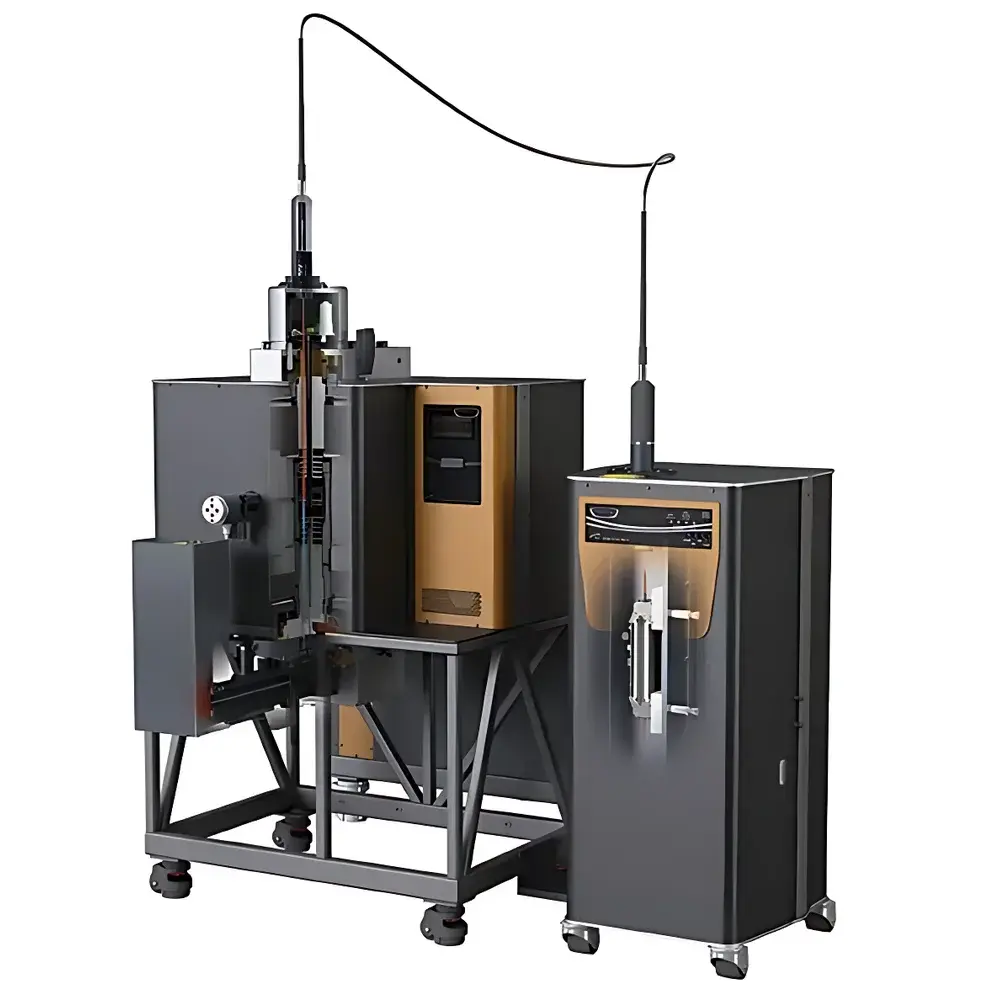
TA Instruments DLF 2800 Laser Flash Thermal Conductivity Analyzer
| Brand | TA Instruments |
|---|---|
| Origin | USA |
| Manufacturer Type | Authorized Distributor |
| Origin Category | Imported |
| Model | DLF 2800 |
| Instrument Principle | Laser Flash Method (LFA) |
| Dimensions (L×W×H) | 12.7 × 12.7 × 6 cm |
| Accuracy | ±2.3% |
| Thermal Conductivity Range | 0.1–2000 W/m·K |
| Repeatability | ±2% |
Overview
The TA Instruments DLF 2800 Laser Flash Thermal Conductivity Analyzer is a high-temperature, modular laser flash apparatus engineered for precise determination of thermal diffusivity (α), specific heat capacity (Cp), and derived thermal conductivity (λ = α·ρ·Cp) in dense solid materials. Operating on the standardized laser flash method (ASTM E1461, ISO 13826, DIN EN 821-2), the system delivers quantitative thermal transport data across an industry-leading temperature range—from ambient up to 2800 °C under inert or controlled atmospheres. Its core measurement principle relies on single-pulse irradiation of a thin, disk-shaped sample using a high-energy Nd:glass laser, followed by infrared detection of the rear-surface temperature rise profile. This time-resolved thermal response enables robust calculation of thermal diffusivity via the Cowan or error-function solution models—ensuring traceable, physics-based results essential for advanced materials development, nuclear fuel qualification, and high-temperature ceramic process optimization.
Key Features
- Ultra-high-temperature capability: Integrated graphite or molybdenum furnace with active cooling and vacuum/inert gas sealing supports stable operation up to 2800 °C, compliant with ASTM C714 and ISO 22007-4 requirements for refractory characterization.
- High-energy Nd:glass laser source: Delivers uniform, collimated pulse energy (≥10 J/pulse) via fiber-optic delivery, minimizing beam distortion and enabling reliable measurements on thick, highly scattering, or low-absorptivity samples (e.g., SiC, ZrO2, UO2).
- Top-down laser irradiation geometry: Eliminates contamination risk from sample debris falling onto optical windows—critical for long-term calibration stability and reproducibility in multi-cycle testing.
- 6-position rotating sample holder: Enables sequential, automated measurement of multiple specimens without manual furnace intervention, significantly improving throughput and reducing operator-induced thermal drift during Cp calibration runs.
- Real-time pulse waveform monitoring: Onboard photodiode and oscilloscope-integrated acquisition captures incident laser pulse shape, allowing precise zero-time definition and pulse-width correction—key for accurate diffusivity modeling at extreme temperatures.
- Modular furnace architecture: Facilitates rapid exchange between high-temperature (2800 °C) and medium-temperature (1200 °C) furnace modules, supporting flexible lab deployment across metallurgy, aerospace, and energy materials R&D workflows.
Sample Compatibility & Compliance
The DLF 2800 accommodates disk-shaped samples ranging from 6 mm to 12.7 mm in diameter and 0.5–5 mm in thickness, including metals, carbides, nitrides, oxides, composites, and nuclear ceramics. Sample surfaces require minimal preparation—flatness ≤ 5 µm and parallelism ≤ 10 µm are recommended for optimal signal fidelity. The system meets GLP-compliant data integrity requirements through audit-trail-enabled software (see Software & Data Management), and its measurement protocols align with ISO/IEC 17025-accredited laboratory practices. All thermal conductivity values are traceable to NIST-standard reference materials (e.g., NIST SRM 736, 1976), and uncertainty budgets include contributions from pulse timing, IR detector response, emissivity estimation, and furnace temperature homogeneity.
Software & Data Management
TA Instruments’ proprietary DLF Analysis Suite provides full instrument control, real-time visualization, and ISO 17025-aligned reporting. The software implements automatic baseline correction, pulse-shape deconvolution, and multi-layer thermal modeling (e.g., for coated substrates or layered nuclear fuels). It supports 21 CFR Part 11-compliant user access controls, electronic signatures, and immutable audit trails—including timestamped parameter changes, raw waveform exports (.csv/.tdms), and version-controlled analysis methods. Data export formats comply with ASTM E2554 and EU Annex 11 standards for regulatory submissions, and batch reports include uncertainty propagation per GUM (JCGM 100:2008).
Applications
- Development and QA/QC of ultra-high-temperature ceramics (UHTCs) for hypersonic vehicle leading edges and re-entry shielding.
- Thermal property validation of nuclear fuel pellets (UO2, MOX, TRISO) and cladding materials (SiC/SiC composites) under simulated reactor conditions.
- Process optimization of sintered tungsten heavy alloys and refractory metal powders used in additive manufacturing.
- Fundamental thermophysical studies of phase transitions (e.g., α→β Zr, γ→δ Pu) via in-situ thermal diffusivity mapping.
- Thermal interface material (TIM) screening for power electronics packaging, where interfacial resistance effects are decoupled using differential pulse analysis.
FAQ
What temperature calibration standards are supported for the DLF 2800?
The system includes certified NIST-traceable calibration routines using graphite, nickel, and sapphire reference disks across the full 25–2800 °C range, with optional in-situ thermocouple verification per ASTM E230.
Can the DLF 2800 measure anisotropic materials?
Yes—by orienting samples to expose specific crystallographic planes and applying directional pulse alignment, the instrument supports anisotropy quantification when combined with XRD texture analysis.
Is vacuum compatibility required for all measurements?
Vacuum (≤10−5 mbar) or inert gas (Ar, He) purging is mandatory above 1000 °C to prevent oxidation and ensure optical path integrity; ambient air operation is permitted only below 500 °C for non-oxidizing materials.
How is specific heat capacity determined?
Cp is measured separately using modulated temperature DSC (MT-DSC) or drop calorimetry, then integrated into thermal conductivity calculations via density input—DLF 2800 does not perform direct Cp measurement but requires validated external values.
What maintenance intervals are recommended for the Nd:glass laser module?
Laser rod replacement is scheduled every 10,000 pulses or biannually (whichever occurs first); optical alignment verification is performed automatically during system startup and logged in the audit trail.



