
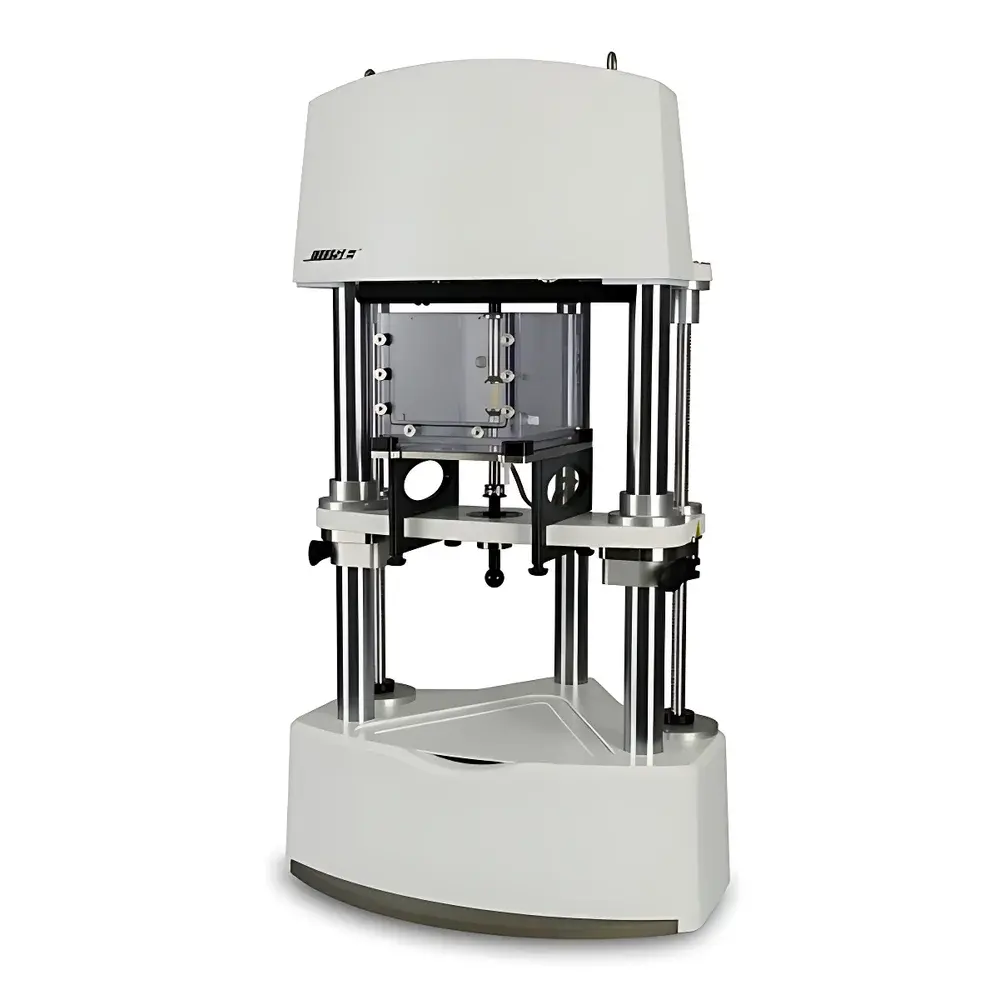
TA Instruments DuraPulse Cardiac Valve Durability Testing System
| Brand | TA Instruments |
|---|---|
| Origin | USA |
| Model | DuraPulse |
| Instrument Type | Dynamic Mechanical Durability Tester for Cardiovascular Devices |
| Compliance | ISO 5840-1:2021, ISO 5840-2:2021, ISO 5840-3:2021 |
| Test Stations | Configurable as 2-, 4-, or 6-channel modular units |
| Actuation Principle | Electromagnetic linear motor with closed-loop digital servo control |
| Waveform Fidelity | ≤ ±0.5% deviation from target physiological waveform (e.g., sinusoidal, pulsatile, or patient-specific waveforms) |
| Environmental Control | Independent, sealed test chambers with integrated temperature and fluid medium monitoring |
| Warranty | 10-year limited warranty on linear motor assemblies |
| Software Platform | DuraPulse Control Suite v4.x with audit trail and 21 CFR Part 11–compliant user access controls |
Overview
The TA Instruments DuraPulse Cardiac Valve Durability Testing System is a purpose-built electromechanical platform engineered for accelerated fatigue evaluation of transcatheter and surgical heart valves under physiologically representative hemodynamic conditions. Unlike conventional dynamic mechanical analyzers (DMAs) or generic servo-hydraulic testers, the DuraPulse system employs a high-bandwidth electromagnetic linear motor architecture—patented by Bose Corporation and integrated under TA Instruments’ quality and compliance framework—to replicate cyclic pressure and flow waveforms with exceptional fidelity. It operates on the principle of direct-force actuation, eliminating hydraulic lag, seal wear, and fluid compressibility artifacts inherent in pneumatic or hydraulic systems. Designed explicitly for regulatory-grade validation per ISO 5840-1:2021 (surgical valves), ISO 5840-2:2021 (transcatheter valves), and ISO 5840-3:2021 (heart valve substitutes), the system delivers traceable, reproducible, and auditable durability data required for premarket submissions to FDA, CE Notified Bodies, and PMDA.
Key Features
- High-frequency actuation capability: Sustained operation up to 10 Hz with full stroke amplitude, enabling accelerated testing protocols without waveform distortion.
- Precision waveform generation: Real-time digital servo control maintains ≤ ±0.5% deviation from target pressure/flow profiles—critical for avoiding non-physiological peak stresses during valve closure.
- Closed-loop environmental stabilization: Each test station operates within an independent, hermetically sealed chamber equipped with embedded temperature sensors and fluid-level monitoring to ensure consistent thermal and hydrostatic boundary conditions across multi-month tests.
- Modular station architecture: Scalable configurations support 2, 4, or 6 parallel test channels, each with independent actuator control, load sensing, and real-time displacement feedback—enabling comparative studies and statistical robustness per ISO 5840 Annex C.
- Interoperable device handling: Integrated quick-release fixtures allow seamless transfer of mounted valve assemblies between DuraPulse test stations and auxiliary pulse duplicator systems or imaging rigs (e.g., micro-CT, high-speed fluoroscopy) without repositioning or recalibration.
- Long-term reliability assurance: Linear motor assemblies are backed by a 10-year limited warranty—reflecting the system’s robust mechanical design, low-maintenance electromagnetic drive train, and validated mean time between failures (MTBF) > 20,000 hours.
Sample Compatibility & Compliance
The DuraPulse system accommodates a broad range of prosthetic heart valves—including bioprosthetic tissue valves (porcine, bovine, equine), polymer-based transcatheter valves, and mechanical bileaflet or tilting-disk designs—mounted in standardized mock circulatory loops using ISO 5840–specified anatomical fixtures. All fluid pathways are constructed from USP Class VI–certified materials, and test media (e.g., phosphate-buffered saline with 0.1% Tween-80 or bovine serum albumin) are compatible with long-term exposure at 37 °C ± 0.5 °C. The system supports full compliance documentation packages, including IQ/OQ/PQ protocols, calibration certificates traceable to NIST standards, and electronic records meeting FDA 21 CFR Part 11 requirements for signature, audit trail, and data integrity.
Software & Data Management
DuraPulse Control Suite v4.x provides a deterministic real-time operating environment for test orchestration, waveform synthesis, and synchronized data acquisition at up to 10 kHz per channel. The software enforces role-based access control (RBAC), automatic electronic signatures, and immutable audit trails for all parameter changes, start/stop events, and calibration actions. Raw force, displacement, and chamber pressure data are stored in HDF5 format with embedded metadata (test ID, operator, timestamp, ISO mode selection, waveform definition). Export modules support ASTM E1447–compliant CSV outputs and direct integration with LIMS platforms via HL7 or RESTful API interfaces.
Applications
- Regulatory submission testing per ISO 5840–mandated minimum 200 million cycles (or equivalent accelerated duration).
- Comparative fatigue analysis of novel biomaterials, leaflet geometries, or frame architectures under identical hemodynamic loads.
- Failure mode mapping—including calcification onset, suture line degradation, or commissural tear propagation—via periodic ex situ inspection aligned with in situ cycle counters.
- Validation of computational fluid dynamics (CFD) models using experimentally derived pressure–flow hysteresis loops.
- Design verification for next-generation valves incorporating shape-memory alloys or electroactive polymers requiring dynamic strain mapping.
FAQ
Does the DuraPulse system meet FDA requirements for IDE or PMA submissions?
Yes—its hardware architecture, software validation, and documentation framework are aligned with FDA Guidance for Industry: “Nonclinical Studies for Heart Valve Substitutes” (2022) and support full traceability from test initiation to final report generation.
Can third-party sensors (e.g., fiber-optic pressure transducers) be integrated into the test loop?
Yes—the system provides analog I/O expansion ports and programmable trigger outputs compatible with industry-standard sensor interfaces (e.g., 0–10 V, 4–20 mA, TTL), subject to prior validation per IEC 62304.
Is remote monitoring and intervention supported during unattended long-duration tests?
Yes—secure TLS 1.3–encrypted web interface enables real-time dashboard viewing, emergency pause/resume commands, and automated email/SMS alerts for out-of-spec conditions (e.g., temperature drift > ±0.3 °C, fluid level drop > 5%).
What calibration standards are used for force and displacement measurements?
Force transducers are calibrated annually using NIST-traceable deadweight standards; linear encoders are verified against laser interferometry per ISO 230-2:2023. Calibration certificates include uncertainty budgets and measurement traceability statements.
How is data integrity ensured over multi-month continuous operation?
All data writes are journal-enabled with write-ahead logging; file system corruption recovery is validated per IEEE 1667. Daily checksum verification and offsite encrypted backups (AES-256) are configurable via the DuraPulse Control Suite.



