
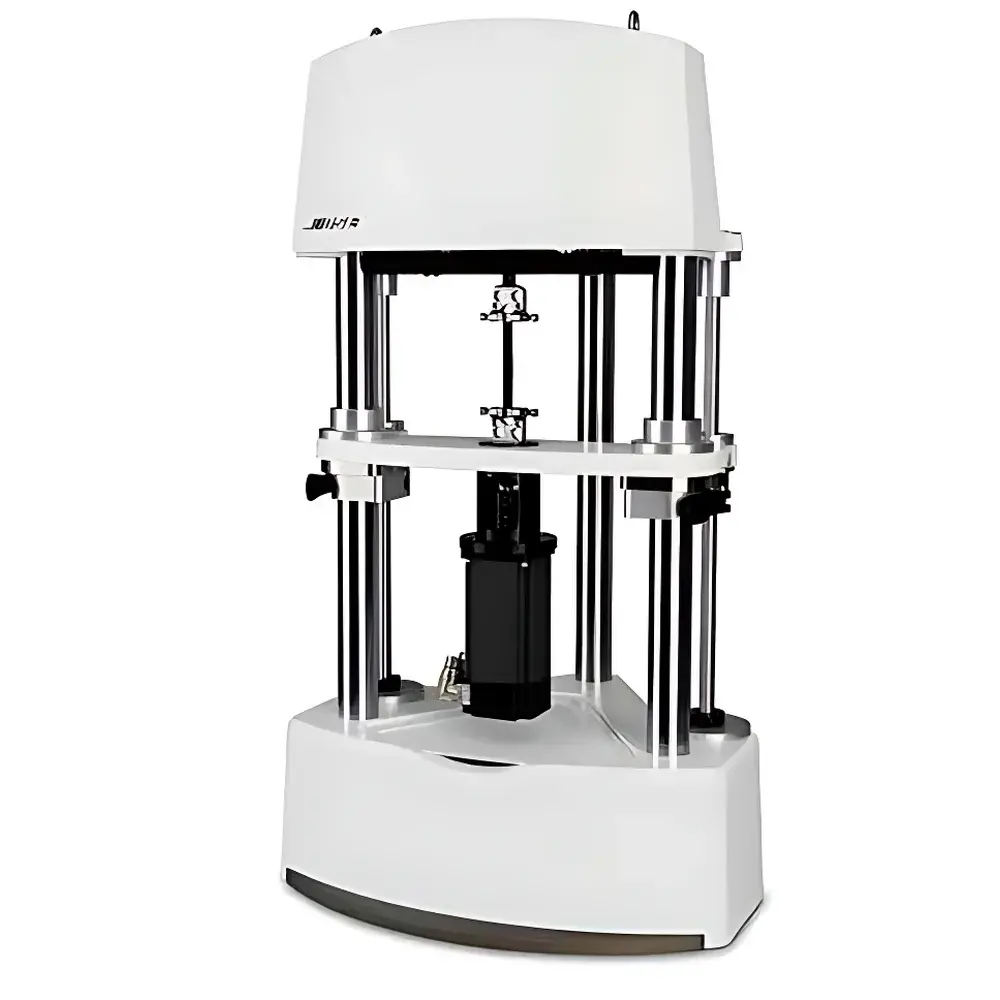
TA Instruments ElectroForce 3200 Desktop Dynamic Mechanical Analyzer (DMA/DMTA)
| Brand | TA Instruments |
|---|---|
| Origin | USA |
| Model | 3200 |
| Instrument Type | Dynamic Mechanical Analyzer (DMA) / Dynamic Mechanical Thermal Analyzer (DMTA) |
| Temperature Range | −150 °C to +315 °C |
| Temperature Accuracy | ±0.3 °C |
| Force Range | ±225 N (optional ±450 N) |
| Displacement Range | ±6.5 mm |
| Frequency Range | 10⁻⁵ Hz to 300 Hz |
Overview
The TA Instruments ElectroForce® 3200 Desktop System is a high-precision, servo-electric dynamic mechanical analyzer engineered for rigorous viscoelastic characterization of advanced materials under controlled thermal and mechanical conditions. Operating on the fundamental principles of forced oscillatory deformation—where a sinusoidal stress or strain is applied to a specimen while measuring the resulting in-phase (storage) and out-of-phase (loss) response—the system delivers quantitative modulus (E′, G′), damping (tan δ), and transition temperature data across an exceptionally broad frequency spectrum (10⁻⁵–300 Hz) and temperature range (−150 °C to +315 °C). Its modular, benchtop architecture integrates a high-stiffness load frame with a low-noise, high-resolution displacement transducer and a thermally isolated environmental chamber interface—enabling direct coupling to liquid nitrogen cryostats, Peltier-based thermal stages, or custom-built humidity- and saline-controlled enclosures. Designed specifically for applications demanding both high force resolution at low loads (<1 N) and robust performance at elevated amplitudes, the ElectroForce 3200 meets the metrological requirements of ISO 6721, ASTM D4065, ASTM D7028, and ISO 11357-2 for dynamic mechanical thermal analysis.
Key Features
- Servo-electric actuation delivering force resolution down to 0.001 N and linearity over ±225 N (upgradable to ±450 N)
- Wide dynamic bandwidth: seamless transition from static creep/relaxation to high-frequency oscillatory testing up to 300 Hz
- DMA-optimized control architecture supporting dual-mode operation—strain-controlled and stress-controlled modes with real-time feedback compensation
- Integrated motorized Z-axis lift with auto-locking control rod for rapid, repeatable sample alignment and fixture exchange
- High-fidelity displacement measurement via differential variable reluctance transducer (DVRT), resolving sub-micron displacements with <0.1% full-scale accuracy
- Front-panel status indicators—including active test mode, thermal stabilization confirmation, and overload warning—for unambiguous operational feedback
- Modular environmental integration: standardized flange interfaces for vacuum-compatible cryo chambers, saline immersion baths, and programmable thermal enclosures
Sample Compatibility & Compliance
The ElectroForce 3200 accommodates specimens ranging from sub-millimeter biological tissues (e.g., cartilage explants, tendon strips, vascular grafts) to macroscopic engineering components (e.g., polymer composites, elastomeric seals, thin-film coatings, microelectronic interposers). Fixture sets include dual-clamp tension/compression, three-point bending, torsional, and shear sandwich configurations—all calibrated per ASTM E2309. All hardware and firmware comply with FDA 21 CFR Part 11 requirements for electronic records and signatures when deployed with validated DMA software. Audit trails, user access controls, and electronic signature workflows are fully supported. The system is routinely employed in GLP-compliant laboratories for regulatory submissions related to ISO 10993 biocompatibility assessments and USP viscoelastic property verification of implantable devices.
Software & Data Management
Controlled by TA Instruments’ TRIOS DMA software, the ElectroForce 3200 provides integrated method development, real-time data visualization, and automated reporting compliant with ISO/IEC 17025 documentation standards. The software supports multi-step experiments—including frequency sweeps at fixed temperature, temperature ramps at constant frequency, time–temperature superposition (TTS), and isothermal fatigue protocols—with built-in compliance correction algorithms for fixture and thermal drift compensation. Raw data files (.taf) are structured in HDF5 format for long-term archival integrity and third-party interoperability. Export options include ASTM E1355-compliant CSV, MATLAB .mat, and universal JSON formats. All instrument parameters, calibration histories, and operator annotations are embedded within metadata headers—ensuring traceability across laboratory networks and audit cycles.
Applications
- Viscoelastic profiling of soft biological tissues: quantification of storage modulus (G′), loss modulus (G″), and phase lag in cartilage, tendons, heart valves, and vocal fold mucosa under physiological saline immersion
- Dynamic fatigue and cyclic loading of biomedical implants: evaluation of stiffness degradation, hysteresis evolution, and crack initiation thresholds in nitinol stents and polymeric suture anchors
- Transition thermodynamics of thermoplastics and thermosets: detection of glass transitions (Tg), secondary relaxations (β, γ), and crosslink density estimation via tan δ peak analysis
- Mechanical aging studies of elastomers and rubber compounds: monitoring modulus shifts and damping changes during thermal oxidative exposure per ASTM D573
- Nanoscale indentation-coupled DMA: synchronized nanoindenter displacement with bulk DMA stress modulation to decouple surface vs. bulk viscoelastic contributions
- Low-force dynamic characterization of thin films and 2D materials: tensile and bending moduli determination of graphene oxide membranes and hydrogel bilayers
- High-strain-rate response of composite laminates: time-resolved modulus mapping during impact-simulated harmonic loading up to 200 Hz
FAQ
What is the maximum recommended sample thickness for three-point bending tests?
For optimal signal-to-noise ratio and beam theory validity, samples should not exceed 10 mm in thickness and maintain a span-to-depth ratio ≥16:1.
Can the system perform simultaneous DMA and TMA measurements?
No—ElectroForce 3200 is dedicated to dynamic mechanical analysis; complementary TMA functionality requires a separate TA Instruments Q400 or Discovery TMA platform.
Is ISO 17025 calibration documentation available for purchase?
Yes—certified calibration kits with NIST-traceable force, displacement, and temperature standards are offered as optional accessories, including full uncertainty budgets per ISO/IEC 17025 Annex A.
Does the system support humidity-controlled testing?
Humidity control is achievable via third-party environmental chambers interfaced through analog I/O or digital RS-485; TA Instruments offers application support for integration with Vötsch or ESPEC humidity cabinets.
What software validation packages are provided for regulated environments?
IQ/OQ/PQ documentation templates, along with installation qualification checklists and performance verification protocols aligned with ASTM E2500, are included with all systems shipped to pharmaceutical or medical device manufacturers.



