
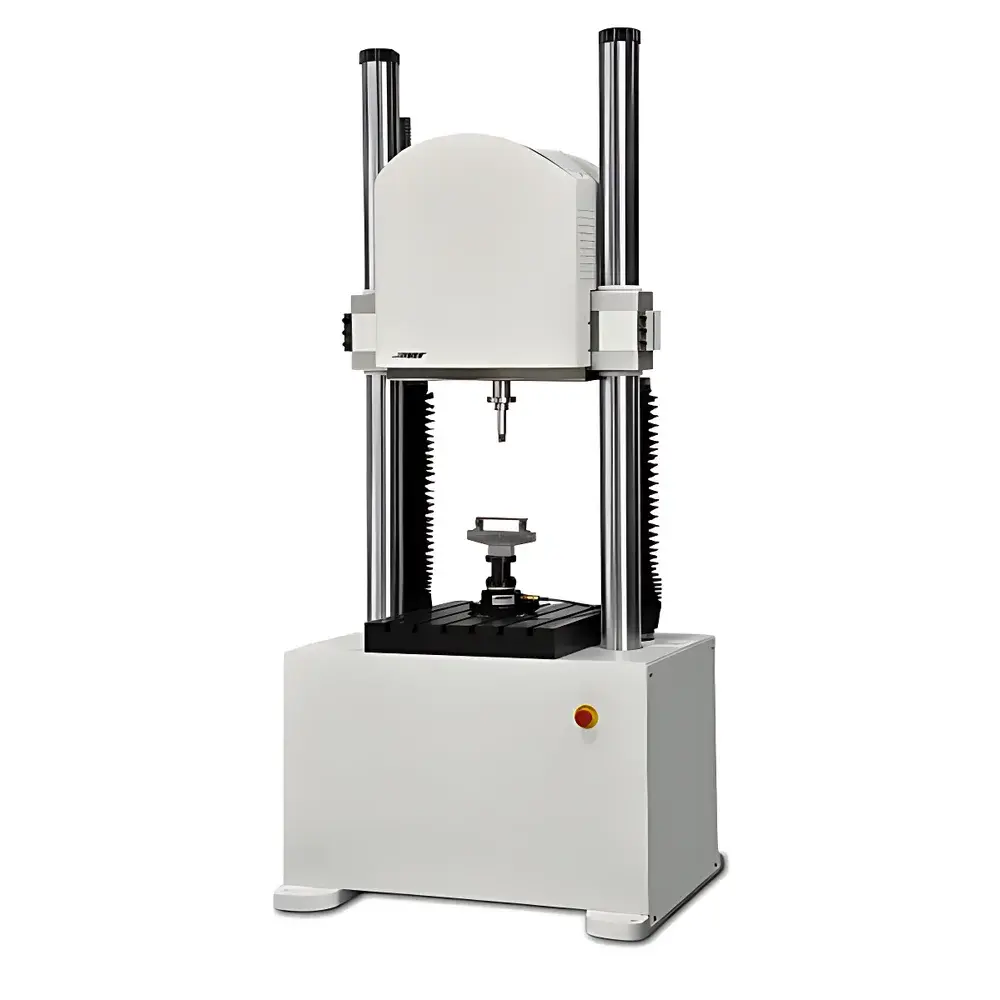
TA Instruments ElectroForce 3450 Dynamic Mechanical Analyzer (DMA) System
| Brand | TA Instruments |
|---|---|
| Origin | USA |
| Model | 3450 |
| Instrument Type | Dynamic Mechanical Analyzer (DMA) / DMTA |
| Force Range | ±3 kN (standard), ±6 kN (high-load option) |
| Displacement Range | up to ±22 mm |
| Frequency Range | 0.0001 Hz to 200 Hz |
| Temperature Range | –150 °C to 300 °C |
Overview
The TA Instruments ElectroForce 3450 Dynamic Mechanical Analyzer (DMA) is an electromechanical testing platform engineered for high-force, high-frequency viscoelastic characterization of structural and functional materials. Unlike conventional servo-hydraulic or piezoelectric DMA systems, the ElectroForce 3450 employs a direct-drive linear motor architecture coupled with a high-stiffness load frame, enabling precise force control, low-noise displacement measurement, and exceptional thermal stability across extreme temperature excursions. Its core operating principle relies on controlled sinusoidal or transient mechanical excitation—applied in tension, compression, bending, or shear configurations—to quantify storage modulus (E′), loss modulus (E″), damping ratio (tan δ), and time–temperature superposition behavior under programmable thermal profiles. Designed for rigorous R&D and quality assurance environments, the system meets the mechanical and thermal demands of advanced polymer composites, elastomeric isolators, biomedical implants, and aerospace-grade laminates.
Key Features
- Electromechanical actuation with zero hydraulic fluid or pneumatic dependency—ensuring clean, quiet, maintenance-free operation compliant with ISO 14644-1 Class 8 cleanroom requirements.
- Dual-force-range capability: standard ±3 kN configuration scalable to ±6 kN via optional high-force load cell and reinforced crosshead assembly.
- High-resolution displacement sensing with ±22 mm total stroke and sub-micron resolution over full range, calibrated traceably to NIST standards.
- Wide dynamic frequency coverage from quasi-static (0.0001 Hz) to high-bandwidth (200 Hz), supporting both time-domain relaxation/creep protocols and frequency-sweep DMTA modes.
- Integrated cryogenic-to-high-temperature environmental chamber with rapid ramp rates (up to 60 °C/min), uniformity ≤ ±0.5 °C across sample zone, and vacuum-compatible sealing options.
- Modular fixture library including dual-cantilever, 3-point bend, axial tension-compression, and torsional shear geometries—all designed for ASTM D4065, ISO 6721, and ASTM D7028 compliance.
Sample Compatibility & Compliance
The ElectroForce 3450 accommodates specimens ranging from thin films (<0.1 mm) to thick structural laminates (up to 50 mm thickness), rigid thermosets, flexible elastomers, fiber-reinforced composites, and viscoelastic adhesives. Sample mounting interfaces support standardized geometry definitions per ASTM D4065 Annex A1–A4 and ISO 6721-1. All thermal and mechanical calibration procedures are documented in accordance with GLP and GMP principles. The system’s firmware and data acquisition architecture comply with FDA 21 CFR Part 11 requirements when configured with electronic signatures, audit trails, and role-based access control through TRIOS software.
Software & Data Management
Controlled exclusively via TA Instruments’ TRIOS software suite, the ElectroForce 3450 provides fully integrated instrument control, real-time data visualization, and post-experimental analysis. TRIOS supports automated method sequencing—including multi-step temperature sweeps, strain-controlled fatigue cycling, and isothermal stress relaxation—with built-in calculation modules for Williams-Landel-Ferry (WLF) modeling, master curve generation, and time–temperature equivalence. Raw data files (.taf) are stored in vendor-neutral HDF5 format, enabling third-party interoperability with MATLAB, Python (via h5py), and commercial CAE platforms. Audit trail logs record all user actions, parameter changes, and calibration events with timestamped digital signatures.
Applications
- Dynamic stiffness and loss factor characterization of automotive NVH components (e.g., bushings, mounts, suspension links) under service-relevant loading spectra.
- Quantification of glass transition (Tg), secondary relaxations (β, γ), and crosslink density in thermosetting resins and rubber compounds.
- Fatigue life prediction of composite laminates using strain-controlled cyclic loading at elevated temperatures.
- Crack initiation and propagation analysis via in-situ DMA monitoring during slow-strain-rate testing.
- Creep compliance and stress relaxation behavior of biodegradable polymers under physiological conditions (37 °C, humidified atmosphere).
- Thermo-mechanical performance validation of thermal interface materials (TIMs) across –40 °C to 125 °C.
FAQ
What distinguishes the ElectroForce 3450 from traditional servo-hydraulic DMA systems?
It eliminates hydraulic oil, noise, heat generation, and periodic maintenance associated with servo-valves and accumulators—replacing them with a brushless linear motor and air-bearing-guided crosshead for superior signal fidelity and long-term calibration stability.
Can the system perform simultaneous thermal and mechanical aging protocols?
Yes—TRIOS software enables synchronized thermal ramping and mechanical hold steps, allowing users to replicate accelerated aging conditions while monitoring modulus decay or tan δ drift in real time.
Is ISO 17025 accreditation support available for this platform?
TA Instruments provides comprehensive calibration documentation, uncertainty budgets, and traceable reference standards compatible with ISO/IEC 17025 laboratory accreditation requirements.
Does the system support custom waveform generation beyond sinusoidal inputs?
Yes—arbitrary waveform synthesis (AWS) mode permits user-defined waveforms (e.g., square, triangle, sawtooth, or transient impact profiles) for non-linear viscoelastic assessment.
How is thermal uniformity validated across the sample chamber?
Each chamber undergoes factory verification using nine-point thermocouple mapping per ASTM E220, with certified reports supplied with system commissioning.



