
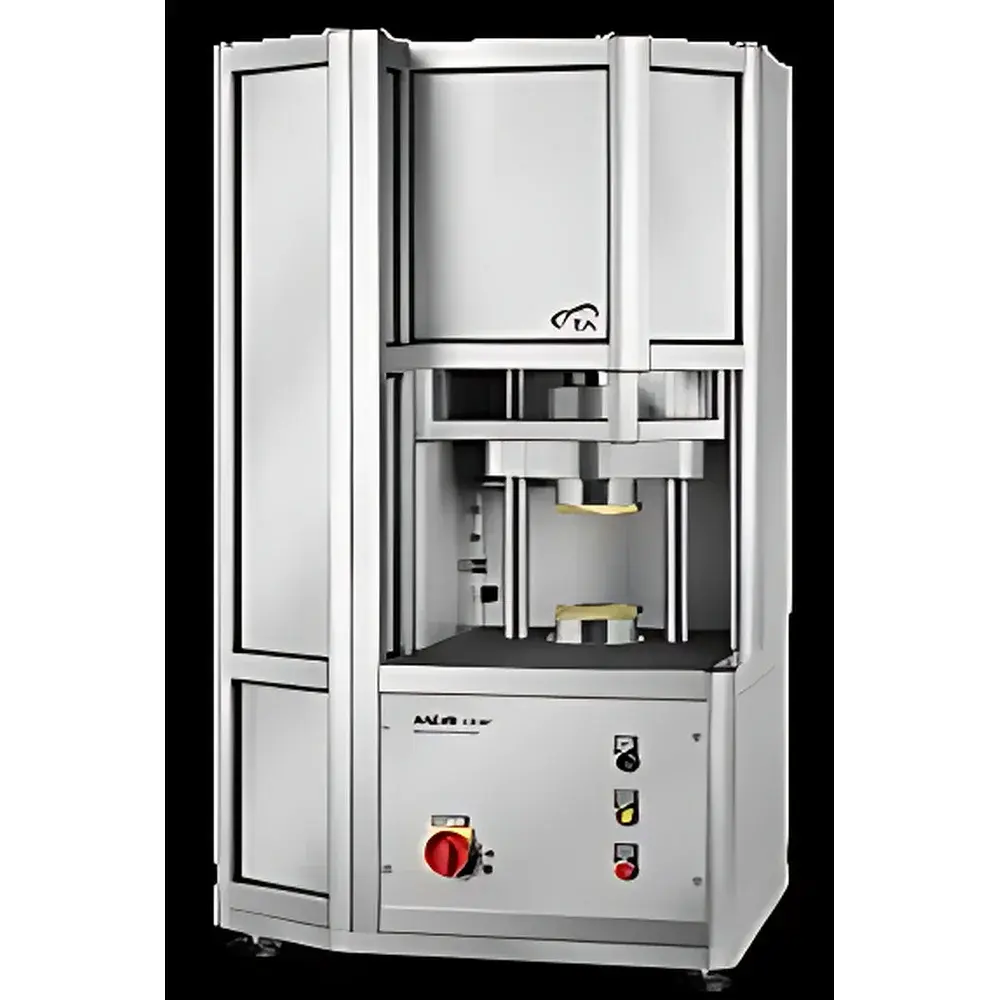
TA Instruments MDR one Unrotor Vulcanizometer
| Brand | TA Instruments |
|---|---|
| Origin | Germany |
| Model | MDR one |
| Compliance | ASTM D5289, ISO 6502, DIN 53529-1 |
| Temperature Control Range | Ambient to 200 °C (standard), optional refrigeration unit for sub-ambient testing |
| Torque Measurement Range | 0.001–10 N·m |
| Angular Displacement Resolution | ≤ 0.001° |
| Drive System | Direct-drive servo motor |
| Frame Stiffness | > 10⁶ N/m |
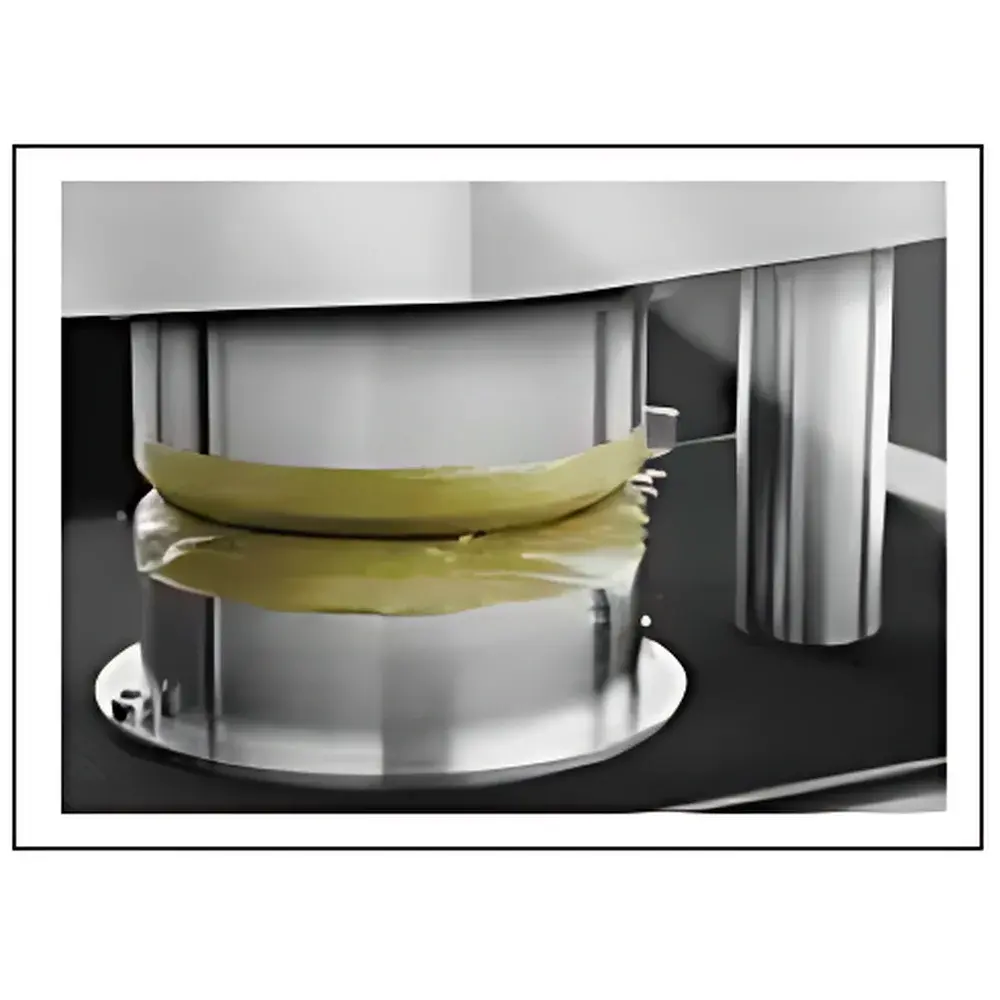
| Sample Geometry | Sealed dual-cone die (standard), interchangeable with oscillating disk or rotorless rectangular dies |
| Automation | Optional robotic sample handler with pneumatic die clamping |
| Software | Scarabaeus v5.x (multi-language UI, 21 CFR Part 11-compliant audit trail, raw data export in ASTM E1382-compliant format) |
| Calibration | User-performed torque and temperature calibration with NIST-traceable reference standards |
Overview
The TA Instruments MDR one Unrotor Vulcanizometer is a precision-engineered instrument designed specifically for the quantitative characterization of rubber vulcanization kinetics under controlled thermal and mechanical conditions. Unlike conventional rotor-based systems, the MDR one employs a sealed, non-rotating dual-cone die configuration that eliminates mechanical wear, reduces sample contamination risk, and ensures unambiguous torque response directly attributable to crosslink development rather than frictional artifacts. The system operates on the principle of oscillatory shear rheometry at fixed strain amplitude and frequency—measuring the time-dependent evolution of complex torque (proportional to storage and loss moduli) as uncured elastomer undergoes thermally activated sulfur crosslinking. Its architecture supports both isothermal and non-isothermal test protocols per ASTM D5289 (Standard Test Method for Rubber Property—Vulcanization Using Rotorless Cure Meters), ISO 6502 (Rubber—Determination of Vulcanization Characteristics with Rotorless Cure Meters), and DIN 53529-1 (Vulcanization Behavior of Rubber Compounds). Designed for integration into quality control laboratories and polymer R&D facilities, the MDR one delivers metrologically traceable data essential for compound formulation validation, batch release testing, and predictive modeling of cure behavior.
Key Features
- Sealed dual-cone die geometry compliant with ASTM D5289, ISO 6502, and DIN 53529-1 — ensures reproducible sample confinement and eliminates volatile loss during high-temperature cure cycles.
- Ultra-rigid monolithic frame (stiffness > 10⁶ N/m) minimizes compliance-induced signal distortion, enabling accurate resolution of low-torque transitions during early-stage scorch and post-cure relaxation.
- Direct-drive servo motor with zero-backlash transmission delivers precise angular displacement control (resolution ≤ 0.001°) and stable frequency fidelity across 0.1–100 rad/s range.
- Intelligent torque transducer with built-in thermal compensation and real-time self-diagnostic capability provides long-term stability and drift correction without external recalibration intervals.
- Pneumatically actuated die clamping mechanism ensures repeatable compressive force application (±0.5% full-scale) and consistent sample thickness control across multiple runs.
- Modular temperature control system offers standard operation from ambient to 200 °C, with optional integrated refrigeration module extending lower limit to –40 °C for low-temperature scorch profiling.
Sample Compatibility & Compliance
The MDR one accommodates standard 3.5 g rubber compounds in accordance with ASTM D5289 specimen mass requirements. The dual-cone die accepts both natural rubber (NR), synthetic elastomers (SBR, BR, EPDM, FKM), and filled or oil-extended formulations. Optional die configurations—including oscillating disk and rectangular non-rotor geometries—enable method transfer across legacy instrumentation and support specialized applications such as adhesion testing or filler dispersion analysis. All hardware and firmware comply with IEC 61000-6-3 (EMC) and IEC 61010-1 (safety). Data integrity meets FDA 21 CFR Part 11 requirements through Scarabaeus software’s role-based access control, electronic signature enforcement, and immutable audit trails.
Software & Data Management
Scarabaeus v5.x serves as the unified platform for instrument control, real-time visualization, and advanced kinetic analysis. The software supports multilingual user interfaces (English, German, French, Japanese, Chinese) and imports legacy datasets from competitor instruments via standardized ASCII and XML formats. Core analytical functions include scorch time (ts₁, ts₂), optimum cure time (t₉₀), minimum/maximum torque (ML/MH), rate-of-cure calculation (dM/dt), and Arrhenius-based activation energy estimation. Raw torque vs. time files are exported in ASTM E1382-compliant format for third-party statistical process control (SPC) integration. Audit logs record all operator actions, parameter changes, and calibration events with timestamped digital signatures.
Applications
- Quality assurance of incoming raw materials and production batches in tire, conveyor belt, and sealing component manufacturing.
- Rapid screening of accelerator systems, sulfur donors, and curatives during elastomer formulation development.
- Thermal stability assessment of heat-sensitive compounds via programmed non-isothermal ramps (e.g., 1 °C/min to 180 °C).
- Correlation studies between MDR-derived rheological parameters and final product performance metrics (e.g., tensile strength, compression set).
- Supporting GLP/GMP documentation workflows in regulated environments where full traceability of test conditions and analyst identity is mandatory.
FAQ
Does the MDR one require periodic factory recalibration?
No — the torque and temperature sensors support user-performed calibration using NIST-traceable reference standards; full calibration verification reports are generated within Scarabaeus.
Can existing ASTM or ISO test methods be executed without modification?
Yes — all default test templates conform to ASTM D5289, ISO 6502, and DIN 53529-1; no method adaptation is required for regulatory submission.
Is remote monitoring supported?
Yes — Scarabaeus includes secure HTTP/S API endpoints for integration with enterprise LIMS and centralized lab monitoring dashboards.
What maintenance is required for the dual-cone die assembly?
Routine cleaning with solvent-wet lint-free cloth after each run; no lubrication or alignment adjustment is needed due to zero-rotor design and preloaded pneumatic clamping.
How is data security ensured during multi-user operation?
Role-based permissions, encrypted local database storage, and automatic backup to network drives ensure confidentiality and integrity across concurrent analyst sessions.





