
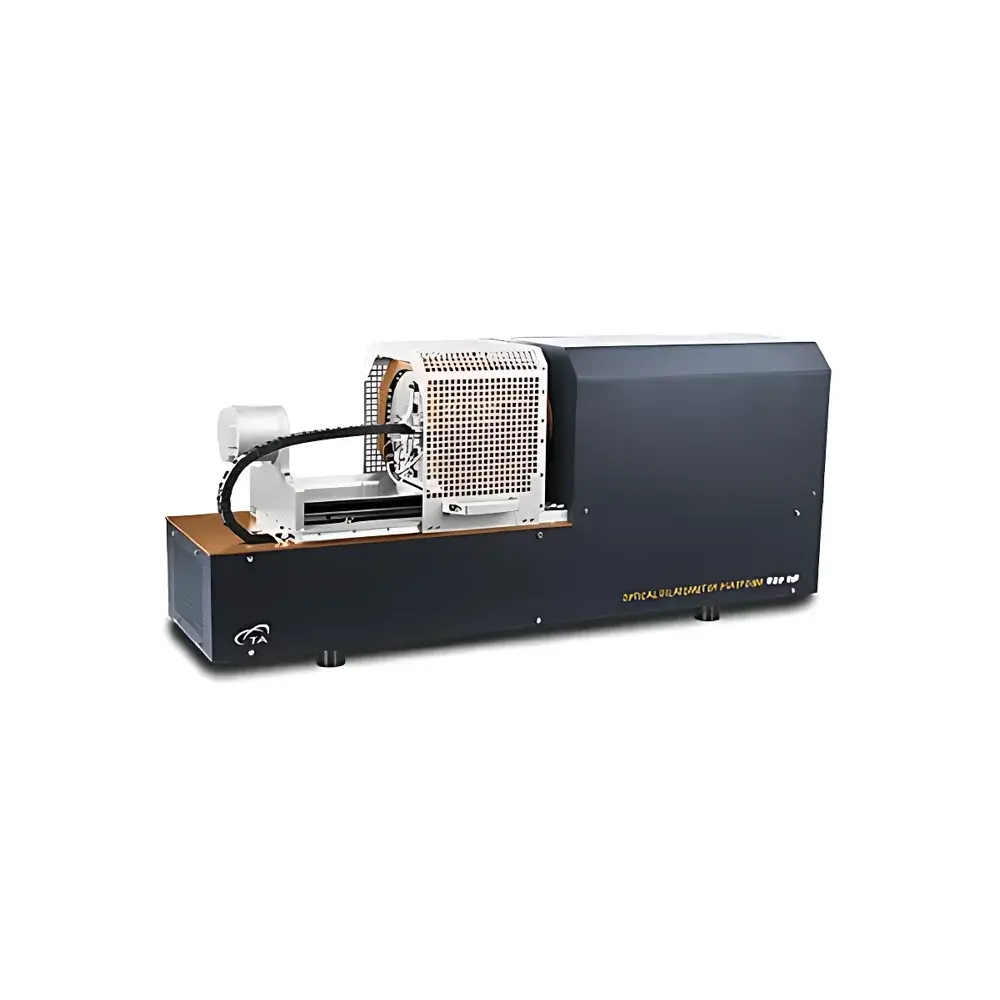
TA Instruments OPD 868 Optical Dilatometer
| Brand | TA Instruments |
|---|---|
| Origin | Italy |
| Model | OPD 868 |
| Temperature Range | RT – 1650 °C |
| Heating Rate | 0.1 – 100 °C/min (up to 200 °C/sec in transient mode) |
| Temperature Accuracy | ±0.2 °C |
| Sample Length | 1 – 85 mm (mode-dependent) |
| Camera Resolution | 5 MP |
| Multi-sample Capability | Up to 8 ISO-standard specimens simultaneously |
Overview
The TA Instruments OPD 868 Optical Dilatometer is a high-precision, image-based thermal expansion measurement system engineered for rigorous characterization of dimensional changes in solid materials under controlled thermal cycling. Unlike conventional push-rod dilatometers, the OPD 868 employs non-contact optical metrology—leveraging high-resolution digital imaging and pixel-level edge detection—to quantify linear thermal expansion, sintering behavior, softening points, shrinkage kinetics, and phase-transition-induced dimensional anomalies. Its core architecture integrates a programmable high-temperature furnace with an inert or reactive atmosphere option (N₂, Ar, air, O₂, CO/CO₂ mixtures), a thermally stabilized optical path, and a calibrated 5-megapixel industrial camera with telecentric lensing to eliminate parallax error across the full field of view. Designed for traceable, repeatable measurements in compliance with ASTM E228, ISO 7991, and DIN 51045 standards, the OPD 868 delivers absolute length change resolution better than 0.1 µm over sample lengths ranging from 1 mm to 85 mm—enabling direct correlation between microstructural evolution and macroscopic dimensional response.
Key Features
- Optical measurement principle eliminates mechanical contact artifacts, ensuring integrity for fragile, porous, or low-modulus samples (e.g., green ceramics, aerogels, polymer composites)
- Programmable heating profiles supporting both standard ramp-hold-cool cycles and ultra-fast transient modes (up to 200 °C/sec) for kinetic analysis of rapid phase transformations
- Thermal accuracy of ±0.2 °C across the full operating range (RT to 1650 °C), verified via dual-point NIST-traceable calibration
- Simultaneous multi-sample analysis capability: up to eight independently positioned specimens conforming to ISO 5725-2 reference dimensions, each tracked with individual ROI masks
- Integrated thermal shielding and purge gas management for stable imaging conditions at elevated temperatures, minimizing thermal lensing and convective distortion
- Modular furnace design compatible with vacuum (10⁻³ mbar) or controlled reactive atmospheres, supporting oxidation, reduction, and carburization studies
Sample Compatibility & Compliance
The OPD 868 accommodates diverse geometries—including rods, discs, prisms, and irregularly shaped specimens—without requiring machining to standardized cross-sections. Sample length flexibility (1–85 mm) supports both miniature research coupons and near-production-scale components. The system complies with international testing standards for thermal expansion and sintering analysis, including ASTM C372 (ceramic dilatometry), ISO 11359-1/-2 (polymer thermal expansion), and EN 14688 (refractory shrinkage). All measurement data are timestamped, sensor-calibrated, and archived with full metadata (furnace zone temperatures, gas flow rates, camera exposure parameters), satisfying GLP and GMP documentation requirements per FDA 21 CFR Part 11 when configured with audit-trail-enabled software licensing.
Software & Data Management
Morphometrics™ software provides real-time image acquisition, automated edge detection, and dynamic feature tracking using adaptive thresholding and sub-pixel centroid interpolation. It computes and plots key thermal events—including dilatometric softening point (Ts), sintering onset (Tonset), maximum shrinkage rate temperature (Tmax), and coefficient of linear expansion (CTE) over user-defined intervals—with automatic annotation against the temperature-time curve. Raw images, processed coordinates, and derivative curves are stored in HDF5 format for interoperability with MATLAB, Python (NumPy/Pandas), and LIMS platforms. Software validation packages—including IQ/OQ documentation, electronic signature support, and configurable user access levels—are available for regulated environments.
Applications
- Development and qualification of advanced ceramics, refractories, and metal matrix composites for aerospace and energy applications
- Optimization of ceramic green-body sintering schedules through quantitative shrinkage kinetics modeling
- Thermal stability assessment of battery electrode materials during charge/discharge thermal cycling simulations
- Characterization of thermal mismatch stresses in multilayer packaging systems (e.g., LTCC, HTCC substrates)
- Validation of CTE predictions from computational thermodynamics (CALPHAD) and finite-element modeling (FEM)
- Regulatory submission support for medical device material dossiers (ISO 10993-12, USP )
FAQ
What distinguishes optical dilatometry from traditional push-rod methods?
Optical dilatometry eliminates mechanical loading and frictional interference, enabling accurate measurement of weak, brittle, or highly viscous materials where contact-based methods induce creep or fracture.
Can the OPD 868 operate under reducing atmospheres?
Yes—the furnace is rated for continuous operation under H₂/N₂ mixtures, CO/CO₂ blends, and pure Ar or N₂, with integrated gas mass flow controllers and leak-tight quartz tube construction.
Is calibration traceable to national standards?
All temperature sensors are calibrated against NIST-traceable reference thermocouples; dimensional calibration utilizes certified gauge blocks and stage-mounted fiducial markers validated per ISO 9001 procedures.
How is data integrity ensured during long-duration tests (e.g., >100 h)?
The system implements redundant storage (local SSD + network-attached backup), cyclic image compression without loss of edge-detection fidelity, and automatic recovery from power interruption with resume-from-checkpoint functionality.
Does the platform support custom scripting for automated analysis workflows?
Yes—Morphometrics™ exposes a Python API (via RESTful endpoints and native bindings) for batch processing, integration with DOE frameworks, and custom event-triggered actions (e.g., auto-adjust heating rate upon detection of Tonset).



