
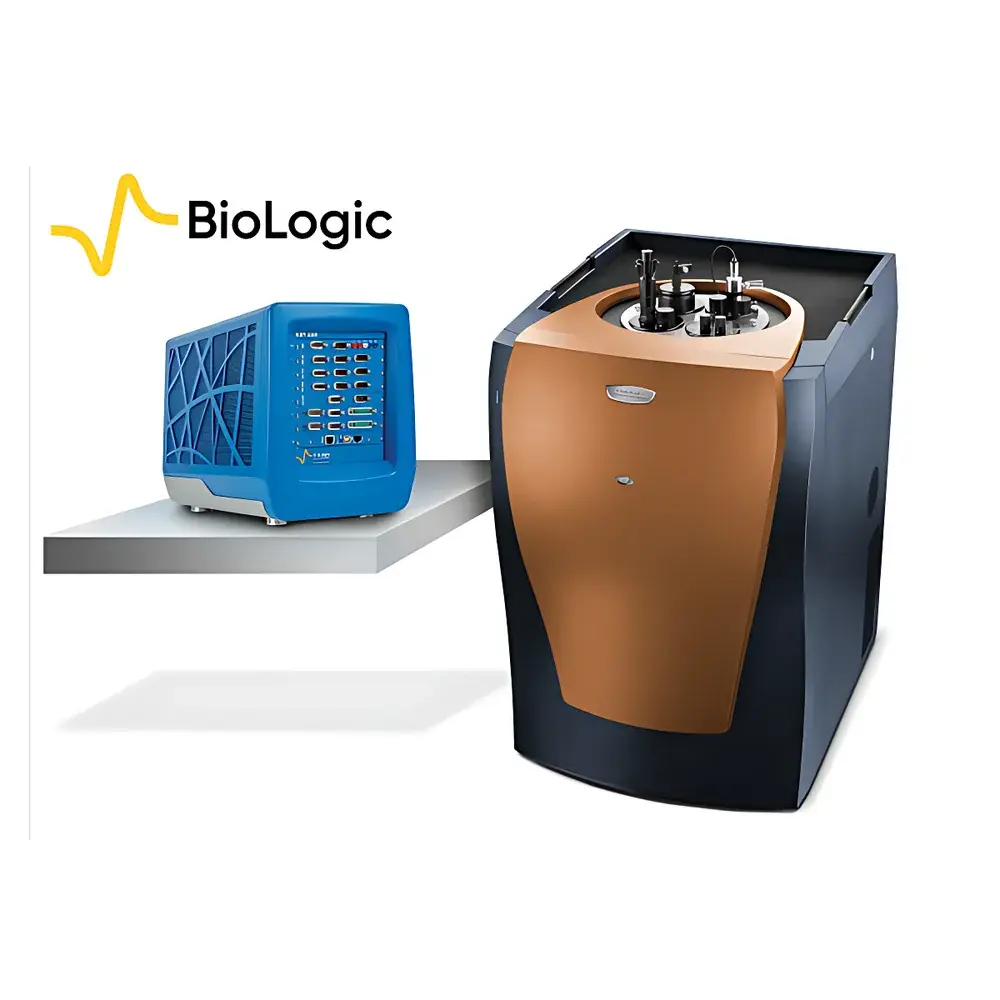
TA Instruments TAM IV+Biologic Battery Cycling Microcalorimetry Solution
| Brand | TA Instruments |
|---|---|
| Origin | USA |
| Manufacturer Type | Authorized Distributor |
| Origin Category | Imported |
| Model | TAM IV+Biologic |
| Pricing | Available Upon Request |
Overview
The TA Instruments TAM IV+Biologic Battery Cycling Microcalorimetry Solution is an integrated, high-precision platform engineered for real-time, isothermal microcalorimetric measurement of electrochemical heat flow during battery cycling. It combines the TAM IV isothermal microcalorimeter—based on highly sensitive thermopile-based heat-flow detection—with the Biologic VSP-300 potentiostat/galvanostat to enable synchronized acquisition of thermal and electrochemical signals (voltage, current, charge/discharge profiles) under identical experimental conditions. This dual-instrument architecture operates within a single unified software environment (TAM Assistant + EC-Lab), eliminating data alignment errors and enabling true multi-parameter correlation at milliwatt-level thermal resolution. Designed specifically for R&D laboratories focused on next-generation battery materials, aging mechanisms, and safety evaluation, the system supports quantitative analysis of parasitic reactions, coulombic inefficiencies, SEI formation enthalpies, and thermal runaway precursors—all under controlled temperature (±0.02 °C stability) and inert atmosphere (optional glovebox integration).
Key Features
- Simultaneous acquisition of heat flow (µW–mW range), voltage, current, and capacity data via synchronized TAM IV and Biologic VSP-300 hardware control.
- Real-time thermal-electrochemical overlay visualization: Preliminary heat evolution trends are available within minutes of test initiation—no post-run batch processing required.
- Modular, plug-and-play battery calorimetry fixtures designed for mechanical and electrical safety compliance; no custom OEM engineering or hazardous wiring modifications needed.
- High-throughput capability: Up to 12 independent battery cells monitored in parallel within a single TAM IV instrument block, significantly accelerating comparative studies across chemistries and cycling protocols.
- Thermal baseline stability 500 cycles).
- Fully compliant with ASTM E1970 (Standard Guide for Calorimetric Measurements) and aligned with ISO 11357-4 thermal analysis methodology frameworks.
Sample Compatibility & Compliance
The system accommodates three standard battery form factors without mechanical adaptation: coin cells (CR2032, CR2325), cylindrical cells (18650), and pouch cells (up to 50 mm × 94 mm). Each fixture type includes calibrated thermal interface materials, pressure-controlled cell clamping (0–500 N adjustable), and integrated current collectors compatible with Li-ion, Na-ion, solid-state, and lithium-metal chemistries. All fixtures meet UL 1642 and IEC 62133 mechanical safety requirements for lab-scale battery testing. The entire platform supports GLP-compliant operation, including full audit trails, user access levels, electronic signatures, and 21 CFR Part 11–ready data archiving when configured with optional TAM Cloud services.
Software & Data Management
Data acquisition and analysis occur within the unified TAM Assistant v5.x and EC-Lab v12.x software suite, deployed on Windows 10/11 platforms. The interface enables synchronized timeline-based event marking (e.g., “cycle #27, 100% SOC, rest period”), automatic calculation of cumulative reaction enthalpy per cycle, and export of time-stamped .csv/.xlsx files with metadata (temperature setpoint, ambient RH, operator ID, instrument serial numbers). Raw heat-flow data are stored in proprietary .tam format with embedded calibration coefficients and traceable NIST-traceable sensor references. Optional TAM Cloud provides secure, encrypted remote access, automated backup, and version-controlled experiment templates—supporting multi-site collaboration while maintaining data integrity per ISO/IEC 17025 documentation standards.
Applications
- Quantification of irreversible heat generation during SEI growth in silicon-anode or lithium-metal cells.
- Comparative assessment of electrolyte additive efficacy (e.g., FEC, LiDFOB) via reaction enthalpy suppression metrics.
- Early-stage thermal runaway screening using accelerated rate calorimetry (ARC)-informed stepwise temperature ramping combined with galvanostatic cycling.
- Validation of physics-based battery models (e.g., Newman-type P2D) through direct heat-source term parameterization.
- Quality control of electrode slurry formulations by correlating exothermic onset temperatures with binder decomposition kinetics.
- Support for DOE-funded projects requiring traceable calorimetric validation per US Department of Energy Vehicle Technologies Office (VTO) guidelines.
FAQ
Does the TAM IV+Biologic system require external cooling or heating circulators?
No—the TAM IV base unit integrates a solid-state Peltier temperature control system capable of stable operation from 15 °C to 60 °C without auxiliary chillers or baths.
Can the system measure heat flow during fast charging (e.g., >3C rates)?
Yes—thermal response time is < 30 s (90% rise), supporting accurate heat-flow capture up to 5C discharge/charge protocols with appropriate fixture thermal mass optimization.
Is raw heat-flow data exportable for third-party modeling tools (e.g., MATLAB, Python)?
Yes—all native .tam files include ASCII-export options with time-aligned thermal, voltage, current, and temperature columns in SI units.
How is calibration traceability maintained?
Each TAM IV sensor undergoes factory calibration against NIST-traceable reference heaters; calibration certificates are digitally embedded and automatically loaded upon instrument initialization.
What safety interlocks are implemented during pouch cell testing?
Fixture-level pressure sensors trigger immediate current cutoff and thermal shutdown if swelling exceeds 5% height increase; all circuits are galvanically isolated per IEC 61000-4-5 surge immunity standards.



