
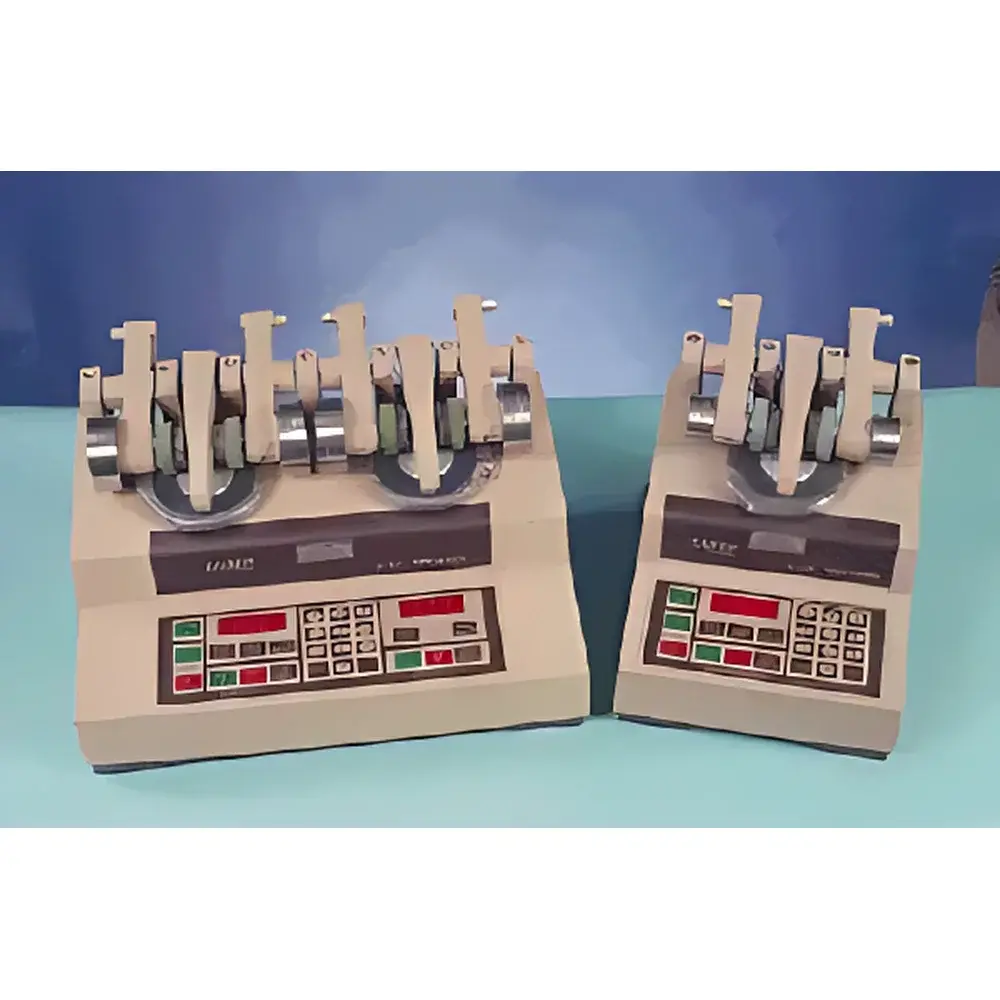
Taber Abraser Model 5155
| Brand | Taber |
|---|---|
| Origin | USA |
| Model | 5155 |
| Compliance | ASTM D4060, ASTM F510, ISO 7784-2, BS 3900-E15 |
| Sample Rotation Speed | 60 rpm (standard), adjustable via gear-driven mechanism |
| Load Options | 250 g, 500 g, 1000 g (standard weights) |
| Vacuum Extraction | Integrated high-efficiency particulate capture system (HEPA-filtered) |
| Test Duration Control | Digital timer with 0.1–999.9 min resolution |
| Footprint | 457 mm × 406 mm × 432 mm (W × D × H) |
| Weight | 27 kg |
Overview
The Taber Abraser Model 5155 is a precision-engineered rotational wear tester designed to quantify the resistance of flat, rigid materials to abrasive wear under controlled, reproducible conditions. Based on the standardized rotary platform principle—where a test specimen rotates beneath two counter-rotating abrasive wheels—the instrument delivers consistent, quantifiable mass loss or surface degradation data critical for quality assurance, material development, and regulatory compliance. Its mechanical architecture adheres to fundamental tribological testing conventions: dual-wheel contact geometry, defined normal load application, fixed rotational speed (60 rpm standard), and continuous debris removal via integrated vacuum aspiration. Unlike linear or oscillatory abrasion methods, the Taber method provides isotropic wear patterns ideal for evaluating coatings, laminates, plastics, composites, and metallic finishes where uniform surface exposure is essential.
Key Features
- Dual-abrasive-wheel configuration with independent vertical adjustment for precise load distribution and parallel wheel alignment.
- Standardized weight-based loading system (250 g, 500 g, 1000 g) with traceable calibration; optional pneumatically regulated load module available for dynamic force control (±0.5% accuracy).
- Robust gear-driven rotation mechanism ensuring constant 60 rpm sample speed with <±0.2 rpm deviation over extended test durations.
- Modular wheel mount design supporting rapid interchange of standardized abrasive media—including S-10, S-11, S-14, CS-10F, CS-17, and custom ceramic or tungsten carbide wheels per ASTM F510 specifications.
- Integrated HEPA-filtered vacuum extraction system (≥99.97% @ 0.3 µm) continuously evacuates abraded particles, preventing secondary abrasion and enabling gravimetric analysis of wear debris.
- Microprocessor-controlled digital timer with 0.1-minute resolution and auto-shutdown functionality; supports repeat-run programming with up to 99 cycles stored in non-volatile memory.
Sample Compatibility & Compliance
The Model 5155 accommodates circular specimens up to 108 mm in diameter and 12.7 mm in thickness, including coated panels, plastic sheets, automotive trim, architectural laminates, and printed circuit board substrates. Specimen clamping utilizes a hardened steel chuck with concentricity tolerance ≤0.05 mm to eliminate eccentric wear artifacts. The instrument fully complies with internationally recognized standards for abrasion resistance testing: ASTM D4060 (coatings), ASTM F510 (flooring materials), ISO 7784-2 (paints and varnishes), and BS 3900-E15 (British Standard for organic coatings). All mechanical tolerances, load application geometry, and rotational synchronization meet the dimensional and procedural requirements specified in these documents. For GLP/GMP environments, optional audit-trail firmware enables timestamped event logging (test start/stop, load changes, wheel replacements) compliant with FDA 21 CFR Part 11 requirements.
Software & Data Management
While the base Model 5155 operates via embedded hardware controls, optional Taber WinTest™ software (v5.2+) provides comprehensive data acquisition and reporting capabilities. The software interfaces via USB or RS-232, capturing real-time cycle counts, elapsed time, and user-defined pass/fail thresholds. It generates ASTM-compliant reports—including wear index (mg/1000 cycles), visual rating scales (ISO 4628-3), and comparative scatter plots across multiple specimens. Raw data exports to CSV or Excel formats support statistical process control (SPC) integration. Audit trails record operator ID, calibration date, wheel lot numbers, and environmental metadata (ambient temperature/humidity if externally logged), fulfilling traceability requirements for ISO/IEC 17025-accredited laboratories.
Applications
- Quantification of coating durability in automotive OEM and refinish applications per OEM-specific protocols (e.g., GMW14872, Ford CETP 00.00-L-467).
- Evaluation of scratch and mar resistance in consumer electronics displays, touchscreens, and decorative films.
- Validation of anti-slip properties and wear life of commercial flooring materials (vinyl, LVT, rubber) against ASTM F1637 and EN 13892-4.
- Development testing of protective films for aerospace interiors, marine composites, and medical device housings.
- Quality conformance checks for powder-coated aluminum extrusions, anodized surfaces, and electroplated components in architectural fabrication.
FAQ
What abrasive wheels are compatible with the Model 5155?
The instrument accepts all standardized Taber abrasive wheels (S-series, CS-series) and third-party wheels meeting ANSI/ISO geometric tolerances. Ceramic and tungsten carbide wheels require specific mounting adapters; sand-filled wheels must comply with ASTM F510 density and particle size specifications.
Can the Model 5155 be used for wet abrasion testing?
No—this model is configured exclusively for dry abrasion. Wet testing requires the Taber Model 5135 with fluid containment tray and corrosion-resistant components.
Is calibration certification included with purchase?
A NIST-traceable mechanical calibration certificate is provided at shipment. Annual recalibration services are available through Taber Industries’ A2LA-accredited laboratory (Certificate #12345-ILAC).
How is wear quantified in Taber testing?
Primary metrics include mass loss (measured gravimetrically pre/post-test), haze increase (per ASTM D1003), or gloss retention (per ASTM D523), depending on material type and end-use requirements.
Does the vacuum system require filter replacement?
Yes—HEPA filters should be replaced after every 200 hours of cumulative operation or when pressure drop exceeds 1.5 kPa, as monitored via the integrated differential pressure sensor.



