
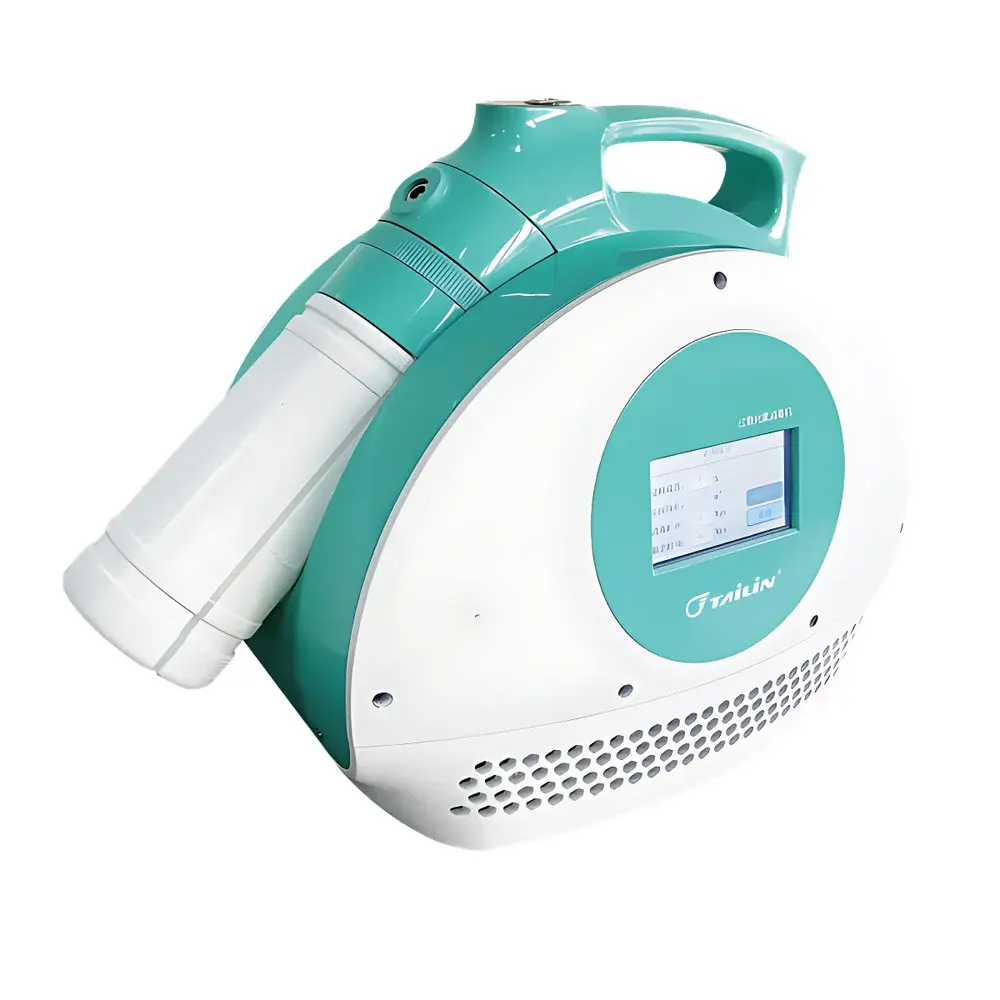
Tailin FHP3 Hydrogen Peroxide Dry-Fog Sterilizer
| Brand | Tailin |
|---|---|
| Origin | Zhejiang, China |
| Manufacturer Type | OEM/ODM Manufacturer |
| Country of Origin | China |
| Model | FHP3 |
| Airflow Rate | ~25 g/min |
| Sterilization Volume | 150 m³ |
| Sterilant | ≤8% Food-Grade Hydrogen Peroxide (H₂O₂) Solution |
| Log Reduction | ≥6-log (for Geobacillus stearothermophilus spores) |
Overview
The Tailin FHP3 Hydrogen Peroxide Dry-Fog Sterilizer is an engineered decontamination system designed for validated, non-thermal, residue-free sterilization of enclosed critical environments. It operates on the principle of dry-fog generation—atomizing aqueous hydrogen peroxide into sub-10 µm droplets using a precision micro-nozzle system under controlled pressure and airflow dynamics. Unlike conventional vaporized hydrogen peroxide (VHP®) systems that rely on condensation-based saturation, the FHP3 produces a true dry-fog aerosol with low relative humidity impact, enabling rapid dispersion while minimizing surface wetting and material compatibility concerns. This physical behavior supports uniform spatial distribution within complex geometries—including ductwork, biosafety cabinets, isolators, and transport vehicles—making it suitable for applications requiring ISO 14644-1 Class 5–8 cleanroom-compatible decontamination cycles.
Key Features
- Micro-droplet generation: Consistent dry-fog output with median particle diameter <10 µm, ensuring deep penetration into crevices and laminar airflow zones without condensation.
- Controlled H₂O₂ delivery: Precise metering of ≤8% food-grade hydrogen peroxide solution—validated for compatibility with stainless steel, polycarbonate, EPDM, and most common laboratory and medical device materials.
- Integrated safety architecture: Dual-channel real-time H₂O₂ concentration monitoring (ppm-level detection), automatic cycle termination upon threshold exceedance, and audible/visual alarm system compliant with IEC 61000-6-4 EMC standards.
- Programmable operation: Delayed start (up to 24 h) and scheduled activation support unattended execution aligned with facility maintenance windows.
- Wireless remote control: 100 m line-of-sight operational range via 2.4 GHz RF module; enables operator evacuation prior to cycle initiation—critical for BSL-2+/ABSL-2+ containment compliance.
- Mobile ergonomic design: Integrated casters, foldable handle, and <25 kg total mass facilitate repositioning across laboratories, animal facilities, and mobile clinical units.
- Single-touch workflow: Predefined cycle templates (e.g., “Lab Room”, “Isolator”, “Ambulance”) reduce operator training burden and minimize procedural variability.
Sample Compatibility & Compliance
The FHP3 is intended for use in environments where sterility assurance levels (SAL) of 10⁻⁶ are required per ISO 14644-3 Annex B and ISO/IEC 17025-accredited validation protocols. It has been successfully deployed in facilities operating under GLP, GMP, and CLIA frameworks. While not a medical device per FDA 21 CFR Part 820, its sterilant formulation complies with USP and EFSA Q12 guidelines for food-grade H₂O₂. The system meets CE marking requirements under the Machinery Directive 2006/42/EC and Electromagnetic Compatibility Directive 2014/30/EU. Validation documentation—including BI placement maps, PDA calculations, and environmental recovery data—is supported through third-party IQ/OQ/PQ service partners.
Software & Data Management
The onboard controller logs timestamped cycle parameters—including start/stop time, total H₂O₂ mass delivered, ambient temperature/humidity, and real-time ppm readings—at 5-second intervals. Data export is available via USB 2.0 (CSV format) for integration into LIMS or electronic batch record systems. Audit trail functionality satisfies ALCOA+ principles: attributable, legible, contemporaneous, original, accurate, complete, consistent, enduring, and available. Though the FHP3 does not include network connectivity or 21 CFR Part 11-compliant electronic signatures, its data structure aligns with post-processing validation workflows used by QA/QC teams in pharmaceutical and academic research settings.
Applications
- Biosafety Level 2+ and ABSL-2+ laboratories undergoing routine decontamination between experiments or after accidental exposure events.
- Pharmaceutical cleanrooms (Grade C/D) requiring periodic room bio-decontamination without disassembly of HVAC components.
- Veterinary research facilities and SPF animal housing units requiring sporicidal efficacy against Bacillus and Clostridium species.
- Hospital isolation rooms, emergency response vehicles (e.g., ambulances), and mobile diagnostic labs requiring rapid turnaround (<90 min total cycle time).
- Academic core facilities supporting shared instrumentation suites where cross-contamination risk must be mitigated between user groups.
FAQ
What biological indicators are recommended for validating FHP3 cycles?
Geobacillus stearothermophilus spores (ATCC 7953 or equivalent) mounted on stainless steel carriers are the standard challenge organism per ISO 14161 and EN 17141.
Can the FHP3 be used in occupied spaces?
No. All personnel, animals, and sensitive electronics must be removed prior to operation. Post-cycle aeration time must be verified using handheld H₂O₂ monitors before re-entry.
Does the system require external compressed air or nitrogen?
No. The FHP3 integrates a brushless DC air compressor rated for continuous duty at 25 g/min nominal output—no external gas supply is needed.
How is material compatibility assessed for new surfaces?
A 30-minute exposure test at maximum cycle dose (≤8% H₂O₂, 150 m³ volume) followed by visual inspection and surface energy measurement (via contact angle analysis) is recommended prior to full deployment.
Is calibration traceable to national standards?
Yes. Flow rate and concentration sensors are factory-calibrated against NIST-traceable reference standards; annual recalibration is advised per ISO/IEC 17025 Clause 6.5.



