
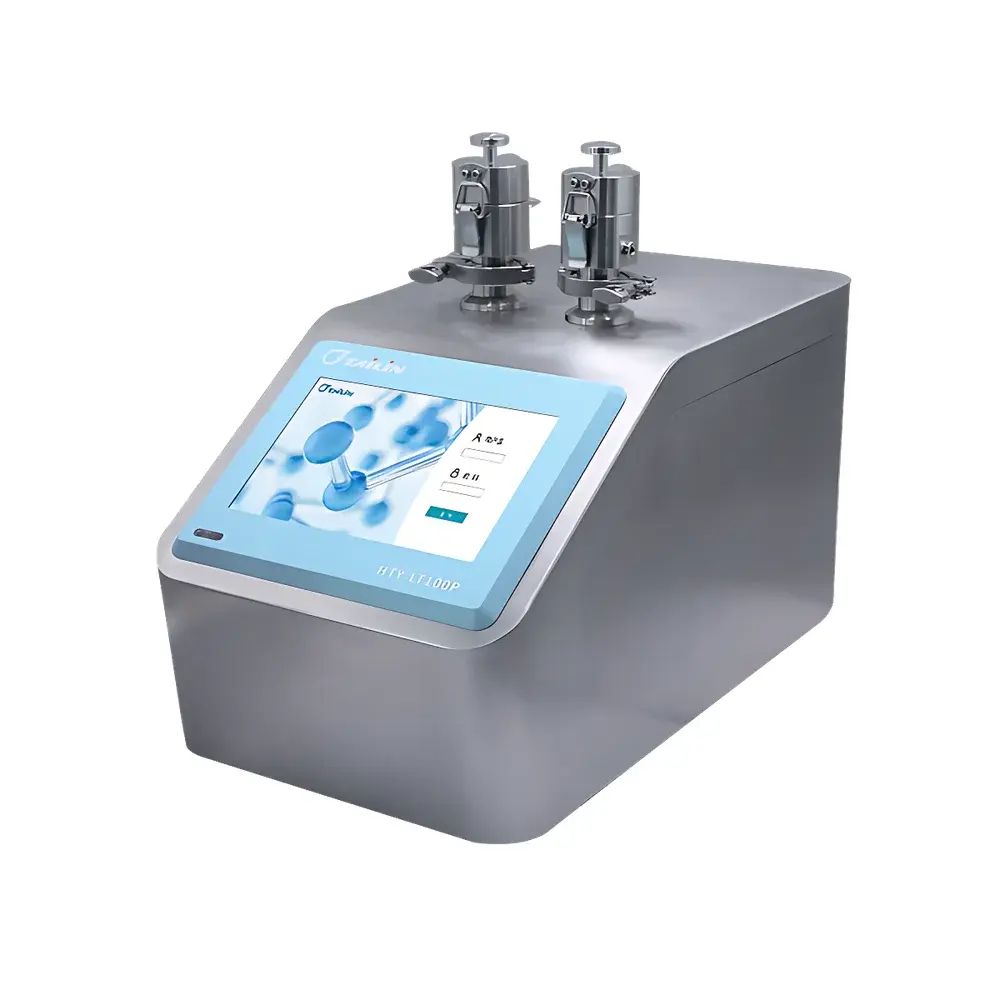
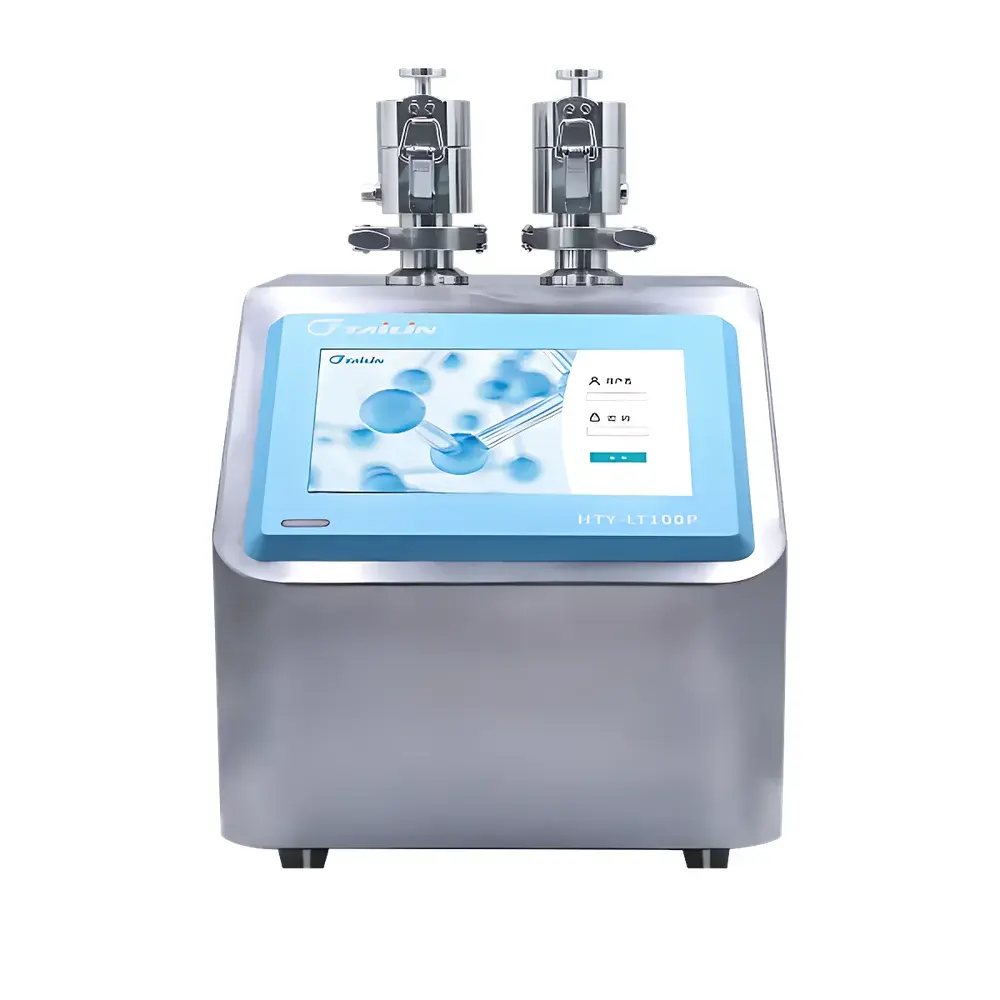
Tailin HTY-LT100P Vacuum & Pressure Decay Integrity Tester for Pharmaceutical Packaging
| Brand | Tailin |
|---|---|
| Origin | Zhejiang, China |
| Manufacturer Type | Direct Manufacturer |
| Origin Category | Domestic (China) |
| Model | HTY-LT100P |
| Pricing | Upon Request |
| Test Methods | Vacuum Decay & Pressure Decay |
| Detection Sensitivity | 1–2 µm (rigid containers), 5–10 µm (flexible packaging) |
| Differential Pressure Resolution | 0.01 Pa |
| Operating Temperature Range | 10–30 °C |
| Relative Humidity Limit | <65 % RH |
| Dimensions | 550 mm × 320 mm × 320 mm |
| Throughput | 2–3 samples/min |
| Chamber Configuration | Dual-symmetric, customizable test chambers |
Overview
The Tailin HTY-LT100P is a fully automated, dual-chamber vacuum and pressure decay integrity tester engineered for deterministic, non-destructive evaluation of package seal integrity in sterile pharmaceutical manufacturing. It operates on the physical principles of gas law-based leak quantification—measuring minute changes in differential pressure over time within a sealed test chamber to infer leakage rates. Unlike probabilistic dye ingress or microbial challenge methods, the HTY-LT100P delivers quantitative, repeatable results traceable to SI units, supporting regulatory alignment with ASTM F2338–22 (Standard Test Method for Nondestructive Detection of Leaks in Packages by Vacuum Decay Method) and ISO 11607–2:2019 (Packaging for terminally sterilized medical devices). Designed specifically for lyophilized vials, pre-filled syringes, blister packs, pouches, and flexible IV bags, the system enables objective pass/fail assessment without compromising product sterility or requiring destructive sampling.
Key Features
- Dual-symmetric chamber architecture: Two geometrically identical, thermally coupled chambers ensure matched thermal mass, volume, and flow path geometry—minimizing drift-induced error and enabling real-time differential measurement that cancels common-mode environmental fluctuations.
- High-resolution differential pressure sensing: Integrated 0.01 Pa resolution transducers enable detection of sub-micron leaks in rigid containers (1–2 µm equivalent orifice) and robust sensitivity for flexible formats (5–10 µm), validated per ASTM F3251–21 for flexible packaging.
- Multi-modal test protocol support: Configurable vacuum decay, pressure decay, and combined ramp-hold-decay sequences accommodate diverse packaging materials—including aluminum-laminated foils, multilayer coextrusions, and elastomeric stoppers—without method revalidation.
- Non-invasive, non-destructive operation: No tracer gases, dyes, or microbial indicators required; no sample preparation, disassembly, or post-test quarantine needed—preserving batch integrity and reducing QA labor burden.
- Customizable chamber inserts: Modular, CNC-machined chamber liners allow rapid adaptation to irregular geometries (e.g., oval trays, nested syringe carriers, or oversized pouch stacks), maintaining consistent test volume and sensor calibration fidelity.
- Environmental compensation logic: Real-time monitoring of ambient temperature (10–30 °C operational window) and relative humidity (<65 % RH) triggers dynamic correction algorithms to mitigate vapor-phase interference and thermal expansion artifacts.
Sample Compatibility & Compliance
The HTY-LT100P supports primary packaging across biologics, small molecules, and cell/gene therapy products—including glass and polymer vials, rubber-stoppered cartridges, peelable foil blisters, Tyvek-backed pouches, and polyolefin-based IV bags. All test methods comply with USP <1207> “Package Integrity Evaluation – Sterile Products” guidance and align with FDA expectations for CCIT (Container Closure Integrity Testing) as described in the 2022 draft guidance “Sterile Drug Products Produced by Aseptic Processing — Current Good Manufacturing Practice (CGMP).” System validation documentation includes IQ/OQ/PQ protocols compliant with Annex 1 (2022) and EU GMP Part I, Chapter 4. Data integrity conforms to 21 CFR Part 11 requirements via electronic signatures, audit trails, and role-based access control.
Software & Data Management
Controlled via Tailin IntegritySuite™ v3.2 software, the HTY-LT100P provides full lifecycle data governance: automated method storage, user-defined pass/fail thresholds, trend analysis across batches, and export-ready reports in PDF/A-1b and CSV formats. The software embeds ALCOA+ principles—ensuring data is Attributable, Legible, Contemporaneous, Original, Accurate, Complete, Consistent, Enduring, and Available. Audit trails record all parameter changes, user logins, and result overrides with timestamped, immutable entries. Optional integration with LIMS (via ASTM E1578-compliant API) and MES systems enables seamless batch record linkage and electronic batch release workflows.
Applications
- Final container closure verification for lyophilized drug products prior to release
- Stability study support—CCIT monitoring at accelerated and real-time intervals
- Process validation of stopper seating, crimping, and heat-sealing operations
- Root cause analysis of packaging-related sterility failures during investigations
- Comparative evaluation of alternative packaging materials or supplier components
- Supporting Quality Risk Management (ICH Q9) through quantitative leak rate trending
FAQ
What regulatory standards does the HTY-LT100P support?
It complies with ASTM F2338–22, ISO 11607–2:2019, USP <1207>, and FDA CGMP expectations for deterministic CCIT.
Can the system validate both rigid and flexible packaging in one run?
No—test parameters (vacuum level, hold time, decay threshold) must be optimized per packaging type; however, method switching is software-controlled and requires no hardware modification.
Is environmental monitoring integrated into the test sequence?
Yes—ambient temperature and humidity are continuously logged and factored into pressure decay compensation algorithms.
Does the dual-chamber design require paired samples for every test?
No—the reference chamber may operate empty or with a known-negative control; symmetry ensures optimal sensor linearity regardless of sample configuration.
How is system performance verified between runs?
Built-in leak standard verification (LSV) mode uses NIST-traceable orifice discs (1 µm, 5 µm, 10 µm) for daily performance qualification per ASTM F3251–21.





