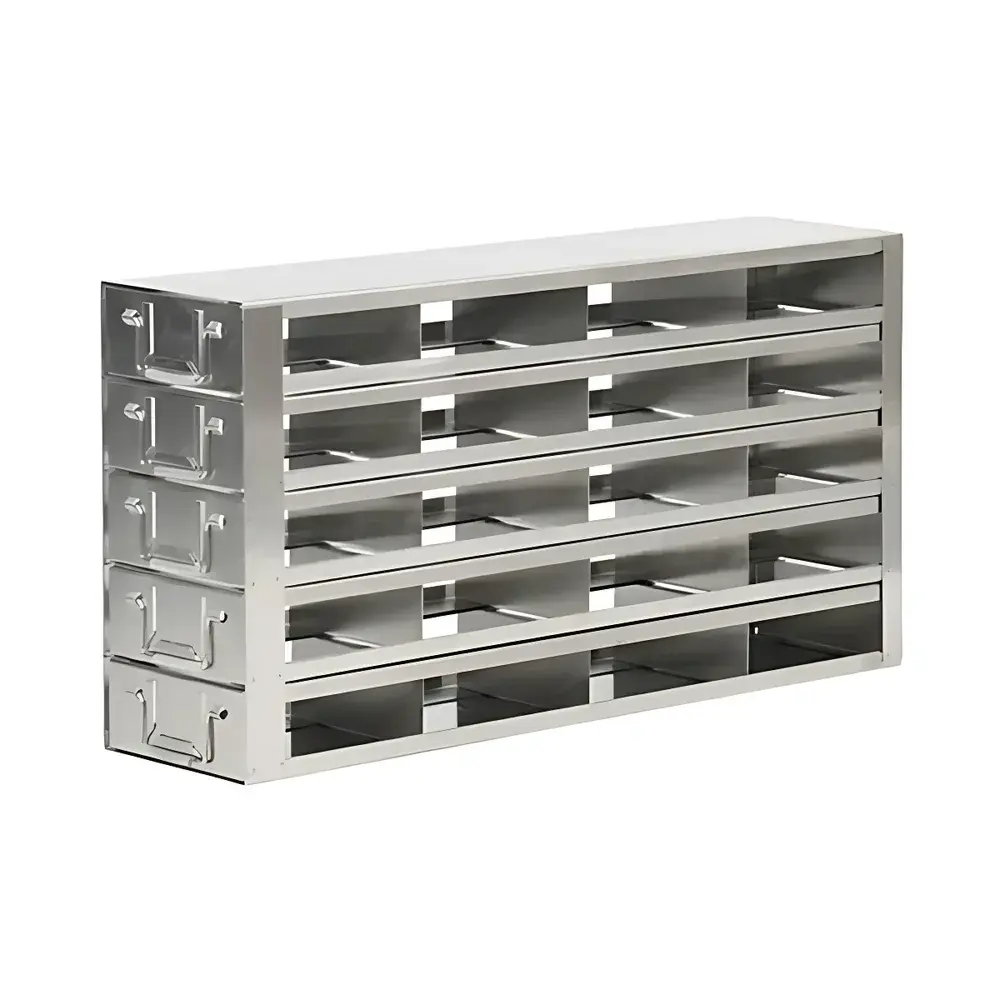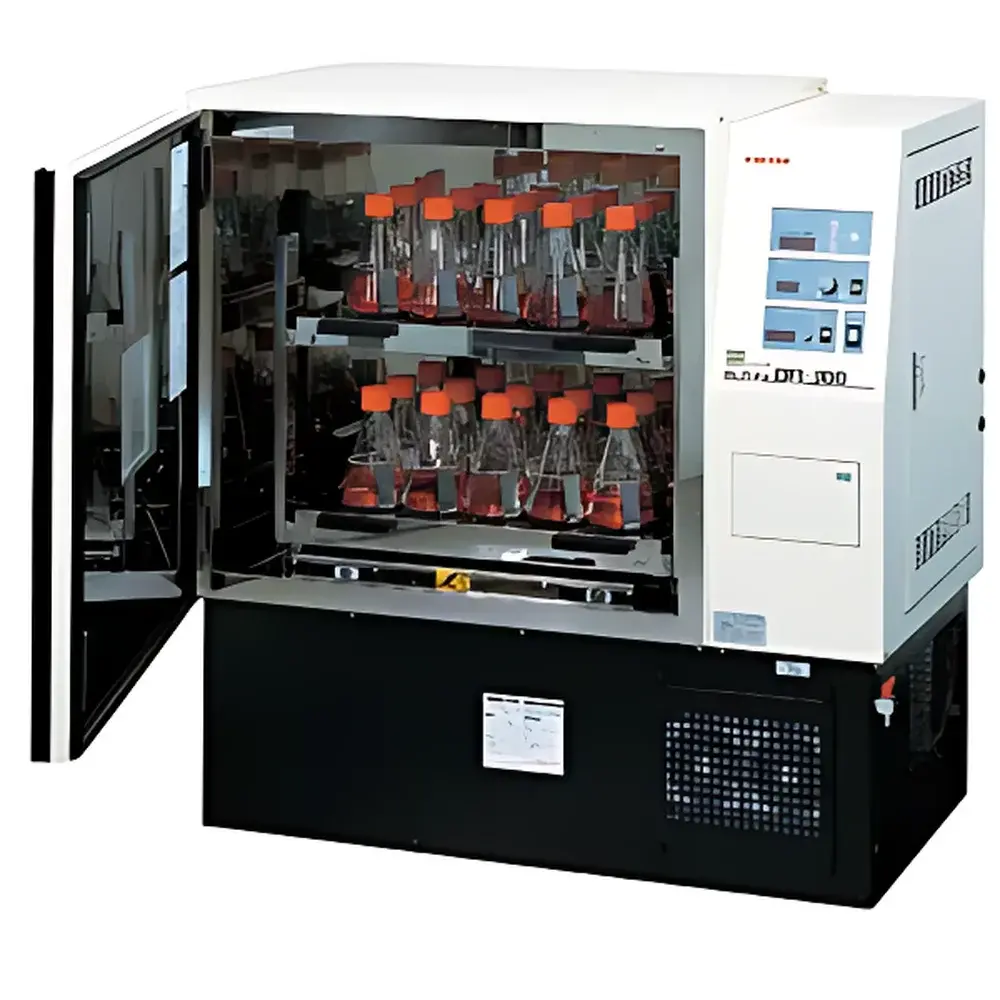
TAITEC BR-300 Dual-Layer Temperature-Controlled Orbital Shaker Incubator
| Brand | TAITEC |
|---|---|
| Origin | Japan |
| Model | BR-300 / BR-300LF |
| Oscillation Mode | Reciprocating or Orbital (Switchable) |
| Speed Range | 25–160 rpm |
| Amplitude | 10–50 mm (adjustable) |
| Temperature Range | +10°C to +70°C (BR-300), +4°C to +70°C (BR-300LF) |
| Platform Dimensions | 600 × 400 mm |
| Internal Height | 575 mm |
| Load Capacity | ~10 kg per shelf (excl. platform) |
| Display | Digital (dual-mode: set temp / chamber temp) |
| Heating | 700 W heater |
| Cooling | Circulating chiller (BR-300) or built-in compressor (125 W, BR-300LF) |
| Timer Function | Cumulative oscillation time (0.1–999.9 h, auto-reset) |
| Safety Features | Leakage/overcurrent breaker, high-temp cutoff (compressor circuit), sensor fault diagnostics, deviation alarm (upper/lower limits) |
| Compliance | Designed for GLP-compliant labs |
| Power Supply | AC 100 V, 8 A (BR-300), 11 A (BR-300LF) |
| Net Weight | 210 kg (BR-300), 220 kg (BR-300LF) |
| Dimensions (W×D×H) | 1110 × 682 × 1120 mm |
Overview
The TAITEC BR-300 is a high-capacity, dual-layer temperature-controlled orbital shaker incubator engineered for demanding microbiological and cell culture applications requiring precise thermal regulation and reproducible mechanical agitation. Unlike single-tier shakers, the BR-300 integrates two independently accessible oscillating platforms within a fixed footprint—effectively doubling volumetric throughput without expanding laboratory floor space. Its core operation relies on a switchable reciprocating-orbital motion drive system, enabling users to select the optimal agitation profile for sensitive cultures (e.g., insect or yeast cells) or high-density bacterial growth (e.g., E. coli in 1 L flasks). The unit maintains temperature stability across its full operating range (+10°C to +70°C for BR-300; +4°C to +70°C for BR-300LF) via PID-controlled heating and either external chilled-water circulation (ZL-100/EL-8F) or integrated compressor-based cooling. This architecture supports continuous, unattended operation under ISO/IEC 17025-aligned environmental monitoring protocols.
Key Features
- Dual-layer oscillating platforms (600 × 400 mm each) with independent access via front-mounted slide-out mechanism—enabling rapid flask loading/unloading and minimizing workflow interruption.
- Switchable oscillation mode: user-selectable reciprocating or orbital motion, both operable up to 160 rpm—critical for optimizing oxygen transfer in aerobic fermentations or minimizing shear stress in suspension-adapted mammalian cells.
- Continuously adjustable amplitude (10–50 mm) calibrated via precision linear actuator—ensuring consistent energy input across vessel sizes from 50 mL tubes to 5 L flasks.
- Digital dual-display interface showing both setpoint and real-time chamber temperature—supports traceable calibration verification per ASTM E2877-22 guidelines.
- Integrated cumulative runtime counter (0.1–999.9 h) with auto-reset function—essential for batch record compliance in GMP manufacturing environments.
- Comprehensive safety architecture including leakage current protection, compressor overtemperature cutoff (BR-300LF), sensor fault self-diagnosis, and upper/lower deviation alarms—aligned with IEC 61010-1 safety standards for laboratory equipment.
Sample Compatibility & Compliance
The BR-300 accommodates a broad spectrum of primary culture vessels via interchangeable platforms: standard MT-6040E clamp trays (supporting 50 mL–5 L Erlenmeyer flasks), MR-4030L spring-grid platforms (for test tubes, centrifuge tubes, and irregularly shaped containers), and application-specific angle racks (AT-series for tubes, AF-series for flasks). Maximum configuration supports 70 × 50 mL flasks per shelf—or 18 × 1 L flasks per shelf (total 36 per unit). All accessories are mechanically secured to prevent displacement during high-amplitude operation. The system meets structural requirements for ISO 13485-certified bioprocess development labs and operates within ambient conditions specified by USP for controlled-environment microbiological testing. When configured with PU-5 or PU-6 programmable controllers, it supports electronic record integrity per FDA 21 CFR Part 11 through configurable audit trails, electronic signatures, and data export in CSV/Excel formats.
Software & Data Management
While the BR-300 operates as a standalone instrument, its optional PU-5 and PU-6 program controllers extend functionality into regulated data acquisition domains. PU-5 enables remote temperature programming with two 8-segment ramp-soak profiles and time-stamped event logging. PU-6 adds oscillation ON/OFF scheduling—requiring minor hardware modification of the BR-300’s control board—and synchronizes thermal and mechanical parameters into unified execution sequences. Both units store historical setpoints and deviations, generating timestamped logs compatible with LIMS integration. Data export adheres to ALCOA+ principles (Attributable, Legible, Contemporaneous, Original, Accurate), supporting retrospective review during regulatory inspections. Firmware updates are performed via secure USB interface with version-locking to ensure configuration consistency across multi-unit deployments.
Applications
- High-yield microbial cultivation: scalable E. coli expression systems requiring uniform aeration across >30 L total working volume per unit.
- Low-temperature yeast and psychrophilic bacterial propagation—enabled by BR-300LF’s compressor-cooled operation down to +4°C.
- Insect cell line maintenance (e.g., Sf9, High Five) where orbital motion minimizes membrane shear versus reciprocating agitation.
- Media preparation and solubility studies under controlled thermal-agitation conditions (e.g., polymer dissolution kinetics).
- Environmental simulation: long-term stability testing of biologics under accelerated temperature-cycling protocols.
- Bioreactor seed train expansion—serving as a bridge between shake-flask screening and benchtop bioreactor inoculation.
FAQ
What is the maximum flask size supported on the upper shelf?
The upper shelf accommodates flasks up to 2 L in height; 3 L and 5 L vessels require removal of the upper platform to utilize the full 575 mm internal height on the lower shelf.
Can the BR-300 operate continuously at 4°C?
Only the BR-300LF model supports sustained operation at +4°C via its built-in compressor; the standard BR-300 requires external chiller integration and is subject to frost accumulation above +10°C ambient.
Is the amplitude adjustment mechanically or electronically controlled?
Amplitude is adjusted manually via calibrated micrometer-style knob linked to eccentric cam mechanism—ensuring repeatable, drift-free positioning without reliance on servo feedback.
Does the system support validation documentation packages?
Yes—TAITEC provides IQ/OQ protocol templates compliant with Annex 15 and EU GMP guidance; installation qualification includes thermocouple mapping (15-point grid) and speed calibration per ISO 17025-accredited methodology.
How is vibration isolation achieved at high speeds?
The base frame incorporates constrained-layer damping plates and elastomeric mounting bushings tuned to suppress resonant frequencies below 25 Hz—verified via FFT analysis per ISO 20816-1.