
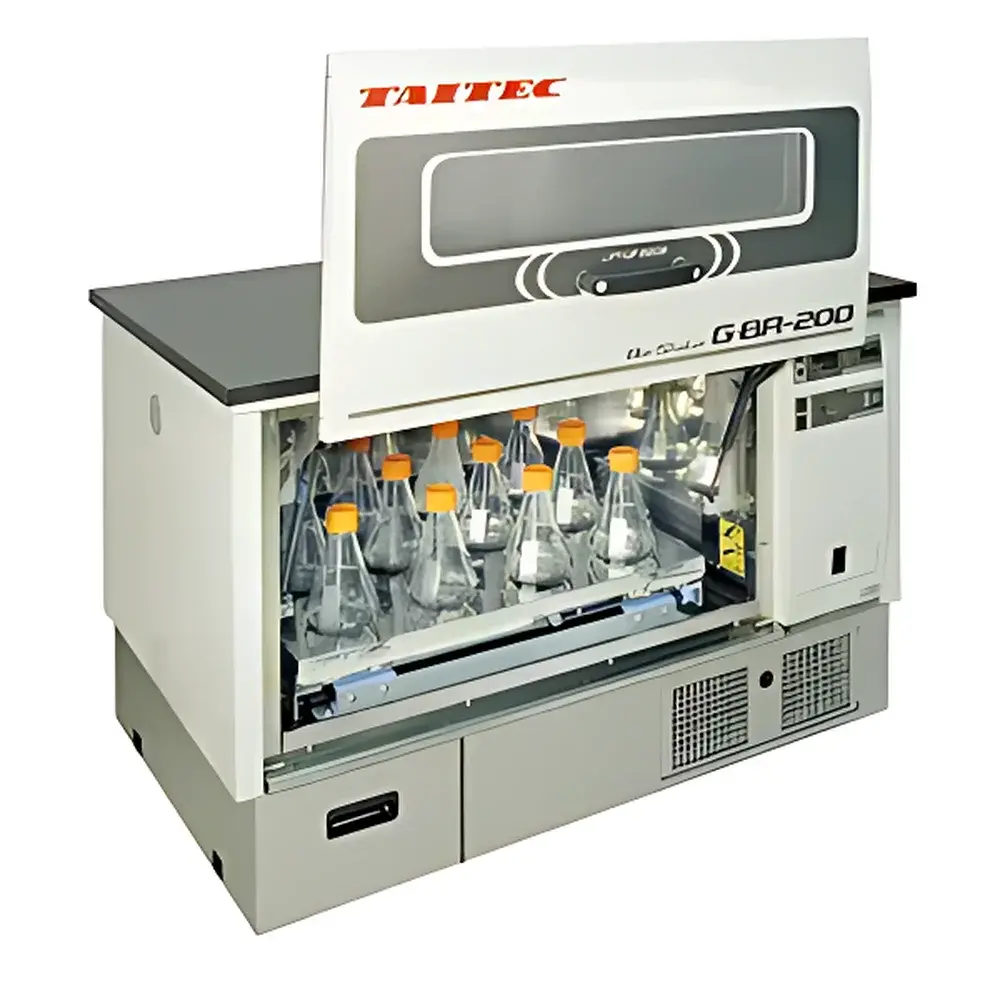
TAITEC G·BR-200 Large-Scale Refrigerated Orbital/Reciprocating Incubator Shaker
| Brand | TAITEC |
|---|---|
| Origin | Japan |
| Model | G·BR-200 / G·BR-300 |
| Oscillation Frequency | 25–300 rpm |
| Oscillation Amplitude | Switchable 25 mm / 50 mm |
| Temperature Range | +4°C to +80°C |
| Platform Dimensions | 700 × 500 mm |
| Max. Capacity | 96 × 50 mL Erlenmeyer flasks (on MT-7050 platform) |
| Temperature Control Accuracy | ±0.3°C to ±1.0°C |
| Heating Power | 700 W |
| Compressor Cooling Power | 125 W |
| Power Supply | AC 100 V, 12 A |
| Net Weight | ~235 kg |
| External Dimensions (H×W×D) | 1200 × 800 × 810 mm |
| Safety Features | Over-temperature/over-current protection, compressor overheat cutoff, door-open detection, motor runaway detection, non-volatile memory error monitoring, filter check indicator |
| Programmable Memory | 4 programs × 9 steps |
| Energy Efficiency | ~25% lower power consumption vs. prior-generation units under equivalent thermal load |
Overview
The TAITEC G·BR-200 is a high-capacity, refrigerated incubator shaker engineered for precision-controlled microbial and cell culture applications requiring simultaneous temperature regulation and mechanical agitation. Designed around a dual-mode oscillation system—switchable between orbital and reciprocating motion—the instrument delivers reproducible mixing dynamics essential for aerobic growth of Escherichia coli, yeast, psychrophilic bacteria, insect cells, and other suspension-based biological systems. Its thermally insulated chamber integrates a high-efficiency compressor-based cooling system and PID-controlled resistive heating, enabling stable operation from +4°C (refrigerated) to +80°C (incubation), with temperature accuracy maintained within ±0.3°C to ±1.0°C across the full range. The unit’s structural architecture supports vertical stacking (up to two tiers, total height ≤113 cm), optimizing floor space in core facilities while maintaining ergonomic accessibility—particularly for users of varying stature. Unlike conventional air-bath shakers relying solely on convection, the G·BR-200 employs active refrigeration combined with intelligent thermal load management: when ambient temperature exceeds setpoint by approximately 9°C, the compressor disengages and the system transitions to passive heat-dissipation mode, reducing energy draw by up to 25% without compromising process continuity.
Key Features
- Dual-Mode Oscillation System: Selectable orbital or reciprocating motion via front-panel interface; amplitude configurable at 25 mm or 50 mm (factory-set to 25 mm; 50 mm conversion requires service support).
- Energy-Optimized Thermal Management: Adaptive cooling logic minimizes compressor runtime; achieves ~25% lower power consumption versus legacy models under identical operational loads.
- Ergonomic Uplift Door Design: Vertically opening lid extends only 30 cm forward—ideal for constrained lab layouts—while preserving full access to the pull-out oscillation platform.
- Stackable Modular Architecture: Certified for safe two-tier configuration (G·BR-200 + G·BR-200 or G·BR-200 + G·BR-300); includes wall-mounting hardware kit (supplied free with stacked orders).
- Real-Time Anomaly Detection: Integrated vibration sensor triggers immediate oscillation halt upon detection of abnormal mechanical resonance or impact event; maintains uninterrupted temperature control and activates visual alarm.
- Programmable Multi-Step Protocols: Stores up to four independent programs, each containing nine user-defined steps; each step independently assigns temperature, speed, duration (00h00m–99h59m), and enables post-setpoint activation (“temperature gradient” mode).
Sample Compatibility & Compliance
The G·BR-200 accommodates diverse vessel formats through interchangeable platforms—including the standard MT-7050 claw-type platform (supporting up to 96 × 50 mL Erlenmeyer flasks), MR-4030L spring-mesh adaptors (for tubes and irregular containers), and specialized angle racks (AT-series) for centrifuge tubes, round-bottom flasks, and disposable bioreactors. All platforms are mechanically secured to prevent lateral displacement during high-speed operation (up to 300 rpm). The system complies with IEC 61010-1:2010 for laboratory equipment safety and incorporates redundant safeguards aligned with GLP/GMP environmental monitoring requirements: dual independent temperature sensors, non-volatile parameter retention, electronic audit trail logging (via optional software integration), and configurable high/low temperature alarms with user-defined thresholds. While not FDA 21 CFR Part 11–certified out-of-the-box, its programmable memory, password-protected settings, and event-triggered log entries provide foundational traceability suitable for regulated QC environments.
Software & Data Management
The G·BR-200 operates via an embedded microcontroller with digital LED display and tactile membrane keypad—no external PC required for basic operation. For advanced data handling, optional connectivity modules enable RS-232 or USB-to-serial interfaces compatible with TAITEC’s OD-Monitor series and third-party SCADA platforms. Logged parameters include real-time temperature, actual rpm, elapsed time per step, anomaly events (e.g., door open, vibration stop, compressor fault), and calibration history. Data export is supported in CSV format for downstream analysis in MATLAB, Python (Pandas), or LIMS systems. Firmware updates are performed via USB flash drive; all configuration changes are timestamped and stored in non-volatile memory with write-protection against accidental overwrite. Audit-ready features include operator ID tagging (when integrated with network authentication), change-log archiving, and tamper-evident event flags—facilitating alignment with ISO/IEC 17025 documentation standards.
Applications
- Microbial Fermentation: High-density cultivation of E. coli BL21(DE3) and related expression strains under tightly controlled dissolved oxygen conditions enabled by orbital shaking at 200–300 rpm.
- Yeast & Filamentous Fungal Culture: Reciprocating motion at 25–150 rpm optimizes mycelial dispersion and nutrient homogenization in Saccharomyces cerevisiae and Aspergillus spp. cultivations.
- Insect Cell Expansion: Gentle 25–100 rpm agitation at 27°C supports adherent-to-suspension transition in Sf9 and High Five™ lines without shear-induced apoptosis.
- Low-Temperature Enzyme Assays: Stable +4°C operation enables long-duration kinetic studies of cold-adapted proteases and lipases in buffered suspension.
- Bioprocess Development: Parallel screening of media formulations using multi-step temperature ramps (e.g., 37°C → 25°C shift for recombinant protein folding optimization).
FAQ
What is the maximum recommended load for the MT-7050 platform?
The MT-7050 platform supports up to 10 kg gross weight (excluding platform mass); verified capacity includes 96 × 50 mL Erlenmeyer flasks or 4 × 5 L vessels.
Can the G·BR-200 operate continuously at +4°C in humid environments?
Yes, but periodic manual defrosting is required during extended low-temperature runs to prevent frost accumulation that may affect temperature uniformity and control accuracy.
Is wall anchoring mandatory for single-unit installation?
Wall anchoring is not mandatory for standalone use, but strongly recommended in seismic zones or high-traffic labs; included hardware enables secure attachment to structural studs.
How does the “temperature gradient” function operate?
This mode initiates oscillation only after the chamber reaches the target temperature—preventing thermal shock to cultures during ramp-up; it does not control the rate of temperature change.
Are replacement parts like claw clamps available as consumables?
Yes—TAITEC supplies CF-series clamps (CF-0050 to CF-5000), SF-series round-bottom adapters, and AT-series tube racks as field-replaceable components with documented compatibility matrices.




