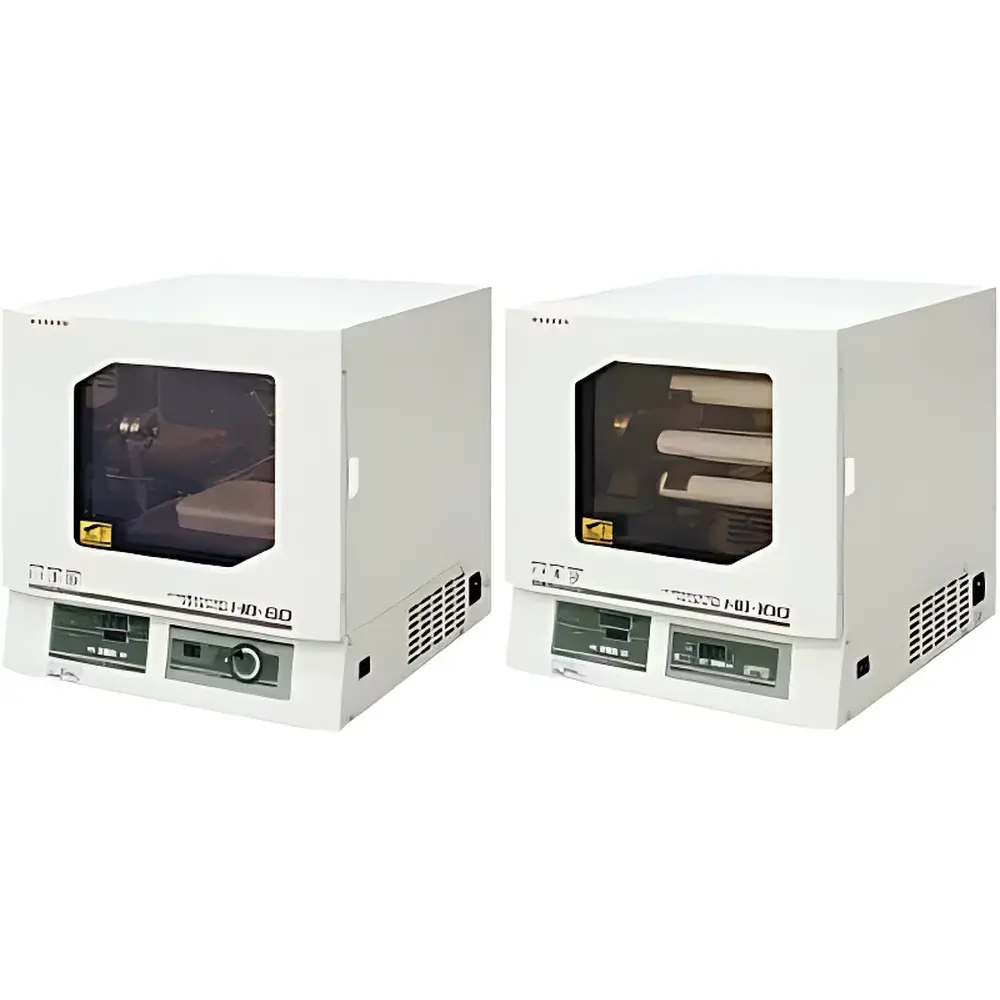
TAITEC HB-80 Molecular Hybridization Oven with Programmable Rocking, Reciprocating, Rolling & Inversion Agitation
| Brand | TAITEC |
|---|---|
| Origin | Japan |
| Model | HB-80 |
| Temperature Range | Ambient +8°C to 80°C |
| Temperature Uniformity | ±0.1°C |
| Agitation Speed | 5–60 rpm |
| Agitation Modes | Rocking (4 tilt angles), Reciprocating (4 amplitudes), Rolling (8-bottle capacity), Tube Inversion (96 × 1.5/2.0 mL microtubes) |
| Heating Power | 300 W |
| Display | Digital LED |
| Safety Features | Dual overheat protection, motor overload cutoff, voltage/current surge protection, temperature controller self-diagnosis, sensor fault indication |
| Dimensions (W×D×H) | 425 × 445 × 445 mm |
| Weight | ~30 kg |
| Power Supply | AC 100 V, 4 A |
Overview
The TAITEC HB-80 Molecular Hybridization Oven is a precision-engineered thermal agitation platform designed for controlled nucleic acid hybridization, post-electrophoresis membrane processing (e.g., Southern/Northern blotting), high-temperature enzymatic reactions, and thermophilic microbial culture. Unlike static incubators, the HB-80 integrates programmable mechanical agitation—based on Couette flow principles and optimized fluid dynamics—to ensure uniform reagent contact across membranes, gels, or suspension cultures under precisely regulated thermal conditions. Its core architecture employs a dual-zone heating system with forced-air circulation and semi-jacketed chamber insulation, enabling stable setpoint maintenance within ±0.1°C across the full operating range (ambient +8°C to 80°C). This level of thermal fidelity meets critical requirements for probe hybridization stringency control—particularly for DNA probes (typically 45°C) and RNA probes (typically 55°C)—as well as stringent wash protocols at 65°C. The unit’s modular design supports GLP-compliant workflow scalability without compromising reproducibility.
Key Features
- Four interchangeable agitation modalities: rocking (7°/8°/11°/15° tilt), reciprocating (18/25/30/40 mm amplitude), rolling (8-bottle configuration), and tube inversion (96-position microtube rack)
- Tool-free platform exchange: installation requires only two steps—”insert” and “connect”—minimizing setup time and operator error
- Stackable chassis design: up to three units can be vertically integrated (total height ≈ 135 cm), optimizing bench space in high-throughput labs
- Dual safety architecture: independent thermal fuses, heater overtemperature cutoff, motor current-limiting circuitry, and real-time sensor diagnostics (HB-100 variant adds maintenance alert logic)
- 300 W high-efficiency heating element with airflow optimization for rapid thermal equilibration and minimal gradient formation
Sample Compatibility & Compliance
The HB-80 accommodates diverse sample formats through vendor-certified accessory kits—including hybridization bags, plastic rectangular trays (e.g., for antibody staining), L-shaped test tubes (φ18 × 120 × 70 mm, 16 per rack), roller bottles (8 × standard hybridization bottles), and microcentrifuge tubes (96 × 1.5/2.0 mL). Its agitation geometry ensures laminar fluid motion during rocking and reciprocation, reducing shear-induced nucleic acid fragmentation—critical for intact probe-target duplex formation. All accessories comply with ISO 8573-1 (compressed air purity) and USP analytical instrument qualification guidelines. The unit itself conforms to IEC 61010-1:2010 for laboratory electrical safety and supports audit-ready operation when paired with optional timestamped log export (via RS-232 interface on HB-100; HB-80 supports manual logging via front-panel display).
Software & Data Management
While the HB-80 operates via intuitive front-panel controls (LED digital display for temperature and speed), it is fully compatible with TAITEC’s optional PC-based monitoring suite (HybridLink v3.2, sold separately) for remote parameter logging, event-triggered alerts, and CSV-formatted data export. All temperature and agitation parameters are stored in non-volatile memory with power-fail recovery. For regulated environments, the HB-100 variant includes FDA 21 CFR Part 11–compliant electronic signatures, audit trails, and user-access tiering—features that may be retrofitted to HB-80 installations via firmware upgrade (subject to TAITEC certification). Raw thermal stability data (per ASTM E2209-18) and agitation repeatability metrics (per ISO 5725-2:2019) are available upon request for IQ/OQ documentation.
Applications
- Nucleic acid hybridization: DNA-DNA, DNA-RNA, and RNA-RNA probing under controlled stringency
- Membrane processing: pre-hybridization blocking, probe hybridization, high-stringency washes (e.g., 2× SSC/0.1% SDS at 65°C)
- Gel staining and destaining: ethidium bromide, SYBR Safe, and Coomassie-based protocols requiring gentle agitation
- Thermophilic culture: growth of Geobacillus, Thermus, or engineered E. coli strains at elevated temperatures
- In situ hybridization: supported by inversion-mode racks accommodating custom glass vials and slide holders
FAQ
What is the maximum recommended load weight for the rocking platform?
The HB-80 rocking platform supports up to 5 kg distributed load—sufficient for standard hybridization bags (up to 200 mL), eight 50-mL conical tubes, or one 260 × 230 mm tray filled with buffer.
Does the HB-80 meet ISO/IEC 17025 calibration traceability requirements?
Yes—when calibrated using NIST-traceable PT100 probes (e.g., Fluke 1523), the HB-80 achieves measurement uncertainty ≤ ±0.12°C (k=2) across its operational range, satisfying Clause 6.5.2 of ISO/IEC 17025:2017.
Can the HB-80 be used for RNA hybridization without RNase contamination risk?
The chamber interior is constructed from electropolished stainless steel with seamless welds and undergoes factory-applied RNase/DNase deactivation treatment; users must maintain this integrity via ethanol/formic acid cleaning per TAITEC Protocol HX-07.
Is vertical stacking structurally validated for long-term use?
Yes—TAITEC’s stackability certification (Report No. TA-HB-SK-2023-089) confirms static load tolerance of 90 kg per column and vibration damping compliance per ISO 20486:2018 for multi-unit configurations.
How does temperature uniformity compare between rocking and static modes?
Independent validation (n = 12 points, per ASTM E2209-18) shows ≤ ±0.1°C deviation in rocking mode vs. ≤ ±0.15°C in static mode—confirming agitation enhances thermal homogeneity across the chamber volume.