
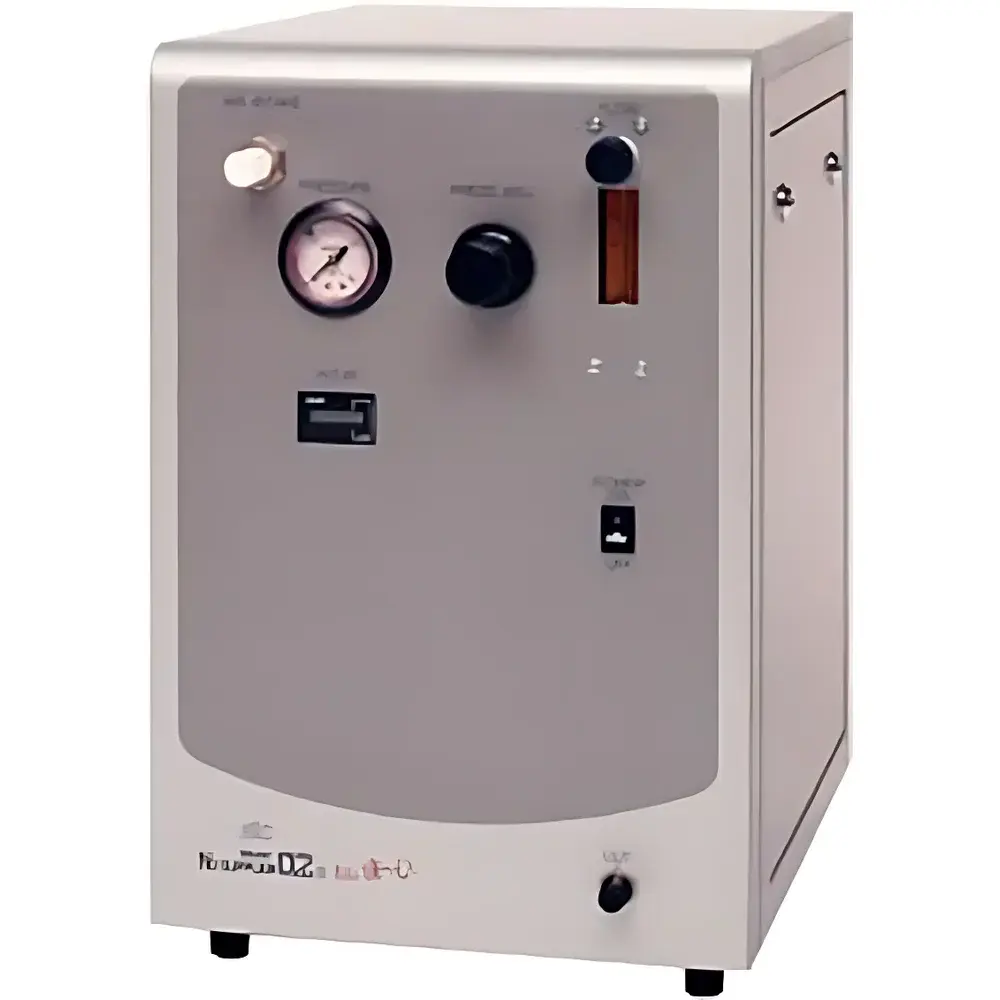
TAITEC N2 Boy Membrane-Based Nitrogen Generator
| Brand | TAITEC |
|---|---|
| Origin | Japan |
| Model | N2 Boy |
| Nitrogen Generation Principle | Hollow Fiber Membrane Separation (MEM) |
| Output Flow Rate | 4 L/min |
| Output Pressure Range | 0.15–0.3 MPa |
| Nitrogen Purity | 97% at 4 L/min (up to 99.9% at ≤2 L/min) |
| Dew Point | −30 °C |
| Dimensions | 280 × 390 × 434 mm (W × D × H) |
| Weight | Approx. 23 kg |
| Power Supply | AC 100 V, 6.5 A |
| Standard Accessory | Pisco-to-conical nozzle adapter × 1 |
Overview
The TAITEC N2 Boy is a compact, on-demand nitrogen generator engineered for laboratory-scale inert gas supply without reliance on high-pressure cylinders. It employs hollow fiber membrane separation technology—a physically selective, pressure-driven process—to continuously extract nitrogen from ambient air. Atmospheric air (78% N₂, 21% O₂, ~1% Ar and trace gases) is compressed and fed across asymmetric polymeric membranes; due to differences in gas permeability and diffusion rates, oxygen, water vapor, and CO₂ preferentially permeate the membrane wall, while nitrogen—exhibiting lower permeability—remains as the enriched retentate stream. This principle enables stable, continuous nitrogen delivery with no consumables, catalysts, or adsorbent regeneration cycles. Designed specifically for integration into sensitive biological and analytical workflows, the N2 Boy delivers consistent flow and purity under variable demand, eliminating logistical constraints associated with cylinder handling, storage, and regulatory compliance for compressed gas transport.
Key Features
- On-Demand, Cylinder-Free Operation: Eliminates dependency on high-pressure nitrogen cylinders—reducing safety risks, storage footprint, and recurring procurement costs.
- Scalable Purity–Flow Trade-off: Delivers up to 99.9% N₂ purity at reduced flow rates (≤2.0 L/min); maintains ≥97% purity at maximum rated output (4.0 L/min), optimized for common lab applications requiring moderate inerting performance.
- Integrated Dew Point Control: Built-in membrane-based drying achieves a consistent −30 °C pressure dew point, minimizing moisture-related interference in lyophilization, anaerobic culture, and solvent evaporation processes.
- Plug-and-Play Integration: Equipped with a standardized Pisco quick-connect fitting and includes a conical-tip nozzle adapter—enabling direct compatibility with centrifugal concentrators (e.g., Savant, Thermo Fisher) and freeze dryers requiring laminar nitrogen purging.
- Stable Pressure Regulation: Integrated pressure control maintains output within 0.15–0.3 MPa (1.5–3.0 bar), suitable for pneumatic actuation of sample chambers, glove box purge lines, and reactor headspace blanketing.
- Low-Maintenance Architecture: No moving parts beyond the intake compressor; membrane modules are sealed, non-regenerating, and rated for >20,000 hours of continuous operation under standard lab conditions (25 °C ambient).
Sample Compatibility & Compliance
The N2 Boy supports applications requiring Class 3–4 inert gas quality per ISO 8573-1:2010 (solid particle class 3, water class 3, oil class 4). Its −30 °C dew point satisfies ASTM E2653–22 requirements for lyophilizer chamber backfilling and meets typical specifications for anaerobic workstation purge protocols (e.g., Don Whitley Scientific, Baker Ruskinn systems). While not certified to ISO/IEC 17025 or FDA 21 CFR Part 11 out-of-the-box, its deterministic, non-software-dependent operation ensures full auditability of gas supply parameters—supporting GLP-compliant documentation when paired with external flow/purity verification (e.g., inline O₂ analyzer). The unit complies with JIS C 61000-3-2 (harmonic current emissions) and JIS C 61000-3-3 (voltage fluctuations) for Japanese electrical safety standards.
Software & Data Management
The N2 Boy operates as a standalone hardware system with no embedded firmware, touchscreen interface, or network connectivity. All operational parameters—including inlet pressure, membrane stack temperature, and output flow—are mechanically regulated and inherently stable under nominal line voltage (AC 100 V ±10%). For laboratories requiring electronic monitoring or integration into centralized facility management systems, optional analog 4–20 mA outputs for pressure and flow can be added via third-party signal conditioning modules. Raw operational logs (e.g., runtime hours, power cycling events) must be maintained manually or via external energy metering—aligning with minimal-data-footprint environments such as BSL-2 microbiology labs or QC-controlled pharmaceutical stability chambers.
Applications
- Lyophilization Support: Continuous nitrogen backfill during primary and secondary drying stages to prevent oxidation and improve cake morphology consistency.
- Centrifugal Concentration: Inert gas sparging in vacuum concentrators to accelerate solvent removal while protecting oxygen-labile biomolecules (e.g., nucleic acids, coenzymes, labile metabolites).
- Microaerophilic & Anaerobic Culture: Precise headspace replacement in bioreactors, serum bottles, and anaerobic jars—enabling reproducible growth kinetics for Clostridium, Bifidobacterium, and other strict anaerobes.
- Chromatography & Spectroscopy Prep: Solvent degassing, carrier gas blanketing for LC mobile phase reservoirs, and instrument purge lines in FTIR and Raman systems.
- Electron Microscopy Sample Prep: Dry nitrogen purging of critical-point dryers and sputter coaters to minimize surface oxidation prior to SEM/TEM imaging.
FAQ
Does the N2 Boy require periodic filter replacement or membrane servicing?
The integrated particulate pre-filter should be inspected quarterly and replaced if visibly loaded; the hollow fiber membrane module itself has no scheduled replacement interval and is warrantied for 3 years against manufacturing defects under normal operating conditions (ambient temperature 15–35 °C, relative humidity <80%).
Can the N2 Boy be used in cleanroom environments (ISO Class 5 or better)?
Yes—the unit emits no oil aerosols or volatile organic compounds; however, it must be located outside the cleanroom with nitrogen piped in via stainless steel 316 tubing and point-of-use submicron filtration (0.01 µm) to meet ISO 14644-1 particle count requirements.
Is the 99.9% purity specification validated per ISO 8573-7?
Purity is measured using calibrated electrochemical O₂ sensors traceable to NIST standards; formal ISO 8573-7 certification requires third-party testing at user site under defined sampling protocols and is available upon request.
What is the expected lifetime of the internal compressor?
The oil-free diaphragm compressor is rated for 20,000 hours MTBF; typical lab usage (8–10 hrs/day, 5 days/week) equates to >10 years of service life before routine overhaul.



