
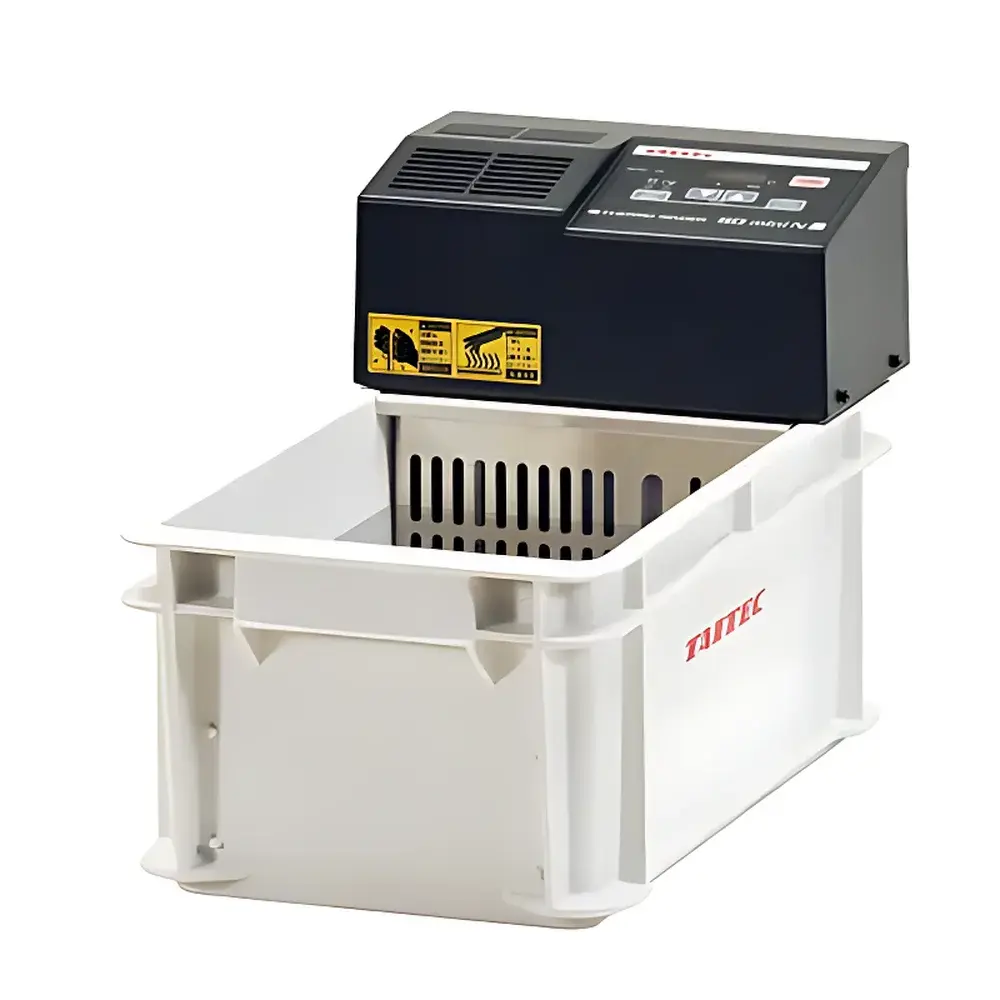
TAITEC SDminiN Immersion-Type Circulating Water Bath Controller
| Brand | TAITEC |
|---|---|
| Origin | Japan |
| Model | SDminiN |
| Bath Type | Immersion Circulating Water Bath |
| Temperature Range | Ambient +5°C to +80°C |
| Temperature Stability | ±0.1°C |
| Heating Power | 500 W |
| Internal Circulation | Jet-flow circulation |
| Control Method | Platinum RTD-based PID control |
| Temperature Resolution | 0.1°C |
| Display | Dual-mode digital display (setpoint / actual bath temperature) |
| Safety Features | Float-type dry-run protection, overcurrent circuit breaker, thermal cut-off, heater guard shield, error diagnostics (low water level, overtemperature, sensor fault) |
| Dimensions (Bath) | 190 × 83 × 147 mm (W×D×H) |
| Dimensions (Unit) | 220 × 127 × 235 mm (W×D×H) |
| Weight | ~3 kg |
| Power Supply | AC 100 V, 5.5 A |
| Standard Bath | Polyethylene C-type tank (45 mm depth) |
| Optional Accessory | Heat-resistant plastic lid PF-SDM |
Overview
The TAITEC SDminiN is a compact, immersion-type circulating water bath controller engineered for precision thermal management in low-volume laboratory applications. Unlike conventional benchtop water baths, the SDminiN employs a dedicated polyethylene C-type tank with a shallow 45 mm liquid depth—optimized for stable thermal equilibration of microcentrifuge tubes, PCR strips, small vials, and other low-profile sample containers. Its core thermoregulation architecture integrates a platinum resistance thermometer (Pt100) sensor, high-gain PID algorithm, and a 500 W submerged heating element with jet-flow internal circulation to ensure rapid heat transfer and minimal thermal gradient across the bath volume. Designed for use in molecular biology, clinical diagnostics, and cell culture workflows, the SDminiN delivers stable setpoint maintenance within ±0.1°C across its operating range (ambient +5°C to +80°C), making it suitable for enzyme incubation, serum inactivation, hybridization protocols, and media pre-warming where reproducible, localized heating is critical.
Key Features
- Ultra-shallow bath geometry (45 mm depth) prevents tube flotation and container tipping during low-volume operation—ideal for 0.2–2.0 mL microtubes and strip formats.
- Dual-mode digital display toggles between setpoint and real-time bath temperature with 0.1°C resolution; intuitive UP/DOWN keypad enables precise parameter entry without menu navigation.
- Jet-flow internal circulation system enhances thermal homogeneity without external pump connections or tubing—minimizing maintenance and cross-contamination risk.
- Comprehensive safety architecture includes float-switch dry-run protection, thermal cut-off at heater zone, overcurrent circuit breaker, and physical heater guard shield.
- Integrated error diagnostics alert users to low water level, sensor failure, or overtemperature events via on-device indicator codes—supporting GLP-compliant operational logging.
- Optional heat-resistant lid (PF-SDM) reduces evaporation loss, accelerates warm-up time by up to 35%, and enables humidified chamber functionality for in situ hybridization and RNA-sensitive assays.
Sample Compatibility & Compliance
The SDminiN accommodates standard microcentrifuge tubes (1.5/2.0 mL), PCR tubes, 8- and 12-strip formats, and flat-bottom microplates (up to 96-well) when used with compatible adapter inserts. Its polyethylene C-type bath is chemically resistant to common aqueous buffers, ethanol rinses, and mild detergents, and complies with ISO 10993-5 (cytotoxicity) for indirect contact with biological samples. The unit meets IEC 61010-1:2010 safety requirements for laboratory electrical equipment and supports traceable temperature calibration per ASTM E1137/E1137M (Standard Specification for Industrial Platinum Resistance Thermometers). While not inherently 21 CFR Part 11 compliant, audit-ready temperature logs can be generated manually or via optional RS-232 interface (with third-party software), supporting GMP-aligned documentation practices in QC/QA environments.
Software & Data Management
The SDminiN operates as a standalone analog-digital hybrid controller with no embedded firmware or network connectivity. Temperature data is displayed locally only; however, the device features a standardized RS-232 serial output port (optional cable required) enabling integration with LabVIEW, MATLAB, or custom Python-based acquisition scripts for time-stamped temperature logging. When paired with validated third-party software, the system supports electronic record retention, user-access controls, and audit trail generation—meeting foundational requirements for FDA-regulated laboratories under 21 CFR Part 11 Subpart B (electronic records) and Annex 11 (computerized systems). Calibration verification is performed using NIST-traceable reference thermometers, and the built-in Pt100 sensor allows two-point offset adjustment via service mode.
Applications
- Enzyme kinetics and restriction digestion incubations requiring tight thermal control between 25°C and 65°C.
- Serum inactivation (56°C, 30 min) and growth medium pre-warming prior to cell passaging.
- Stringent temperature staging in DNA/RNA hybridization protocols—including denaturation (95°C), annealing (42–65°C), and washing steps.
- Low-volume reagent equilibration for ELISA, lateral flow assay development, and qPCR master mix preparation.
- Controlled thawing of cryopreserved samples where rapid, uniform warming minimizes ice recrystallization damage.
- Supporting ISO/IEC 17025-accredited testing labs performing temperature-dependent method validation (e.g., viscosity, dissolution, stability studies).
FAQ
What is the minimum recommended water volume for stable operation?
The SDminiN requires ≥150 mL of deionized or distilled water to activate the float switch and engage heating—sufficient to cover the heater element and sensor at 45 mm depth.
Can the SDminiN be used with oil or organic solvents?
No. The polyethylene C-tank and internal components are rated for aqueous solutions only; use of oils, acetone, or ethanol above 10% v/v may cause material degradation and void warranty.
Is external temperature probe input supported?
Not natively. The unit relies exclusively on its integrated Pt100 sensor; external probe inputs require third-party signal conditioning hardware and custom integration.
Does the PF-SDM lid affect temperature uniformity?
Yes—empirical testing shows the lid improves vertical temperature uniformity from ±0.25°C to ±0.12°C across the bath surface at 37°C, primarily by suppressing convective heat loss and surface evaporation.
How often should calibration verification be performed?
Per ISO/IEC 17025 and internal lab SOPs, calibration verification is recommended before each critical assay series or at least daily when used in regulated environments; full recalibration every 6 months is advised.



