
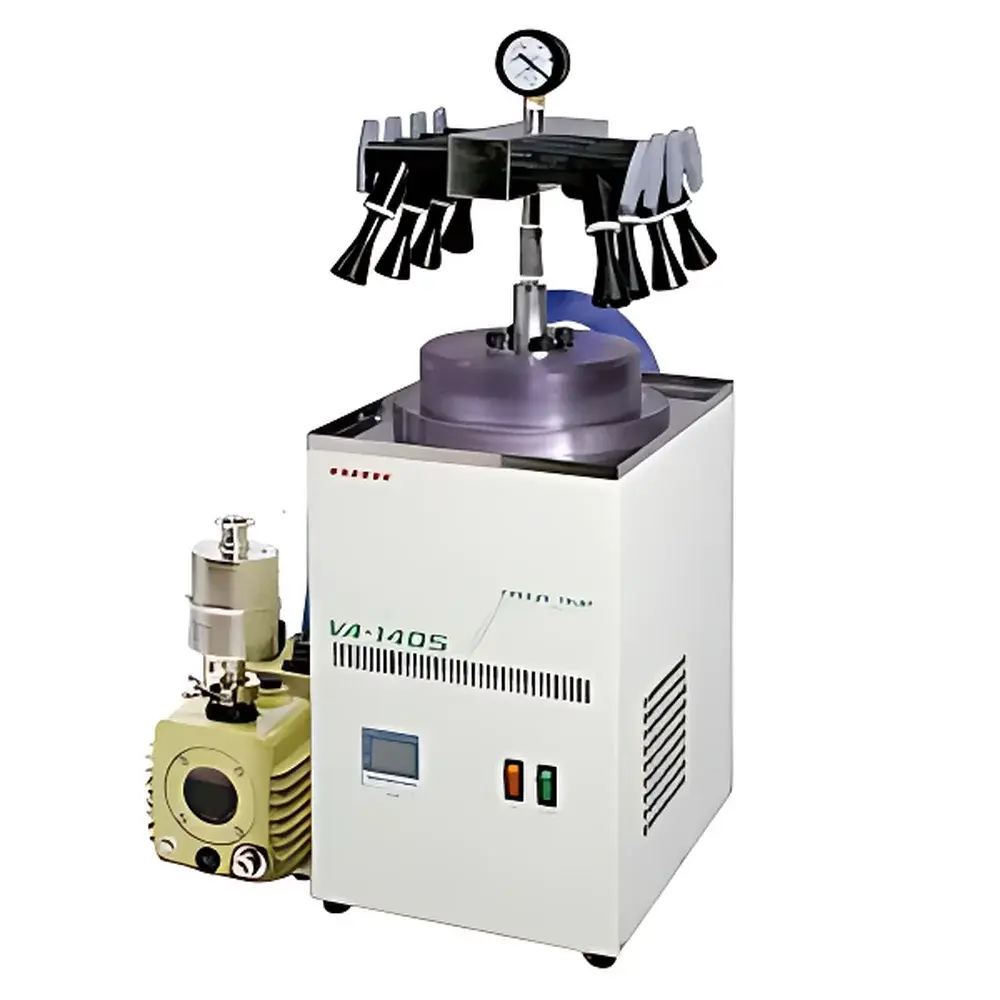
TAITEC VA-140S Freeze Dryer System (Stirling-Cooled, Manifold-Type)
| Brand | TAITEC |
|---|---|
| Origin | Japan |
| Model | VA-140S Freeze Dryer System |
| Instrument Type | Manifold Freeze Dryer |
| Application Scope | Laboratory Use |
| Shelf Area Equivalent | 1 L |
| Ultimate Vacuum | < 50 Pa |
| Condensate Capacity | 120 mL per cycle |
| Cold Trap Temperature | −60 °C |
| Dimensions (W×D×H) | 255 × 351 × 740 mm |
Overview
The TAITEC VA-140S Freeze Dryer System is a compact, Stirling-cycle-cooled manifold freeze dryer engineered for precision lyophilization of small-volume biological and analytical samples in research and quality control laboratories. Unlike conventional refrigerated condensers using compressor-based systems, the VA-140S employs a hermetically sealed Stirling cooler—delivering stable −60 °C cold trap performance with low power draw (rated at 40 W, operating current ≤1 A at AC 100 V) and zero ozone-depleting refrigerants. Its design originates from TAITEC’s modular cold trap platform (VA-140S), enabling seamless integration with centrifugal concentrators (e.g., VC-15S/15SP) or independent operation as a dedicated benchtop freeze dryer. The system operates on primary drying principles governed by sublimation under deep vacuum (<50 Pa), where ice transitions directly from solid to vapor without passing through liquid phase—preserving structural integrity, activity, and stability of thermolabile compounds such as proteins, enzymes, peptides, and food-derived analytes.
Key Features
- Stirling-cooled cold trap maintaining −60 °C (empty, ambient +25 °C), optimized for high-efficiency water vapor capture during primary drying
- Manifold configuration with 8 independent ports accommodating tubes Φ12–21 mm, L-shaped ampoules (Φ8 mm), and optional freeze-drying flasks (FB-6020a/FB-6030a)
- Indirect cooling architecture: standard glass collection bottle (Φ120 × 100 mm, ~1 L capacity) immersed in antifreeze-filled bath—enabling safe recovery of acidic or volatile solvents
- Bourdon-type analog vacuum gauge for real-time pressure monitoring; manual vent valve integrated into manifold for controlled repressurization
- Compact footprint (255 × 351 × 740 mm) and low heat dissipation—suitable for installation inside fume hoods or confined lab spaces
- Dual-mode compatibility: functions either as standalone freeze dryer or as auxiliary cold trap for TAITEC centrifugal concentrators via nitrogen purge nozzle (Φ8 mm, fitted with stopcock)
- Single AC 100 V input with built-in accessory socket (max. 100 V / 7 A), supporting synchronized operation with external vacuum pumps or controllers
Sample Compatibility & Compliance
The VA-140S supports lyophilization of aqueous and mildly acidic solutions across diverse sample formats—including microcentrifuge tubes (1.5–2.0 mL), custom ampoules, and flat-bottomed freeze-drying flasks. Its −60 °C trapping capability ensures efficient condensation of water vapor and low-volatility co-solvents (e.g., acetonitrile, methanol traces), minimizing backstreaming and cross-contamination. While not certified for GMP manufacturing, the system meets essential laboratory practice requirements aligned with ISO 22000 (food testing), USP (sterile processing guidance), and ASTM F2476–21 (standard guide for lyophilization process development). Its manual venting and non-automated cycle control necessitate operator-defined protocols—making it appropriate for method development, pilot-scale optimization, and GLP-compliant analytical sample preparation where full 21 CFR Part 11 audit trails are not mandated.
Software & Data Management
The VA-140S is a manually operated instrument with no embedded microprocessor or digital interface. Vacuum level is monitored visually via Bourdon gauge; temperature is inferred from cold trap specification and stabilized by thermal mass of the antifreeze bath. Users are expected to document parameters (start/end time, vacuum reading, visual endpoint assessment) in laboratory notebooks or LIMS-integrated electronic records. For traceability in regulated environments, pairing with an external vacuum controller (e.g., Edwards nXDSi series) or data-logging pressure transducer (with ±0.5 Pa accuracy) is recommended. No proprietary software is provided; all operational logs remain user-generated and compliant with ALCOA+ principles when maintained per institutional SOPs.
Applications
- Stabilization of recombinant proteins, monoclonal antibodies, and vaccine candidates prior to structural analysis (CD, DSC, XRD)
- Pre-concentration and preservation of metabolites, mycotoxins, and pesticide residues in food safety testing workflows
- Routine drying of calibration standards and reference materials for LC-MS and GC-MS quantification
- Lyophilization of bacterial/fungal cultures for long-term cryostorage without cryoprotectants
- Method scouting for freeze-drying cycle development—particularly for formulations with low eutectic temperatures or high collapse thresholds
- Integration with centrifugal concentration platforms to enable hybrid desolvation–lyophilization workflows for nanomaterial dispersion recovery
FAQ
What vacuum pump is recommended for optimal performance?
A two-stage rotary vane pump with ≥50 L/min free air displacement and ultimate vacuum ≤10 Pa is recommended. Oil-free diaphragm pumps may be used for solvent-sensitive applications but require verification of vapor handling capacity.
Can the VA-140S handle organic solvents beyond water?
Yes—its indirect cooling design and borosilicate glass collection bottle permit safe condensation of low-boiling solvents (e.g., acetone, ethyl acetate) when used with compatible vacuum pumps and proper ventilation.
Is the cold trap temperature actively regulated or fixed?
The Stirling cooler maintains a nominal −60 °C setpoint under no-load conditions; actual trap surface temperature varies with condensate load and ambient conditions—but remains consistently below −50 °C during active sublimation.
How often must the collection bottle be emptied during continuous operation?
With typical aqueous samples, the 120 mL capacity supports ~24 hours of intermittent use; for high-moisture samples or extended runs, monitoring via visual inspection of frost accumulation is advised.
Does TAITEC provide validation documentation (IQ/OQ/PQ) for this system?
No—this is a general-purpose laboratory instrument intended for research and development. Customers requiring formal qualification must perform in-house or third-party protocol execution per ISO/IEC 17025 or GAMP 5 guidelines.



