
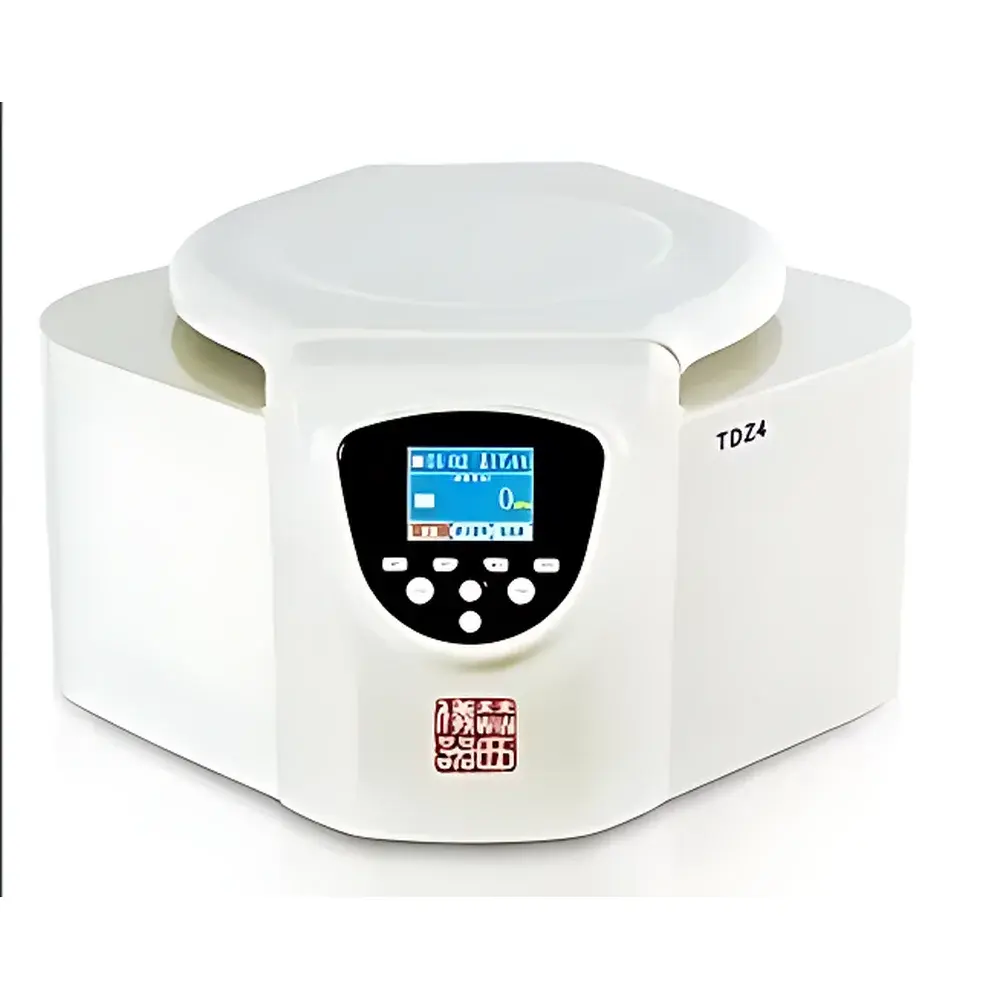
TDZ6-WS Low-Speed Multi-Rotor Centrifuge
| Origin | Hunan, China |
|---|---|
| Manufacturer Type | Authorized Distributor |
| Origin Category | Domestic (China) |
| Model | TDZ6-WS |
| Price | USD 700 (approx.) |
| Centrifugation Class | Biological Macromolecules |
| Maximum Capacity | 4 × 250 mL |
| Maximum Speed | 6000 rpm |
| Dimensions | 600 × 540 × 360 mm |
| Maximum RCF | 5150 × g |
| Timer Range | 0–99 h 59 min / Continuous / Short Spin |
| Power Consumption | 500 W |
| Noise Level | ≤65 dB(A) |
| Net Weight | 35 kg |
| Voltage/Frequency | AC 220 V, 50 Hz |
| Rotor Options | Horizontal (4×250 mL, 4×100 mL, 32×15 mL, 48/76×vacutainer), Angular (12×10 mL), Microplate (2×2×96-well) |
| Drive System | Brushless Frequency-Controlled Motor |
| Control Interface | TFT True-Color Touchscreen Display |
| Programmability | 20 User-Defined Protocols |
| Acceleration/Deceleration Profiles | 10 Adjustable Ramp Rates |
| Safety Features | Motorized Interlocked Door, Automatic Rotor Imbalance Detection, Dual Mechanical & Electronic Balance Compensation |
| Construction | Full Steel Frame, Stainless Steel Chamber |
Overview
The TDZ6-WS Low-Speed Multi-Rotor Centrifuge is an engineered solution for routine and high-throughput sedimentation tasks in life science laboratories, clinical diagnostics, and bioprocessing facilities. Designed around the principles of horizontal and angular rotor-based sedimentation under controlled gravitational force (RCF), it delivers reproducible separation of biological macromolecules—including whole cells, organelles, precipitated proteins, and serum components—without inducing thermal or mechanical denaturation commonly associated with high-speed centrifugation. Its operational envelope (up to 6000 rpm, 5150 × g) positions it between standard benchtop centrifuges and preparative ultracentrifuges, making it ideal for applications requiring large-volume processing (up to 4 × 250 mL per run) while maintaining gentle handling of sensitive biomaterials. The unit complies with IEC 61010-1:2010 safety standards for laboratory electrical equipment and incorporates structural redundancy in its dual-damping suspension system to ensure long-term mechanical stability under repeated load cycling.
Key Features
- Brushless frequency-controlled motor ensures maintenance-free operation, zero carbon dust emission, and acoustic noise ≤65 dB(A) at full load—critical for shared lab environments.
- TFT true-color touchscreen interface with intuitive navigation supports real-time parameter monitoring, including instantaneous RCF, speed, time remaining, and rotor identification via on-screen rotor silhouette visualization.
- 20 programmable protocols with non-volatile memory retain user-defined settings across power cycles; default startup loads the last executed method.
- 10-step acceleration and deceleration ramp control enables precise optimization of pelleting kinetics for fragile samples such as peripheral blood mononuclear cells (PBMCs) or virus particles.
- Motor-integrated electromagnetic door lock prevents accidental opening during rotation and interlocks with rotor imbalance detection circuitry.
- Multi-layer vibration damping system with auto-balancing compensation accommodates minor tube weight discrepancies without manual counterbalancing.
- Full stainless steel centrifuge chamber resists corrosion from organic solvents, disinfectants, and biological residues—facilitating compliance with GLP cleaning validation requirements.
Sample Compatibility & Compliance
The TDZ6-WS accepts a broad range of primary sample containers—from 2 mL vacuum blood collection tubes (76-position configuration) to 250 mL polypropylene bottles—via interchangeable rotors certified to ISO 15195:2019 for calibration traceability. Horizontal rotors support clinical-scale plasma separation (e.g., ASTM D7217-17 for serum harvesting), while the 2×2×96-well microplate rotor enables parallel processing of ELISA plates under standardized spin conditions (4000 rpm, 2360 × g). All rotors undergo fatigue testing per ISO 21501-4 and are supplied with individual serial-numbered certification documents. The system architecture supports audit-ready operation in regulated environments: event logs record every spin cycle (start/stop time, rotor ID, speed, duration, error flags), meeting foundational data integrity expectations aligned with FDA 21 CFR Part 11 Annex 11 principles—though electronic signature functionality requires optional software licensing.
Software & Data Management
While the TDZ6-WS operates autonomously via embedded firmware, optional PC connectivity (RS-232 or USB) enables integration with LIMS or ELN platforms using ASCII-based command protocol. Raw operational logs—including timestamped RCF profiles, motor current draw, and temperature trends (ambient sensing only)—are exportable in CSV format for retrospective analysis. Firmware updates are performed via secure USB stick with SHA-256 checksum verification. No cloud dependency or proprietary runtime environment is required; all control logic resides onboard, minimizing cybersecurity exposure in network-isolated core labs.
Applications
- Clinical hematology: Separation of whole blood into packed red cells, buffy coat, and platelet-poor plasma per CLSI H20-A2 guidelines.
- Vaccine manufacturing: Clarification of bacterial lysates and harvest of recombinant protein inclusion bodies prior to solubilization.
- Food microbiology: Concentration of Listeria monocytogenes or Salmonella from enrichment broths for subsequent PCR or culture isolation.
- Environmental testing: Sedimentation of suspended solids from wastewater effluent for turbidity correlation studies (ISO 7027).
- Academic research: Preparative isolation of mitochondria from liver homogenates using differential centrifugation steps (0–10,000 × g).
FAQ
Is the TDZ6-WS suitable for GMP-compliant production environments?
Yes—when deployed with documented SOPs, calibrated rotors, and enabled event logging, it meets baseline infrastructure requirements for Category B equipment in pharmaceutical manufacturing per EU GMP Annex 15.
Can the centrifuge be validated for IQ/OQ/PQ protocols?
Absolutely. Factory-provided calibration certificates, mechanical tolerance reports, and FAT/SAT documentation packages are available upon request.
Does it support refrigerated operation?
No—the TDZ6-WS is a non-refrigerated model. For temperature-sensitive applications, users should pre-chill samples and operate in climate-controlled rooms (15–25°C).
What rotor certifications accompany the unit?
Each rotor includes ISO/IEC 17025-accredited test reports verifying maximum speed, burst safety margin (>2.5× rated speed), and material composition compliance (ASTM A240 for SS304 chamber).
How often does the rotor require recalibration?
Rotor calibration is lifetime-valid unless physically damaged; however, annual verification of RCF accuracy against NIST-traceable tachometer standards is recommended for regulated workflows.



