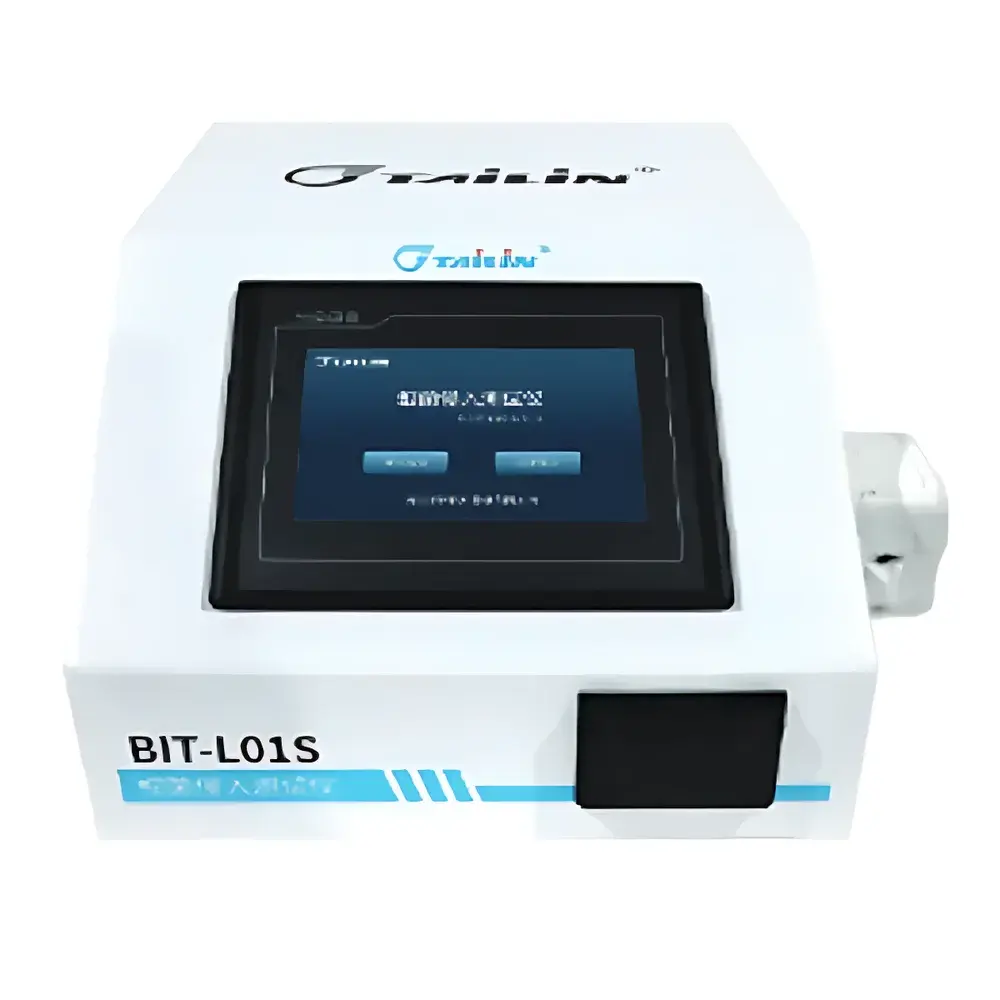
TECHLEAD® BIT-L01S Bacterial Intrusion Integrity Tester
| Brand | TECHLEAD® |
|---|---|
| Manufacturer | Tailin Biotechnology |
| Origin | Zhejiang, China |
| Model | BIT-L01S |
| Type | Microbial Challenge & Dye Penetration Integrity Tester |
| Compliance Design | IP69-rated stainless steel test chamber, steam-sterilizable (125°C), CFR Part 11–ready data logging |
| Application Scope | Parenteral packaging, blister packs, vials, syringes, IV bags, medical device pouches |
Overview
The TECHLEAD® BIT-L01S Bacterial Intrusion Integrity Tester is an engineered solution for deterministic, regulatory-grade package integrity verification in aseptic pharmaceutical manufacturing and quality control. It implements the microbial challenge test principle—defined in ISO 11607-2, ASTM F1608, and USP —where controlled application of pressure differentials drives a standardized suspension of Bacillus atrophaeus spores (or other validated challenge organisms) across potential defect pathways in sterile barrier systems. Unlike probabilistic dye ingress methods alone, the BIT-L01S integrates both microbial challenge and dye penetration modalities within a single, validated platform, enabling direct correlation between physical breach detection and biological penetrability. Its dual-pressure (vacuum-to-positive) cycling architecture replicates real-world stress conditions encountered during transport, storage, and stability testing—making it essential for extractables/leachables risk assessment, container-closure system (CCS) qualification, and lifecycle management per ICH Q5C and Q9 guidelines.
Key Features
- Integrated dual-mode operation: Simultaneous support for dye penetration (colorimetric) and microbial challenge testing under programmable pressure profiles.
- Full-seal fluidic architecture: All critical operations—including vacuum drawdown, positive pressure application, microbial suspension injection, and effluent drainage—are conducted in a closed, Class 100 (ISO 5) compatible environment with zero operator exposure to biohazards.
- IP69-rated 316L stainless steel test chamber: Withstand repeated autoclaving at 125°C for 30 minutes; flanged gasket sealing ensures leak-tight integrity during dynamic pressure transitions.
- Modular, tool-free coupling: Separated main unit and test vessel enable rapid setup, cleaning validation, and spatial flexibility in ISO-classified cleanrooms.
- CFR 21 Part 11–compliant data handling: Audit-trail-enabled electronic records with immutable timestamps, user authentication, and exportable CSV/Excel reports meeting ALCOA+ principles.
- Customizable immersion fixtures: Precision-machined sample holders ensure full surface contact between test articles (vials, pre-filled syringes, blister cards, flexible pouches) and challenge suspension—eliminating false negatives from incomplete wetting.
- High-resolution 7-inch color touchscreen interface: Real-time display of pressure (kPa), elapsed time, cycle phase, and system status; intuitive navigation supports multi-language UI configuration.
Sample Compatibility & Compliance
The BIT-L01S accommodates diverse primary packaging formats including glass and polymer vials (2–100 mL), pre-filled syringes (1–10 mL), blow-fill-seal containers, aluminum-plastic blisters, Tyvek-laminated pouches, and rigid thermoformed trays. It complies with global regulatory expectations for integrity testing: validation documentation aligns with Annex 1 (EU GMP), FDA Guidance for Industry on Container Closure Systems, and PIC/S PE 009-14. Pressure control accuracy meets ±0.5 kPa over 0–100 kPa range; dwell time resolution is 1 second. The system supports method transfer per ICH Q2(R2) and is routinely qualified using reference leaks per ASTM F2338-22.
Software & Data Management
Embedded firmware enables storage of ≥200 test protocols with parameter sets (pressure ramp rate, hold duration, vacuum depth, inoculum volume). Each run generates a timestamped log containing operator ID, environmental sensor readings (optional integrated temperature/humidity), raw pressure curves, and pass/fail determinations based on preset acceptance criteria. Data exports include PDF summary reports and raw .csv files suitable for statistical process control (SPC) analysis. Optional network connectivity supports integration into LIMS or MES platforms via OPC UA or RESTful API.
Applications
- Comparative evaluation of stopper-crimp combinations during CCS development
- Transport simulation studies assessing seal resilience under vibration + pressure cycling
- Stability protocol support: integrity monitoring at accelerated and real-time storage conditions
- Correlation studies linking physical defect size (measured by helium leak or HVLD) to microbial ingress thresholds
- Validation of depyrogenation and sterilization cycles’ impact on seal integrity
- Root cause analysis for sterility failures in commercial batches
FAQ
What organism is recommended for microbial challenge validation?
Bacillus atrophaeus ATCC 9372 spores are the default challenge microorganism per USP , with optional substitution of Escherichia coli or Serratia marcescens for specific risk-based assessments.
Can the BIT-L01S be used for lyophilized product containers?
Yes—its adjustable immersion depth and custom fixtures accommodate rubber-stoppered vials with partial headspace, ensuring consistent wetting of the seal interface without compromising sterility.
Is hardware calibration traceable to national standards?
Yes—pressure transducers are factory-calibrated against NIST-traceable references, with certificate of calibration included; annual recalibration is recommended per ISO/IEC 17025.
How is bioburden control maintained between runs?
The entire fluid path and chamber undergo automated 125°C steam sterilization (SOP-defined cycle); residual moisture is removed via heated nitrogen purge prior to next use.
Does the system support 21 CFR Part 11 electronic signatures?
Yes—role-based access control, electronic signature capture, and audit trail generation comply with Part 11 Subpart B requirements for regulated environments.