
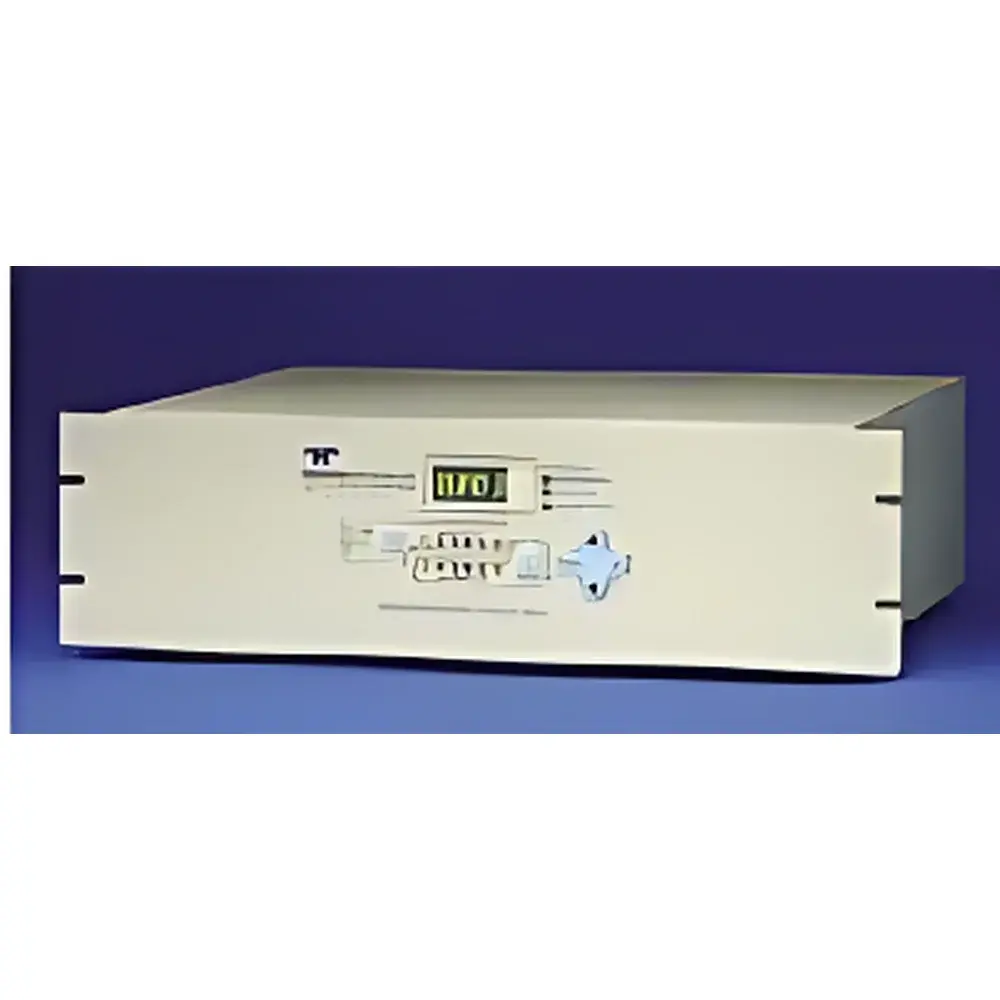
Teledyne Cetac Model 465L UV Absorption Ozone Analyzer
| Brand | Teledyne Cetac |
|---|---|
| Origin | USA |
| Model | 465L |
| Measurement Principle | UV Absorption (254 nm) |
| Concentration Range | 0–1 ppm and 0–500 ppm selectable |
| Units | ppmv, ppbv, ppmw, pphm, µg/m³, mg/m³ |
| Accuracy | ±0.1% of full scale |
| Resolution | 0.001 ppm |
| Response Time (T90) | <30 s |
| Sample Flow Rate | 1–2.5 L/min |
| Operating Temperature | 5–45 °C |
| Signal Output | 4–20 mA (isolated), 0–5 V analog |
| Communication Interface | RS-232 |
| Power Supply | 100–240 VAC, 50/60 Hz |
| Dimensions (W×H×D) | 483 × 133 × 388 mm |
| Weight | 6.17 kg |
| Certification | CE |
Overview
The Teledyne Cetac Model 465L is a laboratory- and field-deployable ozone analyzer engineered for high-stability, trace-level quantification of gaseous ozone (O₃) in ambient air, indoor environments, industrial process streams, and calibration gas verification applications. It employs the well-established ultraviolet (UV) absorption photometric principle at 254 nm—the characteristic absorption peak of ozone—ensuring selectivity against common interferents such as NO₂, SO₂, and hydrocarbons. The instrument’s dual-range optical path design supports both low-concentration monitoring (0–1 ppm) and higher-range applications (0–500 ppm), making it suitable for compliance with EPA Method EQOA-0110, ISO 13964, and ASTM D5157-19 for ozone measurement in environmental and occupational health contexts. Its solid-state UV lamp, temperature-stabilized optical cell, and real-time zero/reference compensation algorithm collectively deliver long-term baseline stability and minimal drift—critical for unattended operation over extended deployment cycles.
Key Features
- High-selectivity UV absorption detection at 254 nm with dual-path optical configuration for enhanced signal-to-noise ratio
- Configurable concentration ranges: 0–1 ppm (for ambient air quality monitoring) and 0–500 ppm (for industrial stack or generator output verification)
- Resolution of 0.001 ppm ensures precise detection at sub-ppb equivalent levels under optimized flow and calibration conditions
- Fast T90 response time of less than 30 seconds enables dynamic ozone profiling during transient events (e.g., photolysis onset, scrubber performance evaluation)
- Integrated temperature-controlled sample chamber and pressure-compensated flow regulation (1–2.5 L/min) minimize environmental influence on measurement fidelity
- CE-marked enclosure with robust EMI shielding meets IEC 61326-1 requirements for electromagnetic compatibility in mixed-signal laboratory and plant-floor installations
- Isolated 4–20 mA analog output and RS-232 serial interface support integration into SCADA, DCS, and data logging systems without signal grounding conflicts
Sample Compatibility & Compliance
The Model 465L accepts dry, particle-free gas samples with dew point ≤ –20 °C and particulate loading < 1 µm. For continuous operation in humid or reactive matrices, optional Nafion™ dryer or stainless-steel catalytic scrubbers may be integrated upstream. The analyzer complies with EN 50081-2 (EMC emissions) and EN 50082-2 (immunity), and its electrical safety design conforms to IEC 61010-1. While not intrinsically safe, it is rated for use in non-hazardous locations per NEC Class I, Division 2. Its measurement methodology aligns with U.S. EPA reference method equivalency criteria for ozone monitoring networks and satisfies QA/QC requirements outlined in 40 CFR Part 58 Appendix A for ambient air quality monitoring stations.
Software & Data Management
The analyzer operates autonomously via front-panel keypad and LCD display but supports bidirectional communication via ASCII-based RS-232 protocol. Host software (provided separately) enables remote configuration of range selection, unit conversion, alarm thresholds, and calibration scheduling. All analog outputs and digital readings are timestamped with internal RTC; audit logs—including zero/span events, error codes, and power-on cycles—are retained in non-volatile memory for GLP-compliant record retention. Data export formats include CSV and fixed-width ASCII, facilitating import into LIMS platforms compliant with 21 CFR Part 11 when paired with validated user access controls and electronic signature workflows.
Applications
- Ambient air quality monitoring networks (AQS, EEA, national reference stations)
- Indoor air quality assessment in healthcare facilities, cleanrooms, and HVAC commissioning
- Verification and control of ozone generators used in water treatment, food processing, and semiconductor cleaning
- Calibration laboratory traceability chains for ozone transfer standards (NIST-traceable primary standards required)
- Research studies on tropospheric chemistry, photochemical smog formation, and oxidation kinetics
- Occupational exposure monitoring per OSHA PEL (0.1 ppm TWA) and ACGIH TLV® (0.05 ppm TWA)
FAQ
Does the Model 465L require periodic lamp replacement?
Yes—the mercury-vapor UV lamp has a typical service life of 12–18 months under continuous operation. Lamp intensity decay is tracked internally and reported via diagnostic codes.
Can it measure ozone in humid air without conditioning?
No. Water vapor absorbs strongly at 254 nm and causes positive interference. A Nafion™ membrane dryer or chilled mirror dew point controller is recommended for relative humidity >40%.
Is factory calibration traceable to NIST?
Yes. Each unit ships with a certificate of calibration referencing NIST Standard Reference Material (SRM) 2198 or equivalent ozone generator standard.
What maintenance is required beyond lamp replacement?
Quarterly verification of zero/span response, annual optical window cleaning, and biannual flow rate validation using a certified mass flow meter.
Does it support Modbus RTU or Ethernet connectivity?
No—only RS-232 and analog 4–20 mA outputs are natively supported. Protocol conversion to Modbus or TCP/IP requires an external gateway device.
Related Products







