
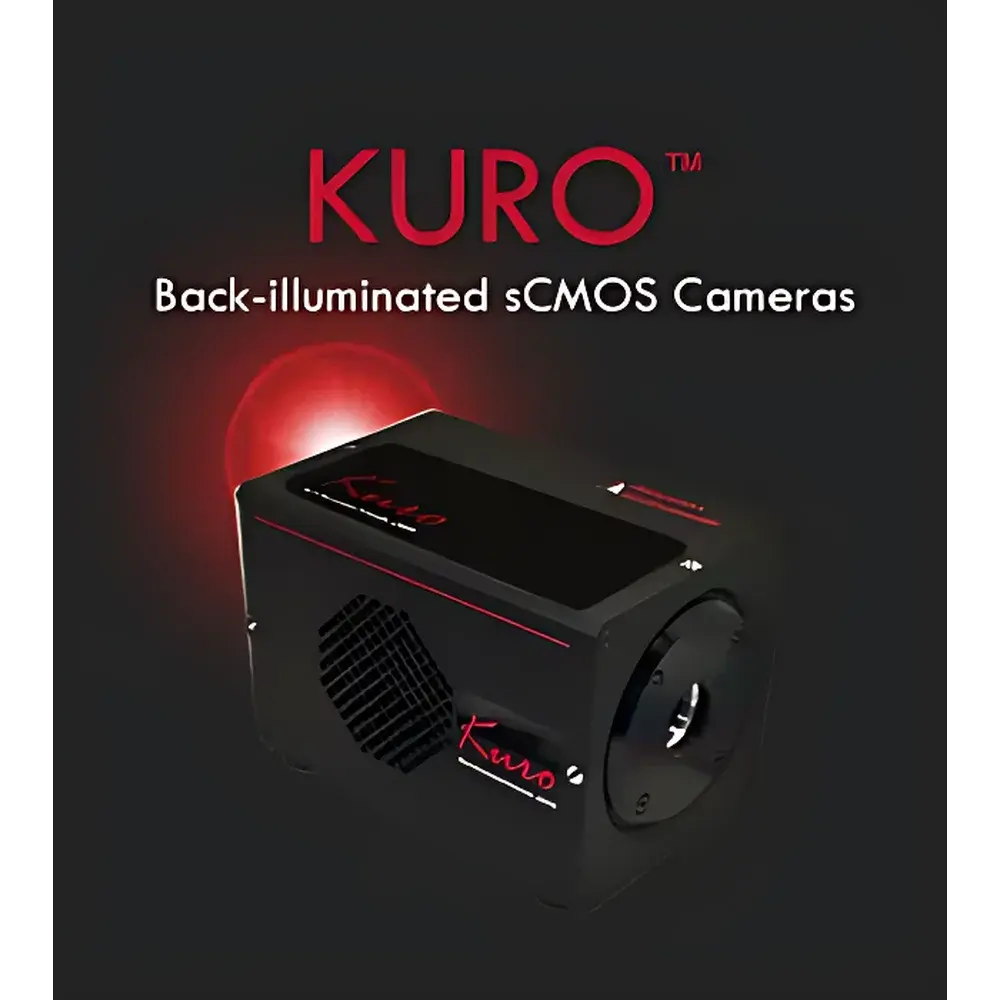
Teledyne Princeton Instruments KURO 1200B/2048B Back-Illuminated sCMOS Camera
| Brand | Teledyne Princeton Instruments |
|---|---|
| Origin | USA |
| Model | KURO 1200B / KURO 2048B |
| Pixel Size | 11.0 × 11.0 µm |
| Quantum Efficiency | >95% (peak) |
| Read Noise | 1.3 e⁻ rms (median) |
| Full-Well Capacity | 80,000 e⁻ |
| Dynamic Range | 61,500:1 (95 dB) |
| Frame Rate | 82 fps @ 1200 × 1200 (12-bit), 41 fps @ 1200 × 1200 (16-bit) |
| Fill Factor | 100% |
| Spectral Optimization | UV–NIR (180–1100 nm) |
Overview
The Teledyne Princeton Instruments KURO series represents the world’s first commercially available back-illuminated scientific CMOS (sCMOS) cameras engineered for quantitative low-light imaging and spectroscopy. Unlike conventional front-illuminated sCMOS sensors—whose quantum efficiency (QE) is limited by gate structures and microlens absorption—the KURO leverages a monolithic back-illuminated architecture with 100% fill factor and no on-chip microlenses. This design enables peak QE exceeding 95% across the UV–visible–NIR spectrum (180–1100 nm), while simultaneously delivering high frame rates, ultra-low read noise (1.3 e⁻ rms median), and exceptional dynamic range (95 dB). The KURO operates on the fundamental principle of photon-to-electron conversion in a deep-depletion silicon photodiode array, optimized for both temporal fidelity and photon-counting linearity. Its performance bridges the historical trade-off between CCD-level sensitivity and sCMOS-level speed—making it uniquely suited for applications requiring sub-second integration times, high spatial fidelity, and rigorous photometric accuracy under photon-starved conditions.
Key Features
- Back-illuminated sCMOS sensor with >95% peak quantum efficiency and 100% fill factor—eliminating microlens-induced spectral non-uniformity and UV attenuation
- Ultra-low read noise of 1.3 e⁻ rms (median) at full-frame readout, enabling single-photon-level detection without electron multiplication
- Large 11.0 × 11.0 µm pixels yielding 2.8× greater light-collection area versus standard 6.5 µm sCMOS pixels, with 80,000 e⁻ full-well capacity
- High-speed acquisition: 82 fps at 1200 × 1200 resolution (12-bit) and 41 fps (16-bit); scalable ROI readout supports >500 fps for sub-array acquisitions
- Fixed-pattern noise suppression via advanced pixel-level calibration and on-sensor circuitry—critical for long-exposure stability in astronomical and cryogenic imaging
- Hardware-triggered synchronization with programmable delay, exposure gating, and external TTL/CMOS compatibility for time-resolved spectroscopy and pump-probe experiments
Sample Compatibility & Compliance
The KURO platform is designed for integration into vacuum-compatible, cryogenically cooled, and ultra-high-stability optical environments—including vacuum chambers (<10⁻⁶ Torr), liquid nitrogen dewars (77 K operation), and vibration-isolated optical tables. Its hermetically sealed, passivated sensor package meets MIL-STD-810G environmental robustness requirements for thermal shock and humidity resistance. From a regulatory standpoint, KURO-acquired data complies with ISO/IEC 17025 analytical measurement traceability frameworks when used with calibrated light sources and NIST-traceable reference standards. While not inherently FDA 21 CFR Part 11–compliant, its LightField software supports audit-trail logging, user-access controls, and electronic signature workflows—enabling GLP/GMP-aligned deployment in regulated R&D laboratories. The camera conforms to CE, FCC Class A, and RoHS directives, and its spectral response is validated per ISO 15739:2013 (photographic sensitivity standards) and ASTM E1552–20 (spectral responsivity calibration).
Software & Data Management
KURO is fully controlled via LightField®, Teledyne Princeton Instruments’ modular, scriptable acquisition and analysis platform. LightField provides real-time hardware control—including exposure sequencing, region-of-interest definition, gain scaling, and multi-camera synchronization—while supporting direct export to HDF5, TIFF, FITS, and MATLAB® .mat formats. Its embedded spectral analysis module enables on-the-fly wavelength calibration, background subtraction, and intensity normalization against reference spectra—essential for hyperspectral and Raman applications. API support includes native LabVIEW® VIs, Python bindings (via PyPrinceton), and MATLAB Instrument Control Toolbox drivers. All acquisition metadata—including sensor temperature, exposure timestamp (UTC-synced), gain settings, and calibration coefficients—are embedded in image headers per FITS 4.0 specification. For enterprise-scale deployments, LightField integrates with networked storage systems using SMB/NFS protocols and supports DICOM-SR export for multimodal imaging workflows.
Applications
- Astronomical imaging: High-resolution narrowband imaging of emission nebulae (e.g., Orion Nebula), stellar photometry, and adaptive optics wavefront sensing
- Quantum optics: Single-atom fluorescence detection, Bose-Einstein condensate imaging, and quantum dot spectroscopy requiring shot-noise-limited SNR
- Time-resolved spectroscopy: Ultrafast transient absorption, laser-induced breakdown spectroscopy (LIBS), and plasma diagnostics with µs-scale gating
- Hyperspectral microscopy: UV-enhanced cellular autofluorescence mapping and label-free tissue histopathology
- Cryogenic spectroscopy: FTIR and Raman measurements at 4–77 K where dark current suppression and QE stability are critical
- High-throughput synchrotron beamline imaging: X-ray fluorescence mapping using scintillator-coupled configurations with sub-pixel spatial registration
FAQ
What distinguishes KURO from traditional back-illuminated CCDs?
KURO retains the high QE and UV response of back-illuminated CCDs but eliminates their readout bottlenecks—achieving 82 fps full-frame versus typical CCD frame rates of <1 fps. It also avoids CCD-specific artifacts such as blooming, smearing, and charge transfer inefficiency.
Can KURO be used for UV spectroscopy below 200 nm?
Yes—its microlens-free, fused-silica window option enables transmission down to 180 nm. For <180 nm operation, optional magnesium fluoride windows or vacuum-compatible configurations are available.
Is on-chip binning supported?
No—KURO does not implement hardware binning. However, its ultra-low read noise permits software binning in LightField without significant SNR penalty, preserving flexibility for post-acquisition rebinning and drift correction.
How is cooling performance characterized?
KURO uses thermoelectric (TE) cooling to –45°C (stabilized ±0.1°C) at ambient; optional liquid-cooled variants achieve –60°C for extended dark-current suppression in multi-minute integrations.
Does KURO support synchronized multi-camera acquisition?
Yes—via master-slave triggering over dedicated sync I/O lines with <10 ns jitter, enabling precise temporal alignment across distributed optical setups such as multi-angle scattering or stereo spectrometers.





