
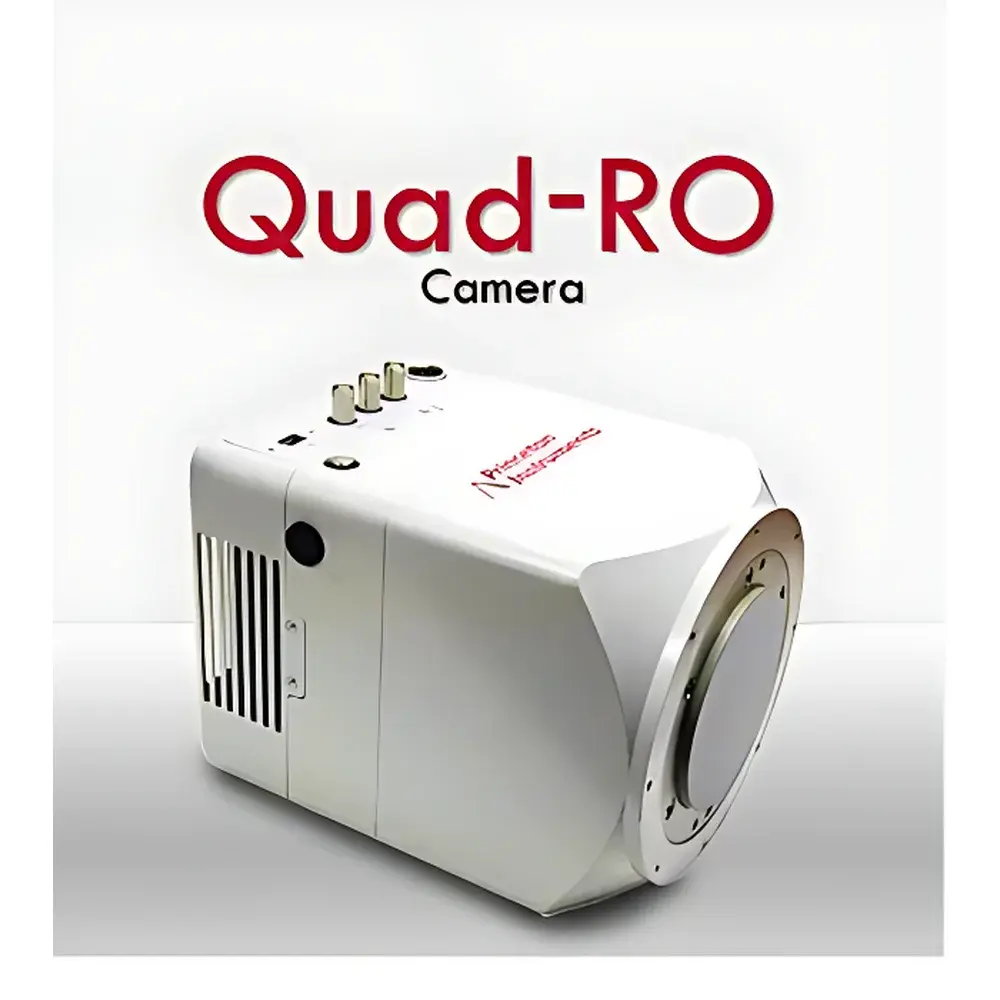
Teledyne Princeton Instruments Quad-RO 4320 Indirect-Detection X-ray Camera
| Brand | Teledyne Princeton Instruments |
|---|---|
| Origin | USA |
| Model | Quad-RO 4320 |
| Pixel Size | 24 × 24 µm |
| Imaging Array | 2084 × 2084 pixels |
| Energy Range | ~3 keV to >20 keV |
| Quantum Efficiency (at 550 nm) | >70% |
| Readout Interface | IEEE 1394a (FireWire) |
| ADC Resolution | 16-bit |
| Maximum Readout Speed | 4 MHz (4 outputs × 1 MHz each) |
| Cooling | Thermoelectric (hot-stage) |
| Scintillator Compatibility | Interchangeable Gd₂O₂S:Tb screens optimized for 8, 12, and 17 keV |
| Software Platform | LightField (64-bit) |
Overview
The Teledyne Princeton Instruments Quad-RO 4320 is a high-performance, indirect-detection X-ray imaging camera engineered for synchrotron beamlines, laboratory X-ray diffraction (XRD), micro-computed tomography (micro-CT), and time-resolved radiography applications. Unlike direct-detection sensors, the Quad-RO 4320 employs a fiber-optically coupled scintillator-to-CCD architecture: incident X-ray photons are first converted into visible light by a replaceable phosphor screen (e.g., Gd₂O₂S:Tb), which is then relayed via high-transmission fiber optic taper to a front-illuminated, scientific-grade CCD sensor. This design enables efficient detection across a broad energy spectrum (~3 keV to >20 keV) while preserving spatial resolution and dynamic range—critical for quantitative intensity mapping in crystallography and phase-contrast imaging. The 2084 × 2084 pixel array with 24 × 24 µm pixels delivers a large active area (50 × 50 mm) ideal for wide-field diffraction patterns and volumetric reconstruction. Its thermoelectric (hot-stage) cooling reduces dark current to sub-0.001 e⁻/pixel/sec levels, supporting long-exposure acquisitions without significant thermal noise accumulation.
Key Features
- Four independent low-noise readout amplifiers: Enables parallel readout at up to 4 MHz total bandwidth (1 MHz per port), balancing speed and noise for both rapid alignment and high-fidelity data collection.
- Interchangeable scintillator modules: Tool-free mechanical interface allows on-the-fly replacement of Gd₂O₂S:Tb screens optimized for specific X-ray energies (e.g., 8 keV for Cu-Kα, 12 keV for Mo-Kα, 17 keV for high-energy diffraction).
- 16-bit analog-to-digital conversion with true linear response: Delivers >87 dB dynamic range and <0.1% integral nonlinearity across full well capacity—essential for quantitative intensity calibration in SAXS/WAXS and tomographic reconstruction.
- IEEE 1394a (FireWire) interface: Fully compliant with industrial machine vision standards; requires no frame grabber or proprietary hardware—enables plug-and-play integration into existing LabVIEW, Python (PICAM SDK), or MATLAB environments.
- LightField 64-bit acquisition software: Provides real-time background subtraction, flat-field correction, pixel defect masking, and automated gain/offset calibration—validated for GLP-compliant workflows and audit-trail-enabled data capture (FDA 21 CFR Part 11 ready when deployed with secure authentication).
Sample Compatibility & Compliance
The Quad-RO 4320 supports diverse sample geometries and experimental configurations—from rotating anode X-ray sources and synchrotron bending magnets to compact microfocus tubes used in benchtop micro-CT. Its modular scintillator system ensures optimal detective quantum efficiency (DQE) across energies relevant to protein crystallography (3–12 keV), residual stress analysis (17–25 keV), and high-energy radiography (>20 keV). The camera meets ISO 11146-2 for beam profiling accuracy and complies with IEC 61000-6-3 (EMC emission standards) and UL 61010-1 (safety certification for laboratory equipment). All firmware and LightField software versions undergo periodic verification against ASTM E1316 (Standard Terminology for Nondestructive Examinations) and ISO/IEC 17025 traceability requirements for metrological validation.
Software & Data Management
LightField serves as the unified control and analysis environment for the Quad-RO series. Its native support for TIFF, HDF5, and NEXUS file formats ensures compatibility with standard scientific computing pipelines (e.g., TomoPy, DAWN, GSAS-II). The PICAM 64-bit SDK provides C/C++, Python, and .NET bindings for custom automation—including synchronized triggering with shutter controllers, motorized stage position logging, and real-time ROI-based histogram monitoring. Metadata embedding (exposure time, temperature, scintillator ID, energy filter status) follows NIEM and NeXus conventions, enabling FAIR (Findable, Accessible, Interoperable, Reusable) data practices. Audit trails record user actions, parameter changes, and calibration events—configurable for GMP/GLP-aligned laboratories requiring full data integrity assurance.
Applications
- X-ray Diffraction (XRD) & Scattering: High-resolution Laue and powder diffraction imaging, reciprocal space mapping, and time-resolved strain analysis in polycrystalline materials.
- Micro-Computed Tomography: Sub-micron 3D reconstruction of porous media (e.g., geological cores, battery electrodes, biological scaffolds), leveraging high DQE and large FOV for isotropic voxel sampling.
- Phase-Contrast Radiography: Edge-enhanced imaging of low-Z materials (soft tissue, polymers, composites) using propagation-based contrast at third-generation synchrotrons.
- Streak Tube Readout Integration: Synchronized acquisition with ultrafast streak cameras for picosecond-scale temporal profiling of X-ray pulses in pump-probe experiments.
- Industrial NDT: In-line inspection of weld integrity, additive manufacturing defects, and aerospace component porosity under laboratory or portable high-energy X-ray sources.
FAQ
What scintillators are compatible with the Quad-RO 4320?
The system supports standardized Gd₂O₂S:Tb screens with fiber-optic coupling; custom scintillators (e.g., CsI:Tl, LuAG:Ce) can be integrated upon request with optical coupling validation.
Is the camera suitable for vacuum or helium-purged environments?
Yes—the housing is rated IP52 and may be operated in dry nitrogen or He atmospheres; optional vacuum-compatible flange mounts are available for beamline integration.
Does LightField support automated calibration routines?
Yes—built-in routines perform gain/offset mapping, flat-field acquisition, and pixel defect identification; calibration files are stored with dataset metadata for reproducible processing.
Can multiple Quad-RO cameras be synchronized?
Yes—via TTL trigger input/output ports and LightField’s multi-camera orchestration module, enabling precise temporal alignment for stereo XRD or dual-energy CT.
What is the typical readout noise at 1 MHz per port?
Measured readout noise is ≤3.2 e⁻ RMS (typical) at 1 MHz, with correlated double sampling and optimized clocking sequences.





