
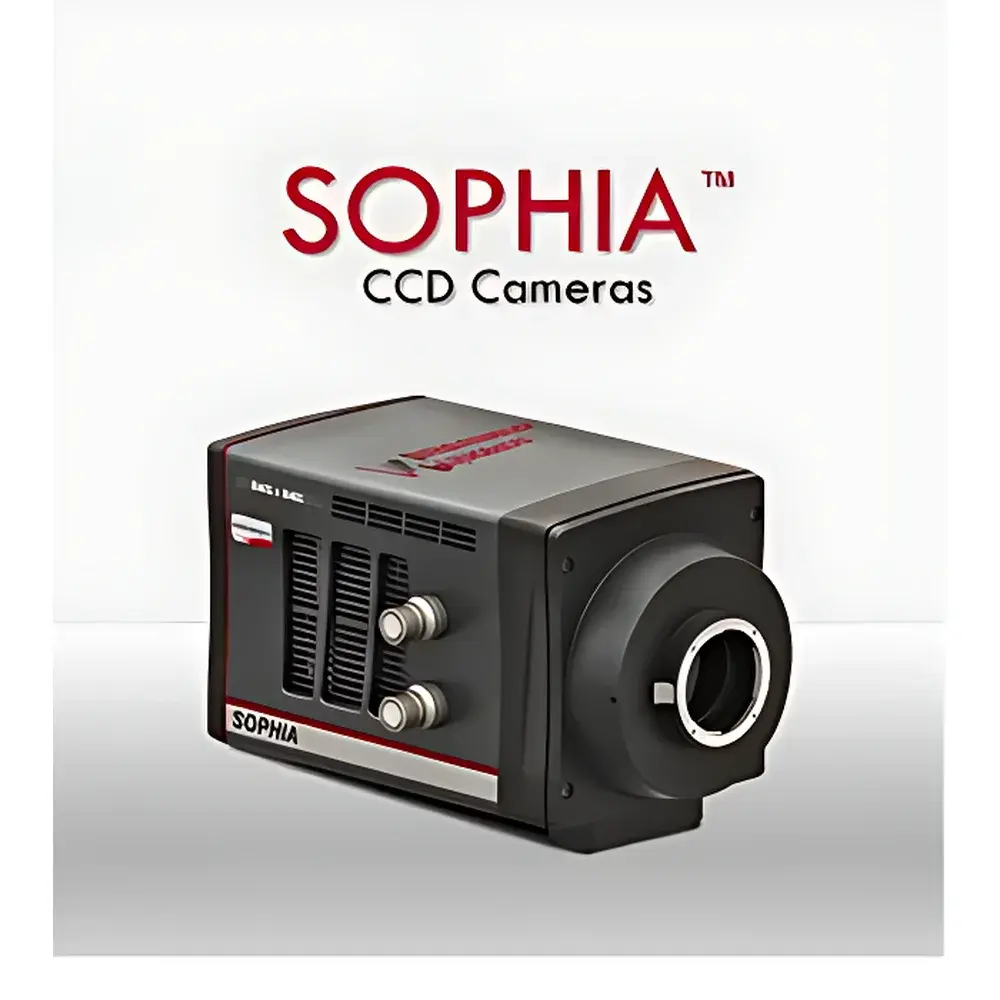
Teledyne Princeton Instruments SOPHIA 2048B/2048BX Back-Illuminated Scientific CCD Camera
| Brand | Teledyne Princeton Instruments |
|---|---|
| Origin | USA |
| Model | SOPHIA 2048B / SOPHIA 2048BX |
| Pixel Size | 15 × 15 µm |
| Sensor Architecture | Back-Illuminated CCD |
| Peak Quantum Efficiency | >95% (eXcelon-enhanced for 2048BX) |
| Cooling | ArcTec™ Thermoelectric Vacuum-Sealed Cryogenic System (down to –90 °C) |
| Readout Noise | ~4 e⁻ rms |
| Readout Speed | Up to 16 MHz (quad-port) |
| Interface | USB 3.0 (5 Gb/s), optional fiber-optic extension (up to 50 m) |
| Software Platform | LightField® 64-bit with IntelliCal™, PICAM API, LabVIEW/MATLAB/EPICS compatibility |
| Vacuum Warranty | Lifetime hermetic seal |
| Spectral Compatibility | UV-VIS-NIR (enhanced with eXcelon anti-fringing technology) |
| Mechanical Interface | Standard Nikon F-mount or spectrograph-compatible flange (ConFlat for SOPHIA-XO variant) |
Overview
The Teledyne Princeton Instruments SOPHIA 2048B and SOPHIA 2048BX are high-performance, back-illuminated scientific CCD cameras engineered for ultra-low-light detection in demanding quantitative imaging and spectroscopic applications. Built upon a 2048 × 2048 pixel architecture with 15 × 15 µm pixels, the SOPHIA series delivers enhanced photon collection efficiency—approximately 23% greater than conventional 13.5 µm pixel designs—while maintaining sub-4 e⁻ rms read noise through optimized analog signal chain design and short-path electronic routing. Its core measurement principle relies on charge integration within a deep-depletion, back-illuminated silicon photodiode array, followed by low-noise correlated double sampling (CDS) and 16-bit digitization. The system’s sensitivity is further extended into the near-infrared via eXcelon™ technology—a proprietary process that reduces etaloning artifacts and improves spectral uniformity across 200–1100 nm. For thermal management, SOPHIA integrates ArcTec™, a fully metal-sealed, epoxy-free vacuum cryostat incorporating custom thermoelectric coolers and fluid-dynamic thermal modeling. This architecture achieves stable sensor temperatures down to –90 °C without liquid nitrogen or external chillers—critical for suppressing dark current to <0.001 e⁻/pix/sec at –80 °C.
Key Features
- ArcTec™ cryogenic cooling: Hermetically sealed all-metal vacuum chamber with lifetime warranty; no outgassing, aging, or seal degradation.
- Back-illuminated CCD sensor: 2048 × 2048 format, 15 × 15 µm pixels, 30.7 × 30.7 mm active area.
- eXcelon™ technology (2048BX): Anti-etaloning coating enabling flat quantum efficiency response from UV to NIR with >95% peak QE.
- Quad-port readout: Simultaneous 4-channel output supporting up to 16 MHz aggregate readout speed—four times faster than single-port equivalents without compromising noise performance.
- Ultra-low-noise electronics: Optimized clock drivers, low-noise amplifiers, and precision CDS circuitry yielding ~4 e⁻ rms read noise at full speed.
- Bias Active Stability Engine (BASE): Real-time bias voltage regulation ensuring ±0.1 °C temperature stability and sub-pixel baseline repeatability across long-duration acquisitions.
- Flexible interface options: Native USB 3.0 (5 Gb/s), plus optional fiber-optic data link for remote operation up to 50 meters.
- Modular mechanical design: Interchangeable Nikon F-mount or spectrograph flange (ConFlat for SOPHIA-XO); integrated mechanical shutter with <5 ms actuation.
Sample Compatibility & Compliance
SOPHIA supports a broad range of optical configurations—from standard lens-coupled fluorescence microscopy to fiber-fed spectrographs and vacuum-compatible X-ray beamlines (via SOPHIA-XO variant). Its vacuum-rated housing meets ISO 10110 surface quality standards for optical windows and complies with ASTM E1544-22 for detector calibration traceability. When operated with LightField software, SOPHIA satisfies FDA 21 CFR Part 11 requirements for electronic records and signatures—including full audit trail logging, user access controls, and secure calibration history. All firmware and driver binaries are digitally signed and validated per GLP/GMP-aligned laboratory informatics workflows. The camera’s radiation-hardened sensor substrate and absence of organic adhesives ensure long-term reliability in synchrotron, space-borne, or nuclear physics environments where total ionizing dose (TID) exposure may exceed 10 krad.
Software & Data Management
LightField® 64-bit acquisition and analysis platform provides native support for SOPHIA’s hardware capabilities, including real-time multi-region-of-interest (ROI) readout, dynamic frame averaging, and synchronized external triggering with microsecond-level jitter. The built-in mathematical engine enables on-the-fly spectral deconvolution, background subtraction, and intensity normalization using calibrated reference datasets. IntelliCal™ automates wavelength and radiometric calibration via integrated LED sources and NIST-traceable standards. Programmatically, SOPHIA is accessible via PICAM SDK (C/C++, Python bindings), MATLAB Image Acquisition Toolbox, LabVIEW IMAQ, and EPICS Channel Access—enabling seamless integration into automated synchrotron end-stations or observatory control systems. All raw image metadata—including sensor temperature, exposure time, gain settings, and calibration coefficients—is embedded in TIFF/FITS headers compliant with IVOA and STScI archival standards.
Applications
- Low-light spectroscopy: Fluorescence, phosphorescence, and photoluminescence decay analysis requiring high dynamic range and temporal fidelity across UV–NIR bands.
- Astronomical imaging: Both steady-state deep-sky imaging (with hour-long integrations) and time-resolved photometry of variable stars, exoplanet transits, and fast radio burst afterglows.
- Quantum optics: Single-photon counting in Bose–Einstein condensate (BEC) time-of-flight absorption imaging, where spatial coherence and shot-noise-limited contrast are essential.
- Chemiluminescence & bioluminescence: High-sensitivity detection in microplate assays, in vivo animal imaging, and enzymatic reaction kinetics without external illumination.
- X-ray imaging: SOPHIA-XO variant enables direct soft X-ray detection (0.1–2 keV) via open-face configuration and uncoated entrance window—ideal for synchrotron beamline end-stations and EUV lithography metrology.
FAQ
What is the difference between SOPHIA 2048B and SOPHIA 2048BX?
The 2048BX incorporates eXcelon™ technology—a deep-depletion, anti-etaloning process that extends quantum efficiency into the near-infrared and eliminates interference fringes, especially critical for Raman and NIR spectroscopy.
Does SOPHIA require liquid nitrogen cooling?
No. ArcTec™ thermoelectric cooling achieves –90 °C sensor stabilization without cryogens, enabling quiet, maintenance-free operation in shared lab environments.
Is SOPHIA compatible with existing spectrometers?
Yes. It features standardized spectrograph flanges (including ConFlat for vacuum systems) and is pre-validated with IsoPlane and SpectraPro optical platforms.
Can SOPHIA be used in regulated environments (e.g., pharmaceutical QC)?
Yes. When paired with LightField’s 21 CFR Part 11 mode, it supports electronic signatures, audit trails, and calibration verification required under GxP frameworks.
What is the expected lifetime of the vacuum seal?
The all-metal, laser-welded vacuum enclosure carries a lifetime warranty against leakage—verified through accelerated aging tests per MIL-STD-883 Method 1014.





