
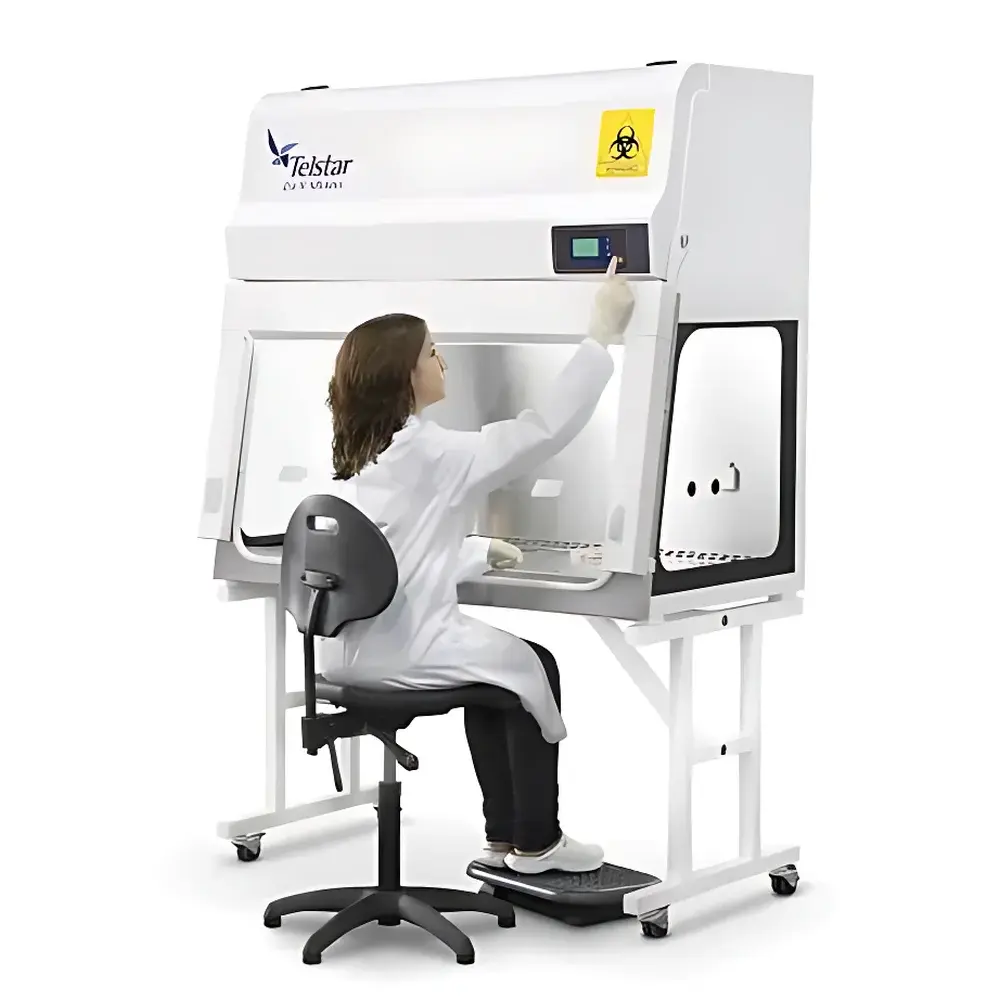
Telstar BIO-II-Advance 4 Class II A2 Biological Safety Cabinet
| Brand | Telstar |
|---|---|
| Origin | Spain |
| Cabinet Type | Class II, Type A2 |
| Certification | EN 12469, TÜV-GS |
| External Dimensions (W×D×H) | 1354 × 759 × 1260 mm |
| Internal Work Area (W×D×H) | 1259 × 605 × 587 mm |
| Sash Opening Height | 200 mm |
| Downflow Velocity | 0.35 m/s |
| Downflow Volume | 882 m³/h |
| Noise Level | 58 dB(A) |
| Illumination | >1000 lux |
| Vibration | <0.005 mm RMS |
| Power Consumption | 1.6 kW |
| UV Lamp | Integrated, Timer-Programmable |
| Fluorescent Lighting | Integrated |
| HEPA Filtration Efficiency | ≥99.999% @ 0.12 µm and 0.3 µm (Supply & Exhaust) |
| Air Recirculation | 70% |
| Exhaust Ratio | 30% |
| Work Surface | Removable stainless steel tray |
| Cabinet Weight | 200 kg |
| Stand Height | 780 mm |
| Exhaust Port Diameter | 160 mm |
| ECO Mode | Yes (reduces downflow to 50%) |
| User Access Control | Dual-level password protection |
| Viewing Window | 10° inclined, anti-reflection, UV-protected tempered glass with bottom-edge unobstructed vision |
| Inlet Design | V-shaped front airfoil |
| Filter Accessibility | Front-accessible for rapid replacement |
Overview
The Telstar BIO-II-Advance 4 is a CE-marked, EN 12469-compliant Class II, Type A2 biological safety cabinet engineered for containment of low-to-moderate risk biological agents (BSL-1 and BSL-2) while protecting both personnel and product integrity. It operates on the principle of inward airflow (for personnel protection), downward laminar airflow (for product protection), and filtered exhaust (for environmental protection). With 70% of the recirculated air passing through a dual-stage HEPA filtration system and 30% exhausted via dedicated ducting or thimble connection, the unit maintains ISO Class 5 (formerly Class 10) cleanroom conditions within the work area. Its robust stainless steel AISI 304 monolithic interior—featuring radiused corners and a removable, seamless work surface—ensures compliance with GLP and GMP cleaning protocols and facilitates full decontamination via vaporized hydrogen peroxide (VHP) or formaldehyde fumigation.
Key Features
- Monolithic AISI 304 stainless steel work chamber with electropolished, matte-finish interior and fully radiused corners for optimal decontamination and corrosion resistance.
- Dual high-efficiency particulate air (HEPA) filters: supply and exhaust filters both certified to ≥99.999% efficiency at 0.12 µm and 0.3 µm particle sizes—validated per EN 1822-1 and tested in accordance with IEST-RP-CC001.6.
- Intuitive tri-color status display: green (operational readiness), red (parameter deviation or alarm condition), yellow (UV decontamination cycle active).
- Programmable UV lamp with integrated timer and cumulative usage logging; real-time monitoring of fan runtime and filter service life via dynamic bar-graph and percentage-based visualization.
- EC motor-driven dual-fan system ensuring stable airflow profiles across variable static pressure conditions; enables precise regulation of downflow (0.35 m/s) and inflow velocities.
- 10° inclined, UV-shielded, anti-reflective tempered glass sash with non-suspended counterbalance mechanism—self-locking at working height (200 mm opening) and fully wipeable inner surface.
- ECO Mode reduces downflow velocity by 50% during operator absence, maintaining sample protection while lowering energy consumption, acoustic emissions (<58 dB[A]), and thermal load.
- V-shaped front airfoil inlet minimizes turbulence and prevents arm-induced flow disruption; integrated splash-proof dual power outlets meet IEC 60309-1 requirements.
Sample Compatibility & Compliance
The BIO-II-Advance 4 accommodates standard microbiological workflows including cell culture, media preparation, antibiotic sensitivity testing, and recombinant DNA handling. Its internal dimensions (1259 × 605 × 587 mm) support multi-tiered equipment configurations—including centrifuges, pipette controllers, and small incubators—without compromising airflow uniformity. The cabinet conforms to EN 12469:2000 for performance verification of biological safety cabinets and carries TÜV-GS certification for electrical safety per EN 61010-1. It supports audit-readiness for FDA 21 CFR Part 11 (via optional software logging), ISO/IEC 17025, and EU Annex 1 requirements when deployed in quality-controlled pharmaceutical or clinical laboratory environments.
Software & Data Management
While the BIO-II-Advance 4 operates via embedded firmware without external PC dependency, its control interface logs critical operational parameters—including cumulative fan hours, UV exposure time, and filter differential pressure trends—for traceable maintenance records. All alarms (e.g., sash misposition, airflow deviation, filter saturation) are timestamped and retained in non-volatile memory. Optional data export via RS-232 or USB interface enables integration into centralized lab infrastructure management systems. Firmware updates follow IEC 62304-compliant development lifecycle protocols, ensuring cybersecurity resilience and regulatory alignment.
Applications
This cabinet is routinely deployed in academic research laboratories, hospital diagnostic units, biopharmaceutical QC labs, and contract development and manufacturing organizations (CDMOs). Typical use cases include aseptic handling of primary mammalian cells, plasmid transfection procedures, mycoplasma testing, sterility assurance of compounded sterile preparations (CSPs), and preparation of reference standards under ISO 13485-regulated conditions. Its compact depth (759 mm) ensures compatibility with standard laboratory doorways and benchtop installations, while the 780 mm stand height optimizes ergonomic reach for seated or standing operators.
FAQ
Does the BIO-II-Advance 4 require external ducting?
It can operate in either ducted (hard-piped) or recirculating (thimble) mode, depending on facility ventilation infrastructure and local biosafety authority requirements.
What validation documentation is supplied with the unit?
Each unit ships with an EN 12469 factory test report, TÜV-GS certificate, and HEPA filter integrity test certificates (DOP/PAO scan reports).
Can the cabinet be validated for ISO Class 5 compliance?
Yes—the downflow velocity profile, particle count distribution, and inflow velocity meet ISO 14644-1 Class 5 criteria when operated per manufacturer specifications and verified using ISO 14644-3 protocols.
Is the UV lamp intensity monitored?
No real-time UV irradiance sensing is included; however, cumulative UV runtime is logged, and lamp replacement intervals follow IEC 60335-2-60 guidelines (typically 10,000 hours or annual replacement).
How frequently should HEPA filters be replaced?
Filter service life depends on usage intensity and ambient air quality; typical replacement interval is 5–7 years, with mandatory retesting after each replacement per EN 12469 Annex C.



