
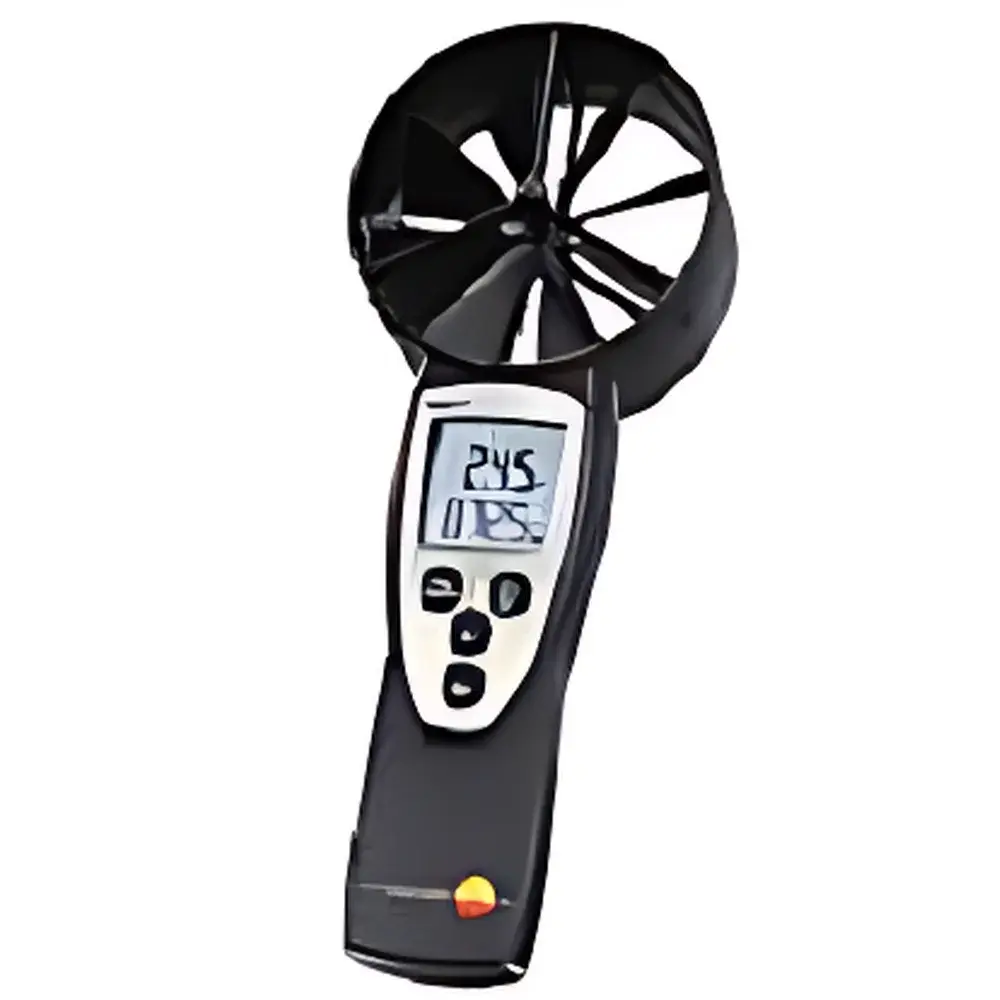
testo 417 Precision Vane Anemometer
| Origin | Germany |
|---|---|
| Manufacturer Type | Authorized Distributor |
| Origin Category | Imported |
| Model | testo 417 |
| Price Range | USD 280–690 |
| Instrument Type | Vane Anemometer |
| Resolution | 0.01 m/s |
| Measurement Range | +0.3 to +20 m/s |
| Accuracy | ±(0.1 m/s + 1.5% of reading) |
| Operating Temperature | 0 to +50 °C |
| Temperature Probe Type | NTC |
| Temperature Range | 0 to +50 °C |
| Temperature Accuracy | ±0.5 °C |
| Temperature Resolution | 0.1 °C |
| Probe Diameter | 100 mm |
| Display | Backlit LCD |
| Data Hold Function | Yes |
| Min/Max Display | Yes |
| Averaging | Time-based & Multi-point |
| Auto Power-off | Yes |
| Battery | 9 V alkaline (6F22) |
| Battery Life | ~50 h |
| Weight | 230 g |
| Dimensions | 277 × 105 × 45 mm |
| Housing Material | ABS |
| Storage Temperature | −40 to +85 °C |
Overview
The testo 417 Precision Vane Anemometer is an engineered field instrument designed for accurate, repeatable measurement of air velocity, volumetric airflow, and ambient temperature in HVAC commissioning, indoor air quality (IAQ) assessments, ventilation system balancing, and environmental compliance audits. Based on the proven principle of rotational vane anemometry—where airflow induces proportional angular velocity in a calibrated 100 mm diameter impeller—the device delivers traceable, low-inertia response across its operational range of +0.3 to +20 m/s. Its integrated NTC temperature sensor enables simultaneous dual-parameter acquisition, while real-time volumetric flow calculation is performed onboard when the user inputs duct or grille cross-sectional area—eliminating manual conversion errors. The instrument complies with fundamental metrological requirements for portable airflow instrumentation per ISO 5167 (annexes), EN 12599 (ventilation system testing), and ASHRAE Guideline 12–2020 for IAQ monitoring equipment.
Key Features
- 100 mm precision-machined vane probe with balanced aerodynamic profile for minimal flow disturbance and high directional sensitivity
- Simultaneous measurement of air velocity, temperature, and derived volumetric flow (m³/h or ft³/min)
- Backlit LCD display with intuitive navigation, supporting real-time data hold, min/max tracking, and time-weighted or multi-point averaging
- Auto power-off after 20 minutes of inactivity; extendable via manual override
- Rugged ABS housing rated for field use, IP52-rated against dust and light water splashes
- Onboard memory stores up to 99 measurement sets with timestamp and parameter tagging (when used with optional PC interface software)
- Integrated zero-point stability compensation to mitigate thermal drift during extended operation
Sample Compatibility & Compliance
The testo 417 is validated for use in non-corrosive, particle-free airstreams typical of commercial HVAC ducts, supply/exhaust grilles, fume hoods, cleanroom diffusers, and laboratory ventilation terminals. It is not intended for high-velocity industrial exhausts (>20 m/s), saturated or condensing environments, or abrasive particulate-laden flows. Calibration traceability is maintained through optional NIST-traceable or ISO/IEC 17025-accredited certificates (e.g., testo calibration service certificate No. 0520 0244), covering reference points at 100, 200, 400, 1000, and 2000 fpm. The instrument supports GLP-compliant documentation workflows when paired with testo’s certified calibration reports and audit-ready data export protocols.
Software & Data Management
While the testo 417 operates as a standalone handheld unit, it interfaces seamlessly with testo’s Smart Probes PC software (Windows-based) via optional USB cable (testo 0554 0025 adapter). This enables secure export of time-stamped datasets—including velocity, temperature, flow, and averaging metadata—in CSV or PDF report formats. All exported records retain instrument ID, calibration due date, operator tag, and environmental context tags. The software supports 21 CFR Part 11–compliant user access control, electronic signatures, and audit trail generation when deployed in regulated GxP environments (e.g., pharmaceutical HVAC validation per EU GMP Annex 1).
Applications
- HVAC system commissioning and TAB (Testing, Adjusting, Balancing) per ASHRAE Standard 111
- Room air change rate verification in healthcare facilities (per FGI Guidelines and HTM 03-01)
- Local exhaust ventilation (LEV) hood face velocity surveys under OSHA 1910.146 and HSE COSHH regulations
- Energy audit pre- and post-retrofit airflow comparisons
- Classified cleanroom airflow uniformity mapping (ISO 14644-3 Annex B)
- Educational laboratory demonstrations of fluid dynamics and thermal comfort parameters
FAQ
What is the recommended recalibration interval for the testo 417 in routine HVAC maintenance use?
For applications requiring documented metrological integrity (e.g., TAB reports, regulatory submissions), annual recalibration against NIST-traceable standards is advised. Field verification using a reference anemometer before each critical measurement session is strongly recommended.
Can the testo 417 measure reverse or bidirectional airflow?
No—the vane mechanism is unidirectional and indicates only forward airflow magnitude. Directional indication is limited to visual alignment of the probe; no vector sign or negative value output is provided.
Is the 100 mm probe suitable for small-diameter ducts (e.g., Ø50 mm)?
The 100 mm probe is optimized for grilles, registers, and ducts ≥200 mm in dimension. For smaller ducts, testo recommends the 40 mm vane probe (model testo 405i) to maintain measurement representativeness and avoid wall interference effects.
Does the instrument meet FDA or ISO 13485 requirements for medical device manufacturing environments?
The hardware itself is not certified to ISO 13485, but its measurement capability, calibration traceability, and data export features support compliance with ISO 14644-1/2 and FDA guidance on environmental monitoring in sterile processing areas when used within a validated QA framework.
How does the averaging function handle transient turbulence during duct traverses?
The multi-point averaging mode allows users to log ≥3 discrete readings across a traverse grid; the device computes arithmetic mean with standard deviation. Time-based averaging (1–10 min) applies exponential smoothing to dampen short-term fluctuations without phase lag artifacts.







