
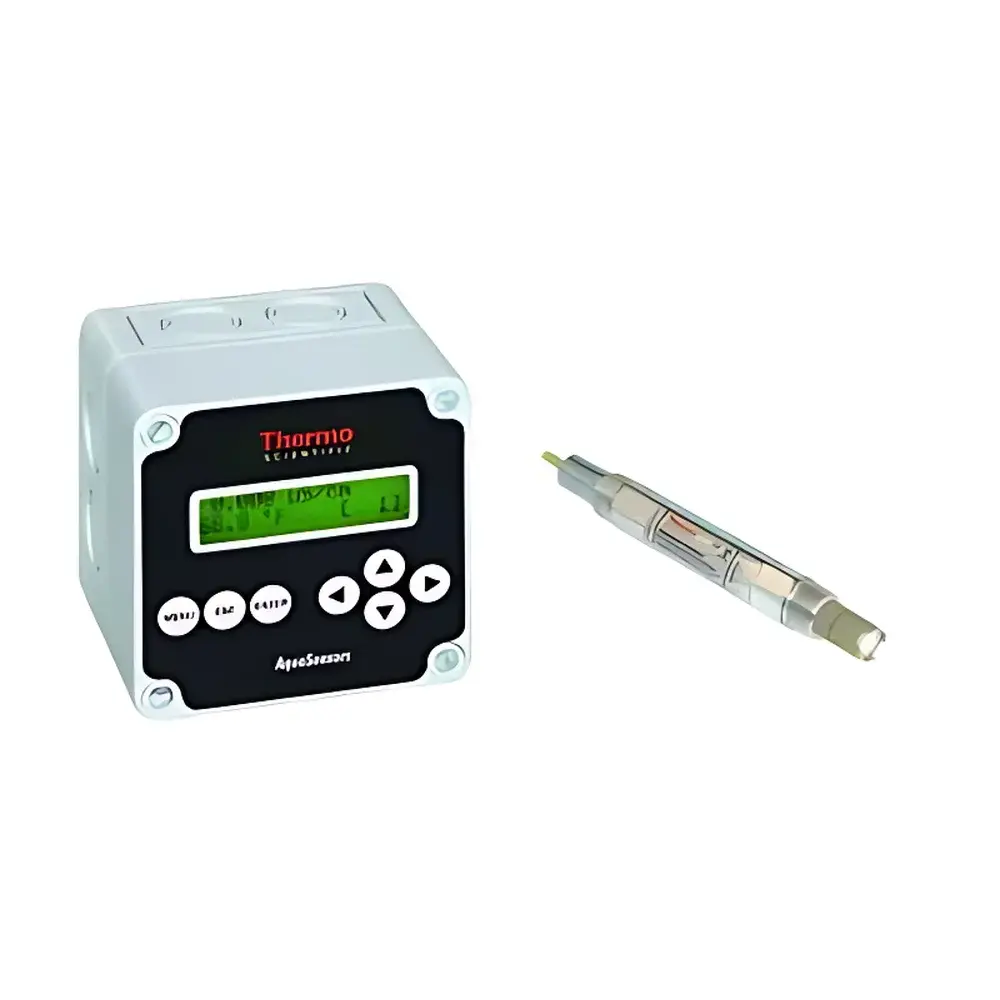
Thermo Fisher AquaSensor Polarographic Ozone Analyzer
| Brand | Thermo Fisher |
|---|---|
| Origin | USA |
| Manufacturer | Thermo Fisher Scientific |
| Type | Imported |
| Model | Ozone DataStick |
| Instrument Category | Online Analyzer |
| Measurement Principle | Polarographic Electrochemical Probe (Clark-type) |
| Range | 0–10 ppm |
| Accuracy | ±2% of reading |
| Resolution | 0.01 ppm |
| Response Time | t₉₀ ≤ 90 s |
| Calibration | Single-point air calibration |
| Compensation | Automatic temperature, atmospheric pressure, and salinity compensation |
| Operating Temperature | –5 to 50 °C |
| Max Pressure | 65 PSIG (4.5 bar) at 50 °C |
| Max Flow Rate | 10 ft/s |
| Housing Material | PEEK |
| Electrode System | Triple-electrode (Au cathode, Ag anode, Ag reference electrode) |
| Oxygen-permeable Membrane | PFA-coated Teflon |
Overview
The Thermo Fisher AquaSensor Polarographic Ozone Analyzer is a dedicated online instrument engineered for continuous, high-stability measurement of dissolved ozone concentration in water treatment, pharmaceutical process water, semiconductor ultrapure water (UPW), and biopharmaceutical clean-in-place (CIP) rinse monitoring. Unlike optical or amperometric sensors, the AquaSensor employs a rigorously validated polarographic electrochemical detection principle based on the Clark membrane electrode architecture—modified for ozone-specific selectivity through optimized cathode potential control and diffusion-limiting membrane selection. The sensor utilizes a triple-electrode configuration comprising a gold cathode, silver anode, and independently polarized silver reference electrode, eliminating drift associated with conventional two-electrode systems by stabilizing the reference potential under varying ionic strength and redox conditions. This architecture ensures long-term baseline stability and resistance to interference from chlorine, hydrogen peroxide, and other oxidants commonly present in ozonated water streams.
Key Features
- Triple-electrode polarographic cell with Au cathode, Ag anode, and actively polarized Ag reference electrode for enhanced signal stability and minimized zero drift
- Pre-assembled, field-replaceable membrane cap module—factory-filled with electrolyte and PFA-coated Teflon membrane—enabling sub-10-second membrane replacement without recalibration
- PEEK-bodied probe housing rated for continuous operation at up to 65 PSIG (4.5 bar) and 50 °C, compatible with pressurized distribution loops and recirculating UPW systems
- Integrated Pt1000 temperature sensor with NIST-traceable characterization; enables real-time temperature compensation compliant with ISO 5814 and ASTM D888 correction algorithms
- Automatic compensation for barometric pressure and salinity (0–70 g/kg), supporting deployment across diverse municipal, industrial, and marine-integrated applications
- Wide dynamic range (0–10 ppm) with 0.01 ppm resolution and ±2% of reading accuracy—validated per USP and EP 2.2.45 specifications for ozone quantification in purified water
Sample Compatibility & Compliance
The AquaSensor is designed for direct insertion into flowing water streams with velocities up to 10 ft/s, making it suitable for inline installation in stainless steel sanitary tubing (1/4″–1″ ID) or bypass cells. It maintains metrological integrity in deionized water, reverse osmosis permeate, and low-conductivity UPW (≥18.2 MΩ·cm), as well as in chlorinated or hydrogen-peroxide-spiked matrices where cross-sensitivity is suppressed via optimized polarization voltage and membrane selectivity. The system complies with key regulatory frameworks including FDA 21 CFR Part 11 (when paired with Thermo Fisher’s TraceFinder™ or Orion Star™ software with audit trail), ISO/IEC 17025-compliant calibration traceability, and GLP/GMP data integrity requirements for pharmaceutical water system validation.
Software & Data Management
The Ozone DataStick interfaces seamlessly with Thermo Fisher’s Orion Star™ A300/A309 controllers or third-party SCADA/DCS platforms via 4–20 mA analog output and Modbus RTU (RS-485). Optional digital integration supports HART 7 protocol for remote diagnostics, firmware updates, and parameter configuration. All measurement data—including timestamped ozone concentration, temperature, pressure, and salinity-corrected values—are logged with full metadata and electronic signatures when used within validated environments. Audit trails meet ALCOA+ principles, capturing operator ID, change timestamps, and reason-for-change entries—essential for compliance with Annex 11 and EU GMP Annex 11.
Applications
- Real-time ozone residual monitoring in municipal drinking water disinfection contact chambers
- In-line verification of ozone sparging efficiency during pharmaceutical WFI (Water for Injection) generation
- End-of-rinse ozone concentration tracking in biotech CIP/SIP cycles to ensure microbial log reduction
- Process control of ozone-based advanced oxidation processes (AOPs) in wastewater reuse facilities
- Validation support for ozone destruct unit performance in semiconductor fab UPW reclaim loops
FAQ
Is the Ozone DataStick compatible with existing Orion Star controllers?
Yes—it natively supports analog input (4–20 mA) and Modbus RTU communication with Orion Star A300, A309, and Star Log software.
Does the sensor require periodic recalibration in the field?
No—single-point air-saturation calibration is sufficient for routine operation; factory calibration certificates are provided with NIST-traceable uncertainty budgets.
Can the probe be installed in high-pressure UPW loops?
Yes—the PEEK housing and sealed triple-electrode assembly are rated for continuous service at 65 PSIG (4.5 bar) and 50 °C.
How does the system handle interference from residual chlorine?
The polarographic cell operates at a cathode potential selectively reducing ozone while suppressing chlorine reduction kinetics; cross-sensitivity is <1.5% relative to 1 ppm Cl₂.
Is the membrane cap certified for USP Class VI biocompatibility?
Yes—the PFA-Teflon membrane and medical-grade silicone O-rings comply with USP cytotoxicity and systemic injection testing requirements.







