
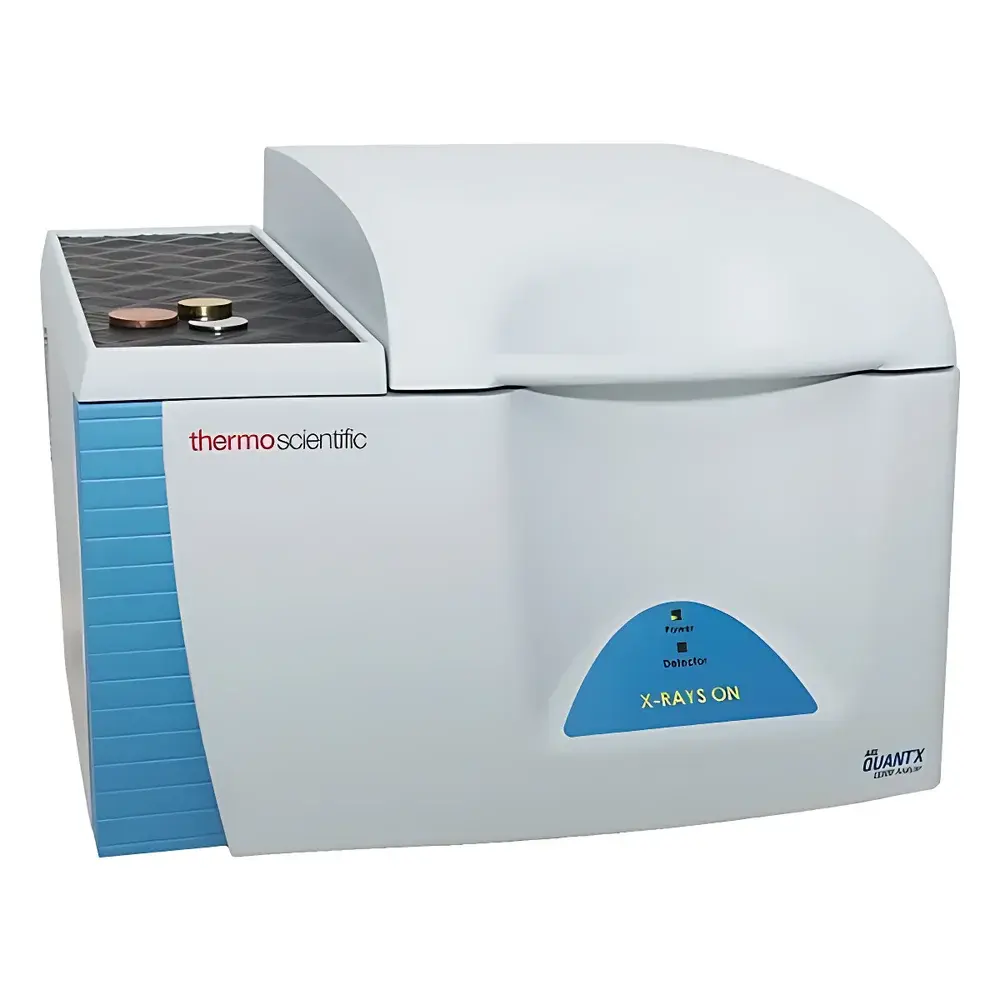
Thermo Fisher ARL™ QUANT Energy Dispersive X-Ray Fluorescence Spectrometer (EDXRF)
| Brand | Thermo Fisher |
|---|---|
| Origin | Shanghai, China |
| Manufacturer Type | Authorized Distributor |
| Product Origin | Domestic (China-manufactured under Thermo Fisher technology transfer & quality oversight) |
| Model | ARL™ QUANT EDXRF |
| Pricing | Available upon consultation |
Overview
The Thermo Fisher ARL™ QUANT Energy Dispersive X-Ray Fluorescence Spectrometer (EDXRF) is an industrial-grade, benchtop elemental analyzer engineered for precision, robustness, and operational flexibility in regulated and high-throughput laboratory environments. Based on the fundamental principle of energy-dispersive X-ray fluorescence—where primary X-rays from a Rh or Pd anode tube excite atoms in the sample, causing emission of characteristic secondary X-rays—the instrument delivers quantitative and semi-quantitative multi-element analysis (Z = 5–95, F to Am) without destructive sample preparation. Its design integrates Thermo Fisher’s globally validated EDXRF architecture with localized manufacturing compliance, ensuring adherence to ISO/IEC 17025-relevant hardware traceability and long-term stability benchmarks. The system is optimized for routine QC, environmental screening, RoHS/WEEE compliance verification, and process control applications where reproducibility, minimal operator intervention, and audit-ready data integrity are mandatory.
Key Features
- High-resolution Silicon Drift Detector (SDD500): Standard configuration provides <125 eV Mn Kα resolution at 100,000 cps; optional SDD500G extends light-element detection down to carbon (C Kα at 277 eV) with enhanced low-energy throughput.
- Digital Pulse Processing (DPP) Architecture: Real-time dead-time correction, pile-up rejection, and adaptive baseline restoration ensure spectral fidelity across wide dynamic count-rate ranges (up to 1 M counts/sec).
- Triple-Mode Sample Environment: Seamless switching between air, vacuum (<10 Pa), and helium purge enables optimal excitation and detection conditions for light elements (Na–F) and volatile matrices.
- Large-Volume Sample Chamber (300 × 300 × 150 mm): Accommodates irregular solids, powders, filters, thin films, and liquids—equipped with integrated HD camera, motorized XYZ stage, and interchangeable collimators (0.1–10 mm diameter).
- Modular Excitation Control: Programmable dual-anode X-ray tube (Rh/Pd selectable), variable kV (4–50 kV) and mA (0.01–1.0 mA) settings, and automated filter selection support method-specific optimization.
- Field-Ready Mechanical Design: Compact footprint (680 × 620 × 420 mm), shock-absorbing chassis, and plug-and-play installation reduce commissioning time to <4 hours—including full factory calibration verification.
Sample Compatibility & Compliance
The ARL™ QUANT accepts heterogeneous solid blocks, pressed pellets, fused beads, loose powders, slurries, thin-film-coated substrates, aerosol-collected filters, and liquid cells. It complies with ASTM E1621 (standard test method for elemental analysis by EDXRF), ISO 20884 (petroleum products), ISO 12677 (cement), and IEC 62321-5 (RoHS screening). All firmware and software modules meet FDA 21 CFR Part 11 requirements for electronic records and signatures, including full audit trail logging, user role-based access control, and electronic signature capture. Hardware design conforms to IEC 61000-6-3 (EMC) and IEC 61010-1 (safety), with CE, FCC, and CCC markings applicable per regional deployment.
Software & Data Management
WinTrace™ v5.3 provides intuitive workflow-driven operation—from method setup and acquisition to reporting—with native support for GLP/GMP documentation templates. It supports both fundamental parameter (FP) quantification (with matrix correction via mass absorption coefficients) and empirical calibration. UniQuant™ (optional) implements full-spectrum iterative modeling: it deconvolves all detectable lines (including overlapping L/M-series transitions), corrects for particle size effects, surface roughness, and variable geometry (mass, area, thickness), and compensates for X-ray tube aging via internal reference tracking. Data export is compliant with ASTM E1382 (ASCII), ASTM E1444 (XML), and direct LIMS integration via ODBC or HL7 protocols. Multi-language UI (English, German, French, Spanish, Chinese, Japanese, Korean, Russian, Portuguese) is embedded and switchable without restart.
Applications
- Environmental: Screening of soils, sediments, sludges, fly ash, and water particulates for As, Cd, Cr, Hg, Pb, Se, U, and rare earth elements per EPA Method 6200 and EN 14385.
- Materials Science: Coating thickness measurement (single/multi-layer metals, polymers), catalyst composition (Pt, Pd, Rh loading), and slag/ore grade analysis (Fe, Al, Si, Ca, Mg, Ti).
- Regulatory Compliance: RoHS/WEEE screening of plastics, electronics, and packaging; ELV directive testing; CPSC lead content verification in consumer goods.
- Geochemistry & Mining: Field-deployable analysis of drill cores, tailings, and exploration samples with portable vacuum accessory kit.
- Industrial Process Control: Real-time monitoring of cement raw meal homogeneity, petroleum distillate additives (S, Cl, Ni, V), and coolant corrosion products (Cu, Fe, Al).
- Forensics & Jewelry: Non-destructive authentication of precious metal alloys (Au, Ag, Pt group), gemstone treatment detection, and gunshot residue (Ba, Sb, Pb) mapping.
FAQ
Does the ARL™ QUANT require external cooling or compressed air?
No—it uses thermoelectrically cooled SDD detectors and solid-state power supplies; no liquid nitrogen, chiller, or air compressor is needed.
Can UniQuant™ be used without certified reference materials?
Yes—UniQuant™ is a true standardless method; however, accuracy improves with ≥3 matrix-matched standards for critical applications requiring ±0.5% RSD.
Is remote diagnostics and software update supported?
Yes—via secure TLS-encrypted connection; Thermo Fisher Service Portal enables proactive health monitoring, firmware patching, and method library synchronization.
What is the typical detection limit for lead in PVC under air mode?
At 1000 s live time, typical MDL is 12 ppm (k = 3); under vacuum, MDL improves to ≤4 ppm due to reduced background scatter.
How is data integrity maintained during power interruption?
All acquisitions write to non-volatile memory in real time; interrupted runs resume automatically with timestamped continuity and full metadata retention.






