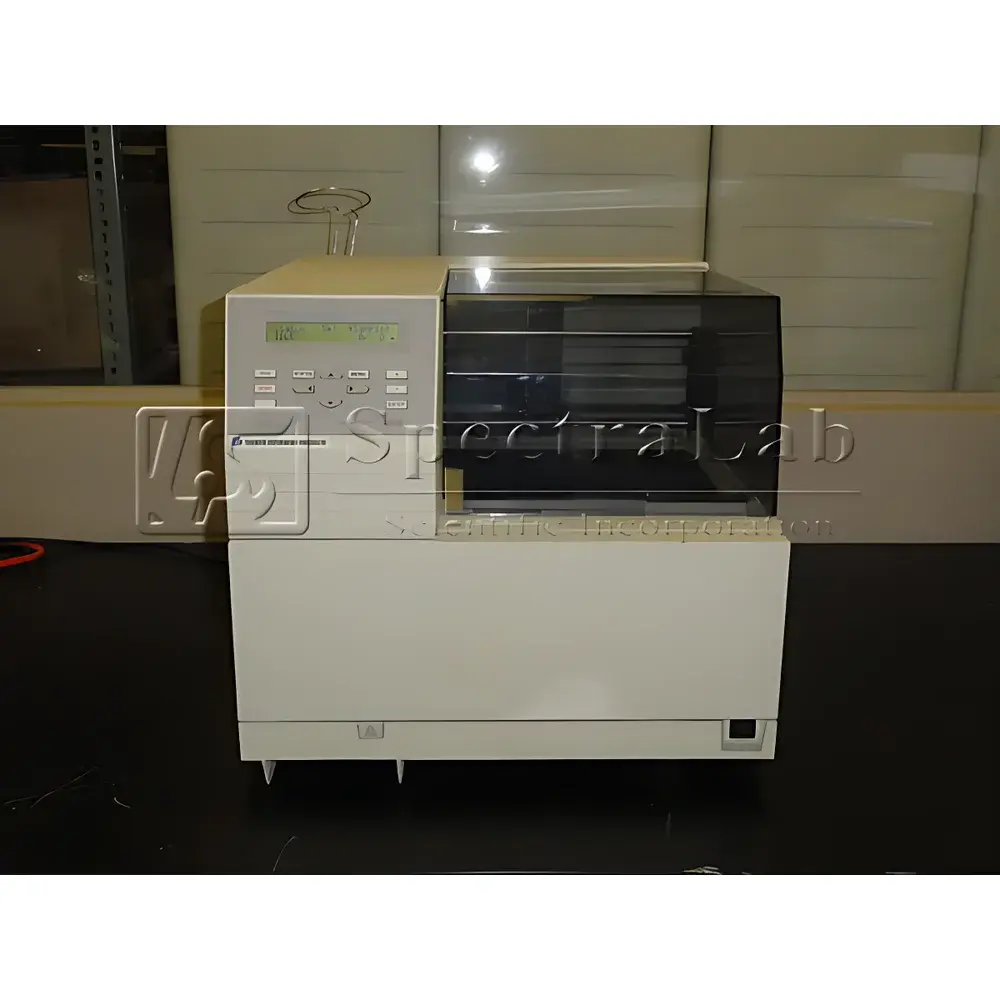
Thermo Fisher AS100 Automated Liquid Chromatography Sampler
| Brand | Thermo Fisher |
|---|---|
| Origin | Canada |
| Model | AS100 |
| Product Category | Chromatography |
| Usage Duration | 5–7 years |
| Warranty | 6 months |
| Condition | Refurbished & Fully Tested |
| Sample Capacity | 120 vials (3 programmable movable trays) |
| Precision Injection | <0.5% RSD |
| Needle Height Adjustment | Programmable in 0.1 mm increments |
| Carryover | Typically <400 nL |
| Wash Volume | Adjustable, residual contamination <0.01% |
| Certification | Factory-tested and verified per SpectraLab Scientific QC protocol |
Overview
The Thermo Fisher AS100 Automated Sampler is a high-precision, refurbished liquid chromatography (LC) autosampler engineered for robust integration with Thermo Fisher UltiMate™ and other compatible HPLC/UHPLC systems. Designed around a dual-syringe, positive-displacement injection architecture, the AS100 delivers consistent volumetric accuracy and minimal carryover through precisely controlled needle positioning, pressure-regulated sample aspiration, and configurable wash protocols. Its mechanical architecture—originally manufactured in Canada under Thermo Fisher’s ISO 9001-certified production standards—features hardened stainless-steel fluidic pathways, stepper-motor-driven tray indexing, and optical vial detection to ensure reliable operation across extended duty cycles. As a second-hand instrument fully refurbished by SpectraLab Scientific, each unit undergoes functional validation against original factory specifications, including linearity testing (5–100 µL range), precision verification (<0.5% RSD at 20 µL), and carryover assessment using caffeine or uracil test solutions.
Key Features
- Refurbished and certified operational integrity: All units are subjected to full electrical diagnostics, fluidic leak testing, syringe calibration, and temperature-stabilized injection sequence validation.
- Modular tray system supporting up to 120 standard 12 × 32 mm screw-thread or crimp-top vials across three independently movable trays—enabling multi-method batch sequencing without manual intervention.
- Sub-millimeter needle height programming (0.1 mm resolution) ensures optimal insertion depth for diverse vial types and septa thicknesses, minimizing coring and improving seal longevity.
- Intelligent wash station with dual solvent capability (Wash Solvent A/B) and adjustable volume control (10–500 µL), validated to achieve <0.01% carryover for high-sensitivity applications such as trace pharmaceutical impurity analysis.
- Onboard memory retains method parameters and tray maps; firmware version compatibility documented for Thermo Chromeleon™ CDS versions 7.2.1 through 7.4.2.
Sample Compatibility & Compliance
The AS100 accommodates standard LC vial formats (1.5 mL, 2 mL, and 4 mL), including polypropylene, glass, and low-binding variants. It supports both aqueous and organic mobile phases (including acetonitrile, methanol, and THF), with wetted materials compliant with USP Class VI biocompatibility requirements. While not supplied with 21 CFR Part 11-compliant audit trail functionality out-of-the-box, the unit operates seamlessly within validated Chromeleon environments where electronic records, user authentication, and change control are enforced at the software layer. Refurbishment documentation—including calibration logs, performance qualification (PQ) reports, and electrical safety verification—is provided with each shipment, supporting GLP and ISO/IEC 17025-aligned laboratory practices.
Software & Data Management
The AS100 communicates via RS-232 or USB-to-serial interface and is fully recognized by Thermo Chromeleon Chromatography Data System (CDS) without driver modification. SpectraLab Scientific provides configuration templates for common workflows: gradient elution with timed valve switching, scheduled column equilibration, and multi-injection replicates with automatic re-injection upon peak area deviation alerts. Raw diagnostic logs—including syringe pressure traces, tray position timestamps, and injection event metadata—are exportable in CSV format for root-cause analysis during method transfer or troubleshooting. No cloud connectivity or proprietary firmware updates are required; all firmware remains at stable, production-proven revision levels.
Applications
This refurbished AS100 is routinely deployed in QC laboratories performing compendial testing per USP , EP 2.2.46, and JP 6.04 methodologies—particularly for dissolution testing, assay quantitation of small-molecule APIs, and stability-indicating assays requiring high injection-to-injection reproducibility. Its low carryover profile and precise volume delivery make it suitable for bioanalytical support workflows (e.g., plasma extract analysis prior to LC-MS/MS), environmental monitoring (EPA Method 8330B), and polymer additive screening where matrix complexity demands stringent blank integrity. Units are also integrated into academic core facilities for teaching HPLC fundamentals and method development courses.
FAQ
Is the AS100 compatible with non-Thermo HPLC systems?
Yes—when operated in external trigger mode using TTL-level start signals and analog voltage feedback, the AS100 can be synchronized with Agilent 1260/1290, Waters e2695, and Shimadzu Nexera systems via third-party interface modules.
What documentation accompanies the refurbished unit?
Each shipment includes a Certificate of Refurbishment, PQ report (injection precision, carryover, linearity), electrical safety test record, and firmware version log—all traceable to SpectraLab Scientific’s internal QA registry.
Can the 6-month warranty be extended?
Yes—extended service plans (12 or 24 months) covering parts, labor, and on-site technician dispatch are available upon request and subject to regional availability.
Are spare parts and consumables available?
SpectraLab maintains inventory of OEM-compatible syringes, needle assemblies, rotor seals, and tray drive belts; lead time is typically 3–5 business days.
Does the unit include a chiller or temperature-controlled compartment?
No—the AS100 does not feature active sample cooling; ambient operation is specified at 15–30 °C with relative humidity ≤70% non-condensing. Integration with external chillers requires custom manifold design.