
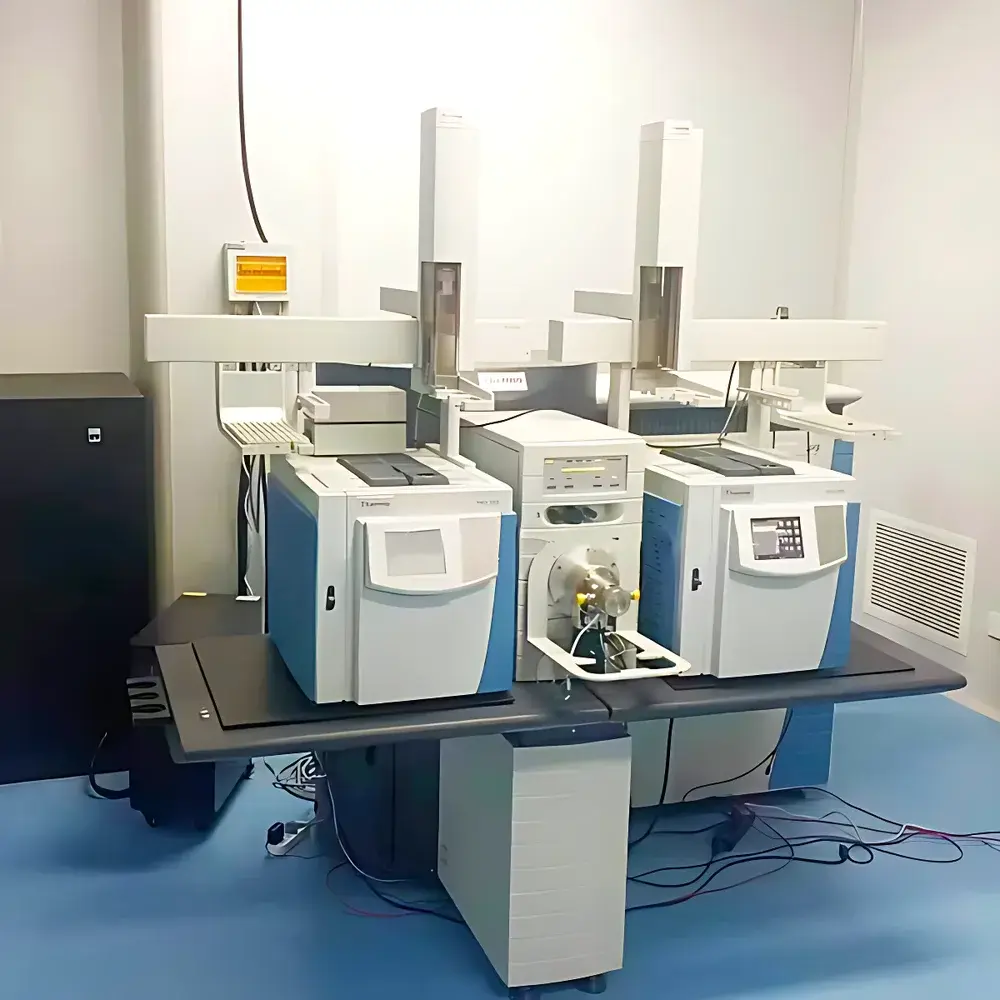
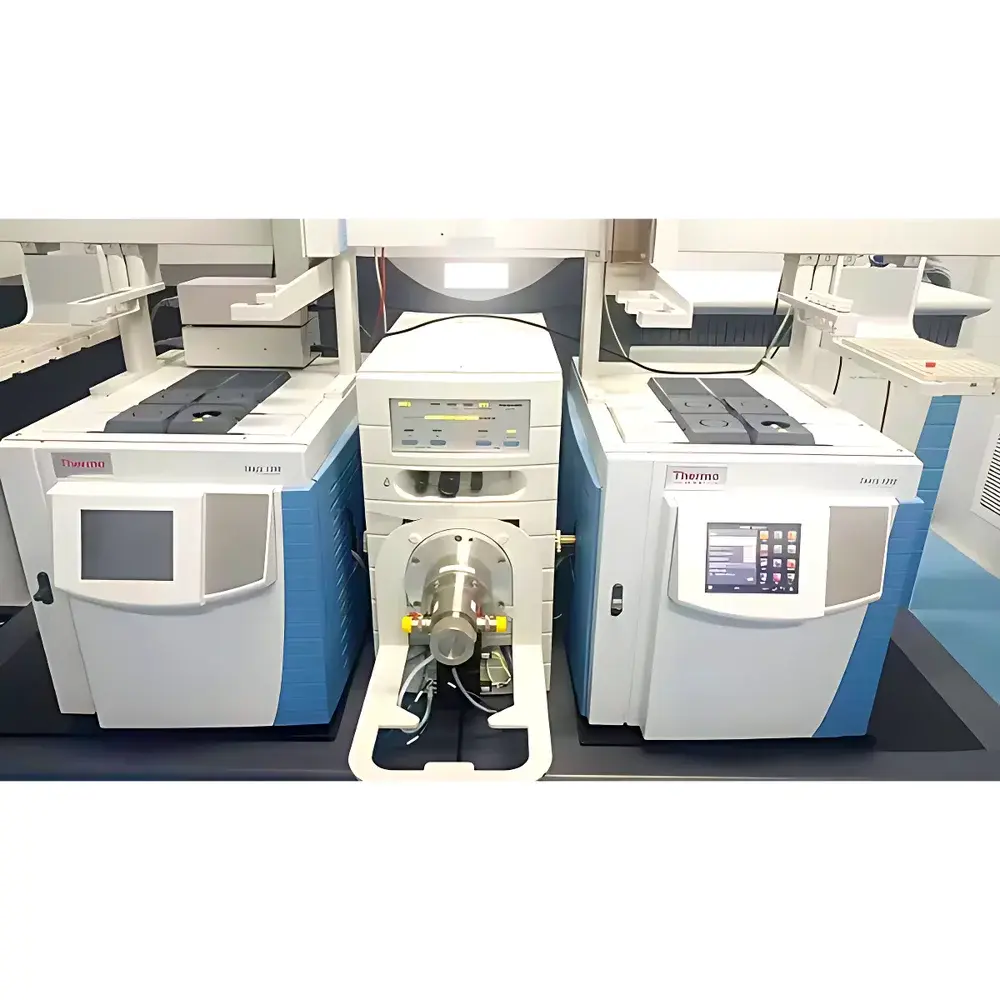
Thermo Fisher DFS+ High-Resolution Magnetic Sector Isotope Ratio Mass Spectrometer
| Brand | Thermo Fisher |
|---|---|
| Origin | USA |
| Manufacturer Type | Authorized Distributor |
| Product Category | Imported Instrument |
| Model | DFS+ |
| Instrument Type | Rare Gas Isotope Ratio Mass Spectrometer |
| Measurement Precision | 0.1‰ (delta notation, per mil) |
| Measured Isotopes | δ¹³C, δ¹⁵N, δ¹⁸O, δ²H, δ³⁴S, and noble gas isotopes (e.g., ³⁶Ar, ³⁸Ar, ⁴⁰Ar, ⁸⁴Kr, ¹³²Xe) |
| Mass Range | 2–500 u |
| Mass Resolution (M/ΔM) | 110,000 (at 10% valley definition) |
| Sensitivity | ≥1000 V per picomole of CO₂ (for δ¹³C analysis under standard dual-inlet configuration) |
Overview
The Thermo Fisher DFS+ is a high-resolution magnetic sector isotope ratio mass spectrometer (IRMS) engineered for ultra-precise stable isotope ratio measurements in geochemical, environmental, clinical, and forensic laboratories. Unlike quadrupole or time-of-flight systems, the DFS+ employs double-focusing magnetic sector mass analysis—combining a high-stability 90° radial electromagnet with a novel toroidal electrostatic analyzer (ESA) to achieve simultaneous energy and direction focusing of ion beams. This dual-focusing architecture delivers exceptional mass-resolving power (up to 110,000 M/ΔM at 10% valley), essential for resolving isotopic peaks with near-identical mass-to-charge ratios (e.g., ⁴⁴CO₂⁺ vs. ¹³CH₃OH⁺, or ⁴⁰Ar⁺ vs. ⁴⁰Ca⁺). Designed specifically for continuous-flow (CF-IRMS) and dual-inlet (DI-IRMS) configurations, the DFS+ supports rigorous δ-value determinations compliant with IUPAC delta-scale conventions and traceable to international reference materials (e.g., VPDB, AIR-N₂, VSMOW).
Key Features
- Radiating laminated magnet design enabling long-term field stability (<0.5 ppm/h drift) and reduced hysteresis during mass scanning
- Field-calibrated mass scale: mass calibration remains invariant across scan speed, ion polarity (positive/negative), and ionization mode (EI, CI, or thermal ionization)
- Toroidal ESA with vertical and horizontal double-bending geometry—corrects both spherical and chromatic aberrations, maximizing ion transmission efficiency and signal coherence
- Multi-collector detection system featuring Faraday cups and discrete-dynode secondary electron multipliers (SEMs), configurable for simultaneous multi-isotope detection (e.g., ¹²C, ¹³C, ¹⁴N, ¹⁵N in single acquisition)
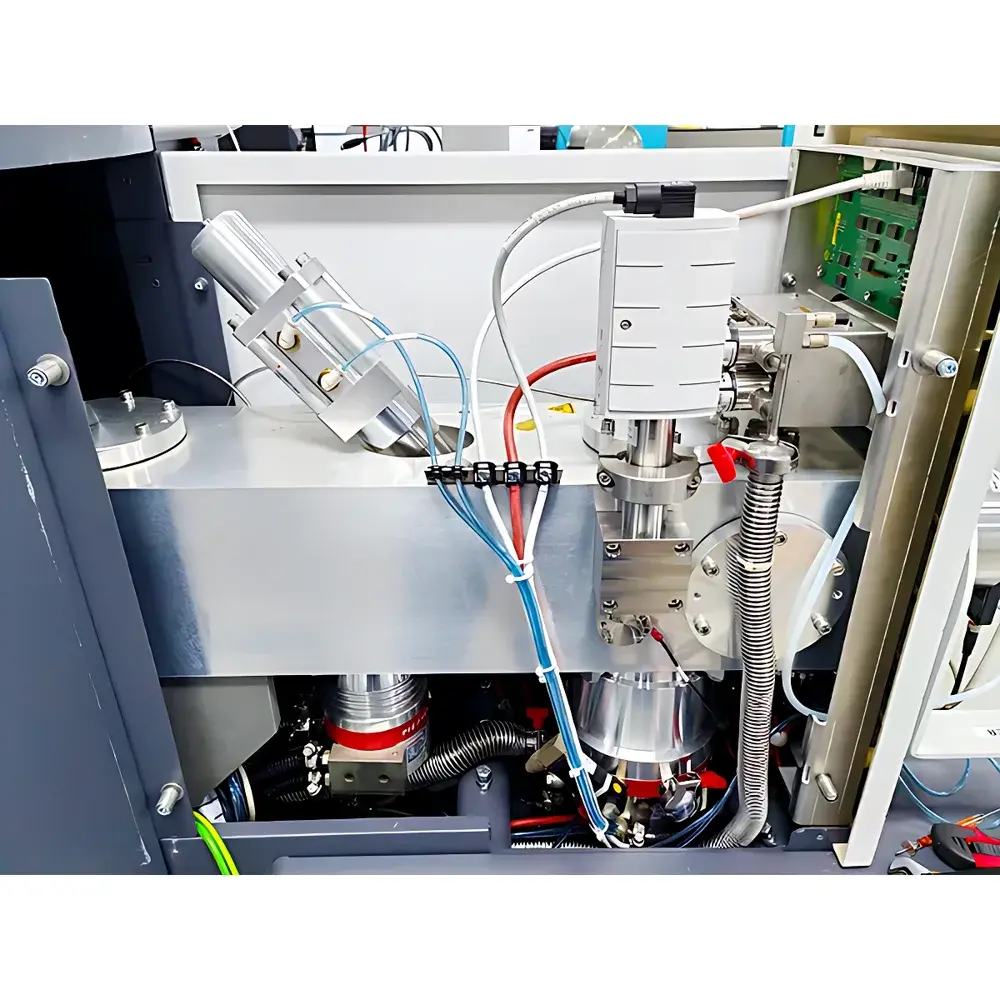
- Pneumatic valve–based vacuum lock mechanism: enables rapid ion source exchange without venting the main analysis chamber, reducing downtime by >85%
- Movable ion source assembly with tool-free access—facilitates routine cleaning, filament replacement, and source alignment under ambient conditions
- Integrated “Power-on-Demand” magnetic current regulation: reduces standby power consumption by 40% versus legacy sector instruments while maintaining field ramp reproducibility <±0.02% (RSD)
Sample Compatibility & Compliance
The DFS+ interfaces seamlessly with Thermo Trace 1310 GC systems and TriPlus RSH autosamplers for compound-specific isotope analysis (CSIA) of volatile organics (e.g., chlorinated solvents, BTEX, pesticides). It also couples with elemental analyzers (e.g., Flash EA, TC/EA) for bulk δ¹³C, δ¹⁵N, δ¹⁸O, and δ³⁴S measurements in solids and liquids. For noble gas analysis, the instrument supports ultra-high-vacuum purification lines (e.g., SAES GP50 getters, cryo-traps) and calibrated micro-volume introduction. All operational parameters—including peak centering, amplifier gain, and baseline correction—are fully audit-trail enabled per FDA 21 CFR Part 11 and ISO/IEC 17025 requirements. Data acquisition and processing comply with ASTM D7622 (δ¹³C in biofuels), ASTM D8203 (noble gas isotopes in groundwater), and USP validation guidelines.
Software & Data Management
Control and data reduction are performed via Thermo Scientific™ Delta V™ software—a GLP-compliant platform supporting automated method sequencing, real-time background subtraction, and multi-point internal standard normalization. The software implements robust statistical algorithms for drift correction (e.g., linear, exponential, or spline-based), linearity assessment (R² > 0.9999 over 5 orders of magnitude), and uncertainty propagation per GUM (JCGM 100:2018). Raw .raw files are stored in vendor-neutral HDF5 format, enabling third-party integration with Python-based isotope data pipelines (e.g., isoR, IRMSpy). Audit logs record every parameter change, user login, calibration event, and detector voltage adjustment—fully traceable for regulatory inspections.
Applications
The DFS+ serves as a reference-grade instrument in accredited laboratories performing high-stakes isotope analyses: forensic attribution of illicit drugs (δ¹³C, δ¹⁵N, δ²H fingerprints), geochronology via ⁴⁰Ar/³⁹Ar step-heating, paleoclimate reconstruction from foraminiferal δ¹⁸O, authentication of food origin (e.g., honey, olive oil, wine), and monitoring of carbon sequestration integrity using δ¹³C/δ¹⁴C dual-isotope tracing. Its sub-0.1‰ (1σ) long-term precision for δ¹³C makes it suitable for detecting subtle metabolic shifts in clinical metabolomics (e.g., ¹³C-glucose tracer studies), while its noble gas capability supports nuclear safeguards verification (e.g., ¹²⁹Xe/¹³²Xe ratios in atmospheric sampling).
FAQ
What is the minimum sample size required for δ¹³C analysis in dual-inlet mode?
Typical requirements are 1–5 µg of carbon for CO₂ gas; solid samples (e.g., cellulose, carbonate) require ≥100 µg depending on carbon content.
Does the DFS+ support simultaneous measurement of multiple isotopes?
Yes—the multi-collector array allows concurrent detection of up to nine isotopes (e.g., ¹²C, ¹³C, ¹⁴N, ¹⁵N, ¹⁶O, ¹⁸O, ³²S, ³⁴S, ⁴⁰Ar) with inter-channel gain matching calibrated to ≤0.05% RSD.
Is remote diagnostics supported?
Yes—Delta V software includes secure TLS-encrypted remote access for firmware updates, spectral troubleshooting, and preventive maintenance alerts.
Can the DFS+ be upgraded for noble gas analysis?
Yes—factory-installed noble gas configuration includes ultra-high-vacuum turbomolecular pumping, cryogenic trapping stages, and specialized ion optics optimized for masses 2–132 u.
What vacuum level is maintained during analysis?
The main analyzer chamber operates at ≤5 × 10⁻⁹ mbar, verified by Bayard-Alpert gauge and cross-checked via residual gas analysis (RGA) during commissioning.
Related Products






