
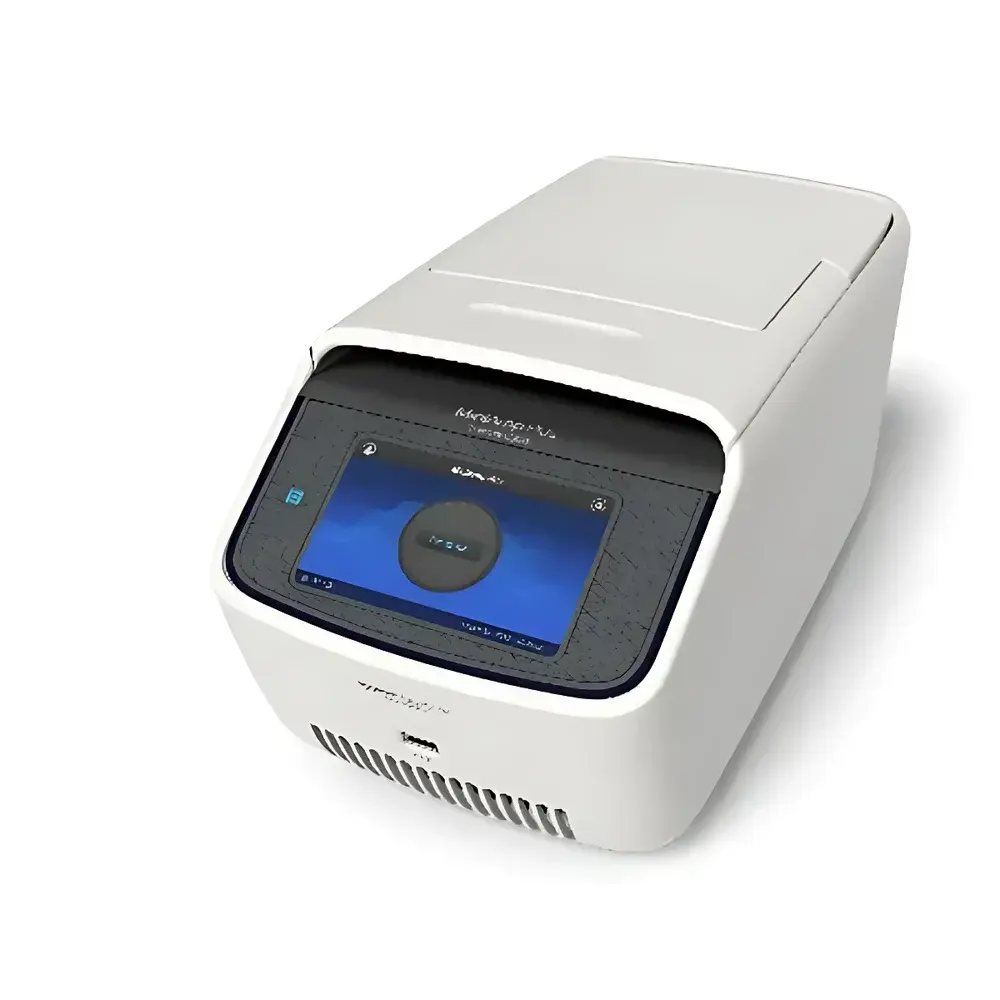
Thermo Fisher MiniAmp Plus PCR Thermal Cycler
| Brand | Thermo Fisher |
|---|---|
| Origin | Shanghai, China |
| Manufacturer Type | Authorized Distributor |
| Product Category | Domestic |
| Model | Thermo Fisher MiniAmp Plus PCR Thermal Cycler |
| Instrument Type | Standard Endpoint PCR Cycler |
| Sample Capacity | 96-well (0.2 mL) |
| Heating Rate | 3.5 °C/sec (programmable ramp rate) |
| Temperature Accuracy | ±0.25 °C (35–99.9 °C) |
| Well-to-Well Uniformity | <0.5 °C (30 sec after reaching 95 °C) |
| VeriFlex Module | 3 independent thermal zones (10 °C zone separation, 20 °C total span) |
| Thermal Lid Temperature Range | 30–110 °C (default 105 °C, lid deactivation supported) |
| Temperature Range | 0–100.0 °C |
| Sample Ramp Rate (reaction volume–optimized) | 2.7 °C/sec |
| NIST-Traceable Calibration | Yes |
| Onboard Storage | 2,000 MB (>1,000 protocols) |
| Display | 5-inch color TFT LCD touchscreen |
| Dimensions (H×W×D) | 20 × 19 × 39 cm |
| Weight | 6.75 kg |
| Power Input | 100–240 V, 50–60 Hz, max 500 W |
| PCR Volume Range | 10–100 µL (compatible with 1–100 µL reactions) |
| Thermal Simulation Mode | Supports emulation of Applied Biosystems 2720, Bio-Rad T100™, MyCycler™, MJ Research PTC-200, Takara Dice, BIOER XP Cycler |
| Connectivity | Ethernet-enabled for multi-unit networked operation (no additional software license required) |
| User Management | Role-based account system with password-protected protocol folders |
| AutoDelta Function | Programmable linear temperature/time decrement/increment per cycle (for touchdown or long-range PCR) |
| Safety & Compliance | Designed and validated in accordance with IEC 61010-1 (Safety Requirements for Electrical Equipment for Measurement, Control, and Laboratory Use) |
Overview
The Thermo Fisher MiniAmp Plus PCR Thermal Cycler is an endpoint polymerase chain reaction instrument engineered for precision, reproducibility, and operational efficiency in routine molecular biology workflows. Built upon the foundational thermal control architecture of Applied Biosystems PCR systems, it implements a solid-state Peltier-based heating/cooling system coupled with a proprietary VeriFlex thermal module — a three-zone, independently controlled 96-well platform that enables deterministic, non-empirical optimization of annealing conditions. Unlike conventional gradient PCR instruments — which rely on spatial thermal gradients across a single heated block and introduce uncertainty due to edge effects and non-linear heat diffusion — the MiniAmp Plus delivers discrete, user-defined temperatures in three parallel sub-blocks within one run. This architecture supports simultaneous evaluation of up to three distinct annealing temperatures under identical cycling kinetics, eliminating interpolation error and reducing optimization cycles by up to 60% in empirical assay development. Its compact footprint (19 cm wide), NIST-traceable temperature calibration, and broad operating range (0–100.0 °C) make it suitable for academic teaching labs, clinical QC environments, and industrial R&D settings requiring reliable, entry-level endpoint amplification without compromise on thermal fidelity.
Key Features
- VeriFlex 3-zone thermal module: Enables precise, concurrent annealing temperature testing (e.g., 55 °C, 58 °C, 61 °C) within a single 96-well run — no gradient estimation required.
- Programmable ramp rates: Independent control of heating (up to 3.5 °C/sec) and sample-specific cooling (up to 2.7 °C/sec) ensures consistent thermal kinetics across diverse primer-template systems.
- NIST-traceable calibration: Factory-calibrated against National Institute of Standards and Technology reference standards; documentation available for ISO/IEC 17025-compliant laboratories.
- Thermal simulation mode: Emulates thermal profiles of legacy platforms (e.g., AB 2720, Bio-Rad T100, Takara Dice), facilitating method transfer and instrument fleet harmonization.
- AutoDelta functionality: Supports touchdown PCR and long-range amplification via linear per-cycle temperature or time modulation — configurable without scripting.
- Robust user management: Role-based access control with encrypted protocol storage, password-protected folders, and audit-ready run log export (CSV/PDF).
- Networked scalability: Ethernet interface allows up to 16 units to be managed from a single host node — no third-party software or licensing required.
Sample Compatibility & Compliance
The MiniAmp Plus accepts standard 0.2 mL skirted or semi-skirted 96-well PCR plates and tube strips, supporting reaction volumes from 10–100 µL (validated for 1–100 µL). Its VeriFlex module maintains <0.5 °C well-to-well uniformity at 95 °C (measured 30 seconds post-equilibration), meeting ASTM E2573-18 criteria for thermal homogeneity in nucleic acid amplification devices. The instrument complies with IEC 61010-1:2010 for laboratory electrical safety and incorporates fail-safes including lid-open detection, overtemperature cutoff, and automatic power recovery after interruption. While not FDA 21 CFR Part 11–certified out-of-the-box, its exportable run logs (with timestamps, operator ID, and parameter metadata) support integration into GLP/GMP workflows when paired with validated laboratory information management systems (LIMS).
Software & Data Management
Operation is fully self-contained via a 5-inch capacitive touchscreen running a real-time embedded OS. No PC or external software is required for protocol creation, execution, or data review. The onboard 2 GB flash memory stores >1,000 protocols with version history, and all run logs include start/end time, cycle-by-cycle temperature profiles, lid status, and user authentication tags. Logs are exportable via USB 2.0 port in CSV format for traceability and regulatory submission. Networked units synchronize protocol libraries automatically; administrator-level accounts can push updates or restrict editing rights per user group. Thermal simulation profiles are preloaded and selectable from the main menu — no firmware modification needed.
Applications
- Routine end-point PCR for genotyping, colony screening, and plasmid verification
- Primer annealing optimization using deterministic multi-zone testing
- Touchdown and long-range PCR via AutoDelta-controlled cycling parameters
- Post-PCR incubation (e.g., restriction digestion, ligation, or enzyme inactivation) using stable zone-specific hold modes
- Teaching laboratory instruction where space, cost, and intuitive interface are critical constraints
- QC release testing in low-throughput diagnostic or biomanufacturing support labs
FAQ
Is the MiniAmp Plus compatible with fast-cycling PCR chemistries?
Yes — its programmable ramp rates (up to 3.5 °C/sec heating, 2.7 °C/sec cooling) and tight thermal uniformity support fast-cycling protocols without sacrificing specificity or yield.
Can I validate temperature performance in-house?
Yes — the instrument includes built-in self-test diagnostics and supports external validation using NIST-traceable thermistor probes (e.g., Fluke 1523/1524); calibration certificates are provided with shipment.
Does it support USB keyboard or mouse input?
No — the interface is optimized for direct touchscreen interaction only; no peripheral HID support is implemented.
What happens during a power outage?
The system resumes the interrupted run from the last completed cycle upon power restoration, provided the thermal block remains above 4 °C; otherwise, it prompts user confirmation before restarting.
Is remote monitoring or cloud connectivity available?
No — the Ethernet interface supports only local area network (LAN) discovery and peer-to-peer control; no internet-facing services, cloud APIs, or remote desktop functionality are included.





