
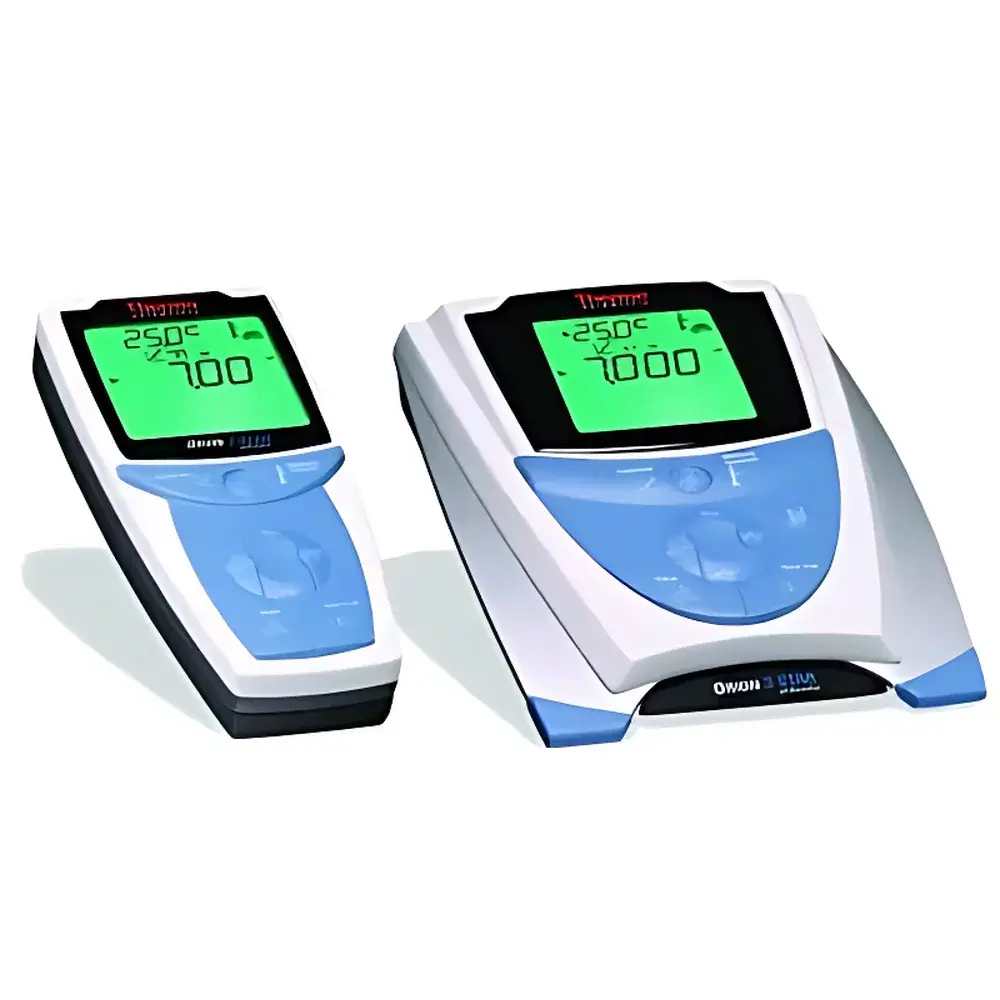
Thermo Fisher Orion 3-Star Benchtop/Portable pH/ORP Meter
| Brand | Thermo Fisher |
|---|---|
| Origin | USA |
| Manufacturer | Thermo Fisher Scientific |
| Product Type | Imported Instrument |
| Model | 3-Star |
| Price | Upon Request |
| pH Range | -2.000 to 19.999 |
| pH Resolution | 0.1 / 0.01 / 0.001 |
| pH Accuracy | ±0.001 |
| Calibration Points | 1–5-point with US/NIST, DIN, or Custom Buffers |
| ORP Range | ±1999.9 mV |
| ORP Resolution | 0.1 mV |
| ORP Accuracy | ±0.1 mV or ±0.05% (whichever is greater) |
| Temperature Range | -5 to 105 °C |
| Temperature Resolution | 0.1 °C (-5 to 99.9 °C), 1.0 °C (>99.9 °C) |
| Temperature Accuracy | ±0.1 °C |
| Temperature Compensation | Automatic or Manual |
| Display | Backlit LCD |
| Electrode Interface | pH – BNC |
| Communication | Bidirectional RS232, optional USB cable |
| Data Logging | 1000 readings |
| Calibration History | Last 10 calibrations |
| Method Storage | 10 user-defined methods |
| Password Protection | 10 user accounts |
| Power | 4×AA batteries |
| Certifications | CE, CSA, UL, TÜV, FCC Class A |
| Operating Environment | 5–45 °C, 5–85% RH (non-condensing) |
| IP Rating | Benchtop – IP54 |
| Dimensions (Benchtop) | 9.4 × 17.0 × 22.4 cm (H×W×L) |
| Dimensions (Portable) | 4.8 × 9.7 × 21.3 cm (H×W×L) |
Overview
The Thermo Fisher Orion 3-Star Benchtop/Portable pH/ORP Meter is a precision electrochemical instrument engineered for reliable, traceable, and repeatable measurement of hydrogen ion activity (pH) and oxidation-reduction potential (ORP) across laboratory, field, and quality control environments. Based on potentiometric principles, the meter measures the voltage difference between a pH-sensitive glass electrode (or ORP redox electrode) and a stable reference electrode—typically Ag/AgCl—under controlled temperature conditions. Its dual form factor—fully functional benchtop and ruggedized portable configurations—enables seamless transition between controlled lab settings and demanding outdoor or production-floor applications. Designed and manufactured in the United States by Thermo Fisher Scientific, the 3-Star platform predates the Star A series but remains widely deployed in regulated and non-regulated settings where robustness, long-term stability, and compliance-ready functionality are prioritized. While superseded in new product development by the Star A series, the 3-Star continues to serve as a validated workhorse in legacy installations, method transfers, and educational laboratories requiring NIST-traceable calibration and GLP-compliant data handling.
Key Features
- Precision pH measurement over an extended range of −2.000 to 19.999, with selectable resolution down to 0.001 pH units and accuracy of ±0.001 at 25 °C.
- ORP measurement capability from ±1999.9 mV with 0.1 mV resolution and accuracy specified as ±0.1 mV or ±0.05% of reading (whichever is greater), supporting both relative (mV) and absolute (RmV/EH) reporting modes.
- Intelligent endpoint detection via Smart Stability™ and Smart Averaging™ algorithms, minimizing operator dependency and improving reproducibility during titration-like workflows or unstable sample conditions.
- Automated buffer recognition for US/NIST (1.68, 4.01, 7.00, 10.01, 12.46) and DIN (1.68, 4.01, 6.86, 9.18) standards—reducing calibration errors and accelerating setup time.
- Dual power architecture: benchtop units support universal AC adapters and 4×AA alkaline batteries; portable units operate up to ~2000 hours on the same battery configuration—ideal for remote sampling campaigns.
- IP67-rated portable housing and IP54-rated benchtop enclosure ensure operational integrity in humid, dusty, or splash-prone environments—validated per IEC 60529.
- Built-in password-protected method storage (10 methods) and user account management (10 profiles), facilitating multi-user laboratories operating under defined SOPs.
Sample Compatibility & Compliance
The Orion 3-Star is compatible with all standard BNC-output pH and ORP electrodes—including double-junction, refillable, gel-filled, and specialized low-ionic-strength probes—when paired with appropriate miniDIN temperature sensors. Its analog input architecture ensures compatibility with legacy Orion electrodes and third-party sensors meeting ISE/pH output specifications. From a regulatory perspective, the instrument supports audit-ready operation when used with compliant electrodes and documented procedures. Data integrity features—including timestamped calibration logs (last 10 calibrations), full method recall, and secure user authentication—align with foundational expectations of ISO/IEC 17025, CLIA, and internal GLP frameworks. Optional PC software enables export of CSV-formatted datasets and supports validation documentation for 21 CFR Part 11 compliance, including electronic signatures, audit trails, and role-based access controls—provided system-level IT infrastructure and procedural controls are implemented accordingly.
Software & Data Management
Data acquisition and archival are supported through bidirectional RS232 communication (with optional USB-to-RS232 adapters), enabling direct integration into LIMS or custom data collection platforms. The instrument stores up to 1000 measurement records with embedded timestamps, electrode IDs (if entered manually), temperature values, and calibration metadata. All stored data—including calibration history and method parameters—can be retrieved and exported without loss of contextual information. No proprietary cloud service or mandatory firmware updates are required; configuration remains fully local and deterministic. Firmware versioning is accessible via the front panel menu, allowing traceability during equipment qualification (IQ/OQ/PQ). For regulated environments, users are advised to maintain version-controlled backup files of calibration reports and method definitions as part of their quality documentation system.
Applications
- Environmental monitoring: surface water, wastewater effluent, and soil extract pH/ORP profiling under EPA Methods 9030B and 9040B.
- Pharmaceutical QC: raw material and excipient testing per USP , buffer verification, and cleaning validation rinse monitoring.
- Food & beverage process control: fermentation tank monitoring, brine stability assessment, and shelf-life modeling via redox potential trends.
- Academic research: teaching labs requiring intuitive interface design and consistent electrode response across student cohorts.
- Industrial cooling water treatment: real-time corrosion potential tracking and biocide efficacy evaluation using ORP endpoints.
- Electroplating bath management: maintaining optimal redox conditions for nickel, chromium, and copper deposition processes.
FAQ
Is the Orion 3-Star compliant with 21 CFR Part 11?
The instrument itself is not inherently Part 11-compliant, but when used with validated software, documented procedures, and administrative controls (e.g., user training, audit trail review, electronic signature policies), it can support a compliant workflow.
Can the 3-Star be connected to an autosampler?
Yes—the benchtop variant includes a phono-jack stirrer interface and RS232 port, enabling integration with Thermo Fisher’s Orion Auto-Sampling Systems for unattended multi-sample analysis.
Does the meter support automatic temperature compensation (ATC)?
Yes—ATC is enabled via a miniDIN-connected temperature probe; manual temperature entry is also supported.
What electrode types are recommended for low-ionic-strength samples?
Double-junction pH electrodes with KNO₃ or LiCl electrolyte bridges—such as the Orion 9107BNMD—are strongly recommended to minimize junction potential errors.
How is calibration verification performed between scheduled calibrations?
Users may perform a single-point verification using a fresh NIST-traceable buffer; deviation beyond ±0.02 pH or ±2 mV (ORP) triggers full recalibration per SOP.
Related Products






