
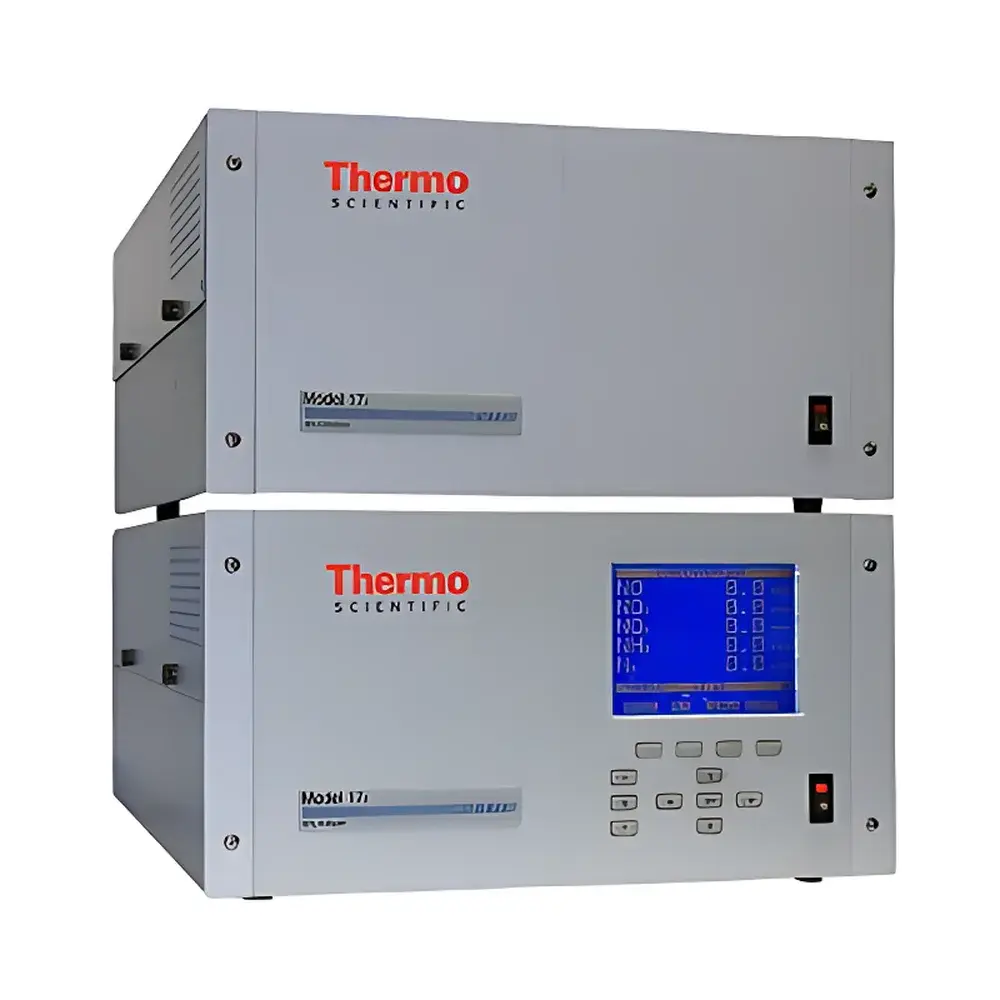
Thermo Fisher Scientific 17i Ammonia (NH₃) Analyzer
| Brand | Thermo Fisher Scientific |
|---|---|
| Origin | USA |
| Manufacturer Type | Original Equipment Manufacturer (OEM) |
| Import Status | Imported |
| Model | 17i NH₃ Analyzer |
| Instrument Type | Online Gas Analyzer |
| Detection Principle | Chemiluminescence Detection (CLD) |
| Measurement Range | 0–50, 100, 200, 500, 1,000, 2,000, 10,000, 20,000 ppb |
| Alternate Units | 0–100, 200, 500, 1,000, 2,000, 5,000, 10,000, 20,000, 30,000 µg/m³ |
| Zero Noise | 0.5 ppb RMS (120-s averaging time) |
| Limit of Detection (LOD) | 1 ppb |
| Zero Drift (24 h) | ≤1 ppb |
| Span Drift (30 days) | ≤1% of full scale |
| Analog Outputs | Independent isolated 0–10 V or 4–20 mA outputs for NO, NO₂, NH₃, and NOₓ |
| Diagnostic Capability | Real-time status monitoring, remote performance diagnostics, built-in fault detection and logging |
Overview
The Thermo Fisher Scientific 17i Ammonia (NH₃) Analyzer is a high-performance, online gas analyzer engineered for continuous, real-time quantification of atmospheric ammonia in ambient air, stack emissions, and process streams. It employs chemiluminescence detection (CLD), a well-established and metrologically traceable method that relies on the light-emitting reaction between ozone (O₃) and nitric oxide (NO) — generated in situ via catalytic reduction of NH₃ with hydrogen over a heated molybdenum converter. This selective conversion pathway ensures high specificity for NH₃ in complex matrices containing interfering gases such as water vapor, CO₂, and hydrocarbons. Designed for unattended operation in demanding environmental monitoring networks and industrial compliance applications, the 17i delivers sub-part-per-trillion sensitivity with long-term stability, meeting stringent requirements for regulatory-grade data acquisition under EPA Method 205 and ISO 11890-2.
Key Features
- Sub-ppb detection capability: Achieves a verified limit of detection (LOD) of 1 ppb with zero noise < 0.5 ppb RMS over 120-second integration, enabling reliable measurement near background concentrations.
- Multi-gas analog output architecture: Provides fully isolated, user-configurable 0–10 V DC or 4–20 mA outputs for NH₃, NO, NO₂, and NOₓ — supporting seamless integration into SCADA, DCS, and data acquisition systems without signal crosstalk.
- Automated diagnostic suite: Monitors critical operational parameters—including converter temperature, ozone generator output, photomultiplier tube (PMT) voltage, flow rates, and pressure—displaying real-time status and generating event-triggered logs for preventive maintenance planning.
- Remote performance verification: Supports remote calibration validation and zero/span checks via internal solenoid valves and certified gas standards, minimizing site visits and ensuring data continuity during GLP/GMP audits.
- Robust thermal management: Features dual-zone temperature-controlled optics and reaction chamber to mitigate condensation and thermal drift, sustaining accuracy across ambient temperatures from −20 °C to +50 °C.
- Compliance-ready firmware: Includes audit-trail functionality compliant with FDA 21 CFR Part 11 requirements when operated with Thermo’s optional Traceable™ Data Management Software.
Sample Compatibility & Compliance
The 17i is optimized for gaseous samples with particulate loading < 10 µg/m³ and dew point ≤ −20 °C. Sample conditioning is achieved via Nafion™ dryer or chilled mirror dew point control (optional), ensuring consistent moisture removal without NH₃ adsorption losses. The analyzer meets EN 14625:2012 for ambient NH₃ monitoring and supports adherence to U.S. EPA Ambient Air Monitoring Guidelines (Appendix A to 40 CFR Part 58). Its design incorporates fail-safe interlocks, redundant sensor feedback loops, and automatic fault flagging aligned with IEC 61508 SIL 2 functional safety principles for continuous emission monitoring systems (CEMS).
Software & Data Management
The instrument operates natively with Thermo’s INTELLILOG™ embedded firmware, supporting Modbus TCP/IP, Ethernet/IP, and RS-232/485 protocols for bidirectional communication. When paired with the optional Traceable™ Data Acquisition Suite, it enables secure, timestamped data storage with electronic signatures, change history tracking, and export to CSV, XML, or EPA-compatible .DAT formats. All calibration events, diagnostic alerts, and configuration changes are logged with immutable timestamps — satisfying ALCOA+ (Attributable, Legible, Contemporaneous, Original, Accurate, Complete, Consistent, Enduring, Available) data integrity criteria required by environmental regulators and quality assurance departments.
Applications
- Ambient air quality networks (e.g., EPA CASTNet, EMEP, national AQMS programs)
- Agricultural emission monitoring near livestock facilities and fertilizer application zones
- Industrial stack monitoring for chemical manufacturing, refrigeration, and semiconductor fabrication
- Indoor air quality assessment in wastewater treatment plants and animal housing facilities
- Research-grade flux measurements using eddy covariance systems requiring fast-response NH₃ concentration inputs
- Calibration reference standard for portable NH₃ sensors and diffusion tube networks
FAQ
What is the recommended sample flow rate and pressure range for optimal performance?
The 17i operates at a nominal sample flow of 0.8–1.2 L/min with inlet pressure maintained between 95–105 kPa absolute; deviations beyond this range trigger automatic flow compensation or alarm states.
Does the 17i require external ozone generation?
No — it integrates a solid-state, UV-based ozone generator with closed-loop concentration control, eliminating dependency on external O₃ sources and reducing maintenance intervals.
Can the 17i be used for measuring NH₃ in high-humidity or corrosive stack gases?
Yes, provided appropriate sample conditioning is implemented: a heated sampling line (≥180 °C) combined with a Nafion™ dryer or permeation dryer is strongly recommended to prevent NH₃ loss on wet surfaces and avoid catalyst poisoning.
Is the molybdenum converter replaceable in the field?
Yes — the Mo-converter assembly is a user-serviceable module with documented replacement procedure and lifetime specification of ≥12 months under typical ambient monitoring conditions.
How does the 17i handle cross-sensitivity to other nitrogen-containing compounds?
The heated Mo-converter exhibits >95% selectivity for NH₃ over common interferents (e.g., amines, hydrazine); residual interference is corrected via factory-characterized response factors stored in calibration memory.







