
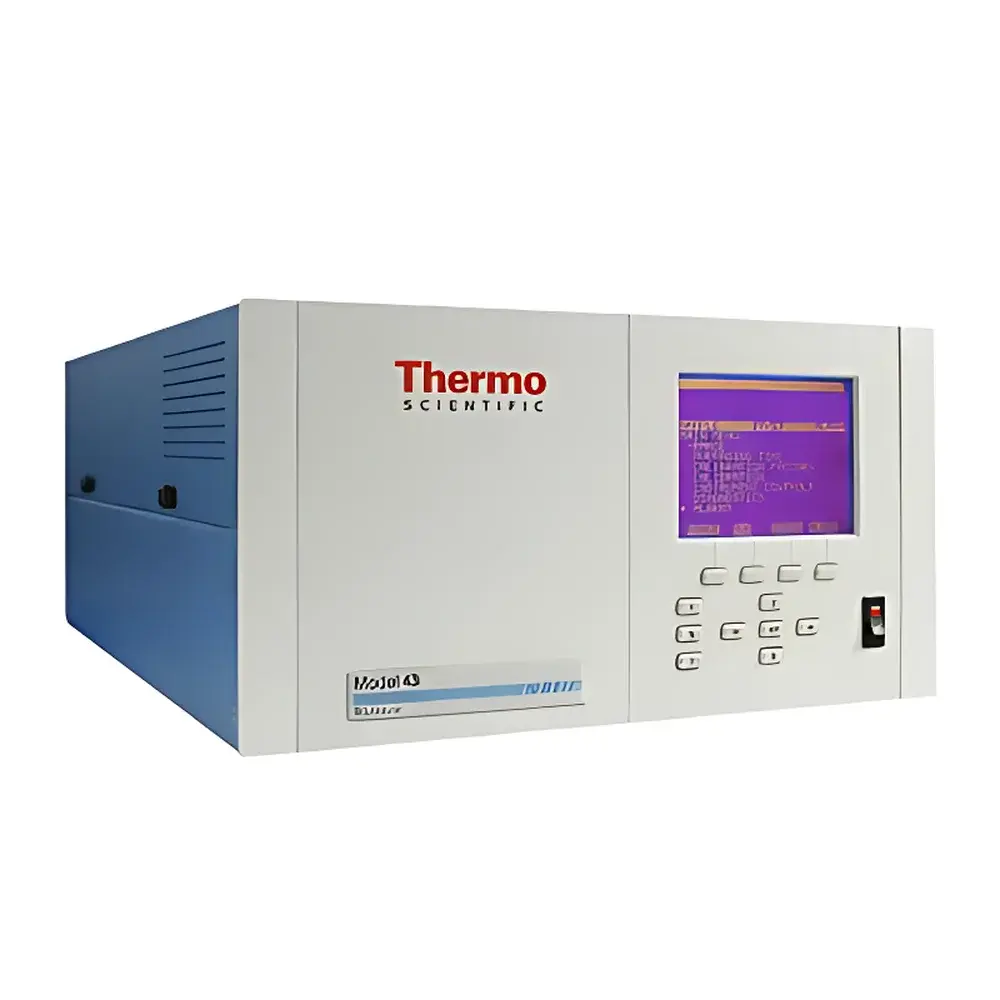
Thermo Fisher Scientific 43i Series Sulfur Dioxide (SO₂) Analyzer
| Brand | Thermo Fisher |
|---|---|
| Origin | USA |
| Manufacturer | Thermo Fisher Scientific |
| Product Type | Imported |
| Models | 43i, 43i-HL, 43i-TLE |
| Instrument Type | Online Continuous Emission Monitor |
| Target Gas | SO₂ |
| Response Time (Lag Time) | <20 s |
| Measurement Precision | 1 ppb (for 43i) |
| Measurement Ranges | 43i: 0–0.05 / 0.1 / 0.2 / 0.5 / 1 / 2 / 5 / 10 ppm |
| 43i-HL | 0–10 / 20 / 50 / 100 / 200 / 500 / 1000 ppm |
| 43i-TLE | 0–10 / 20 / 50 / 100 / 200 / 500 / 1000 ppb |
| Zero Noise | 0.5 ppb RMS (60 s avg, 43i) / 0.25 ppm RMS (300 s avg, 43i-HL) / 0.025 ppb RMS (300 s avg, 43i-TLE) |
| Detection Limit | <0.5 ppb (43i) / 0.5 ppm (43i-HL) / 0.05 ppb (43i-TLE) |
| Zero Drift (24 h) | <1.0 ppb (43i) / <1 ppm (43i-HL) / <0.2 ppb (43i-TLE) |
| Span Drift (24 h) | ±0.5% FS (43i) / ±1% FS (43i-HL & 43i-TLE) |
Overview
The Thermo Fisher Scientific 43i Series Sulfur Dioxide (SO₂) Analyzer is a high-performance, EPA-designated reference-grade instrument engineered for continuous ambient air quality monitoring and stack emission compliance applications. It employs pulsed ultraviolet (UV) fluorescence detection—a highly selective and sensitive optical technique in which SO₂ molecules are excited by short-wavelength UV light (typically 214 nm), emitting characteristic fluorescence at ~320 nm. This signal is isolated via optical filtering and quantified using a low-noise photomultiplier tube (PMT), delivering exceptional specificity with minimal cross-sensitivity to ozone, NO₂, or hydrocarbons. The analyzer operates under strict adherence to U.S. EPA Method 40 CFR Part 53 for equivalency determinations and meets EN 14212:2012 requirements for ambient SO₂ measurement in the European Union. Its modular architecture supports seamless integration into national air quality networks (e.g., AQS, EEA AirBase) and industrial continuous emission monitoring systems (CEMS).
Key Features
- Pulsed UV fluorescence detection with real-time background subtraction, enabling sub-part-per-trillion-level sensitivity and long-term baseline stability.
- Three model variants optimized for distinct concentration regimes: standard-range 43i (ppm), high-level 43i-HL (up to 10,000 ppm), and trace-level 43i-TLE (sub-ppb resolution).
- Intelligent on-board diagnostics including automatic zero/span validation, lamp intensity monitoring, and flow path integrity checks—fully compliant with EPA PS-1 and PS-2 performance specifications.
- Large backlit LCD display with user-configurable soft keys for rapid access to calibration logs, alarm status, and real-time concentration plots.
- Embedded flash memory (≥2 GB) supporting ≥18 months of second-by-second data storage with timestamped audit trails—meeting FDA 21 CFR Part 11 and ISO/IEC 17025 data integrity requirements.
- RS-232, RS-485, Ethernet (TCP/IP), and optional Modbus RTU/ASCII protocols for SCADA, EMS, and central data acquisition systems.
- Modular internal layout with tool-less access to optical chamber, PMT assembly, and gas handling components—reducing mean time to repair (MTTR) to under 15 minutes.
Sample Compatibility & Compliance
The 43i Series accommodates a wide range of sampling configurations—including heated sample lines (up to 180 °C), Nafion dryers, and particle filters—to ensure representative analysis of humid, particulate-laden, or thermally unstable gas streams. All models comply with ISO 7203 (ambient air), ASTM D5019 (stack testing), and USP environmental monitoring guidelines. The 43i and 43i-TLE are certified as Federal Equivalent Methods (FEM) under EPA EQPM-0807-153 and EQPM-0812-177; the 43i-HL meets EPA PS-17 for high-concentration source testing. Each unit undergoes factory verification per ISO/IEC 17025-accredited procedures, including multi-point linearity assessment, temperature coefficient evaluation, and pressure sensitivity testing across operating ranges of 60–106 kPa and 0–50 °C.
Software & Data Management
Thermo Fisher’s Instrument Manager™ software provides full remote configuration, firmware updates, and historical data retrieval via secure HTTPS or SSH. Raw fluorescence counts, analog output values, diagnostic flags, and calibration metadata are logged with ISO 8601 timestamps and stored in CSV or NetCDF format. The system supports automated report generation aligned with EU Directive 2008/50/EC Annex IX and U.S. Clean Air Act Title IV reporting formats. Audit trail functionality records all operator actions—including method changes, zero/span executions, and parameter edits—with immutable user ID, timestamp, and reason-for-change fields. Data export complies with EPA Data Validation and Verification (DVV) protocols and integrates natively with AQS, AirWatch, and third-party LIMS platforms via ODBC or RESTful API.
Applications
- Ambient air quality monitoring networks (AQN) operated by EPA, EEA, and national environmental agencies.
- Continuous emissions monitoring (CEM) at coal-fired power plants, cement kilns, and sulfuric acid production facilities.
- Industrial hygiene and occupational safety assessments in refineries, chemical processing units, and pulp & paper mills.
- Research-grade atmospheric chemistry studies requiring ultra-low detection limits and high temporal resolution (e.g., boundary layer SO₂ flux modeling).
- Calibration transfer standards and reference analyzers for laboratory validation of portable and diffusion-based sensors.
- Regulatory compliance reporting under EU Industrial Emissions Directive (IED), U.S. NSPS Subpart UUU, and China’s GB 3095-2012.
FAQ
What is the fundamental detection principle used in the 43i Series?
It utilizes pulsed ultraviolet fluorescence, where SO₂ molecules absorb 214 nm UV light and emit measurable fluorescence at ~320 nm—enabling high selectivity and low detection limits without chemical conversion.
How does the 43i-TLE achieve sub-0.1 ppb detection limits?
Through extended integration time (300 s averaging), ultra-low-noise PMT electronics, cryogenically stabilized optical alignment, and active thermal management of the reaction chamber to suppress thermal drift.
Is the 43i Series compatible with existing CEMS infrastructure?
Yes—it supports 4–20 mA analog outputs with HART protocol, Modbus TCP, and native Ethernet communication, and has been validated for interoperability with major CEMS vendors including Siemens, Emerson, and Yokogawa.
What maintenance intervals are recommended for routine operation?
Optical window cleaning every 90 days, PMT gain verification quarterly, and full system calibration semiannually—though extended calibration stability allows annual verification under GLP-compliant conditions with documented risk assessment.
Can the 43i operate unattended in remote outdoor environments?
Yes—rated IP54, equipped with internal temperature-controlled enclosure (operating range: −30 °C to +50 °C), and designed for rack-mount or freestanding installation with integrated surge protection and uninterruptible power interface support.







