
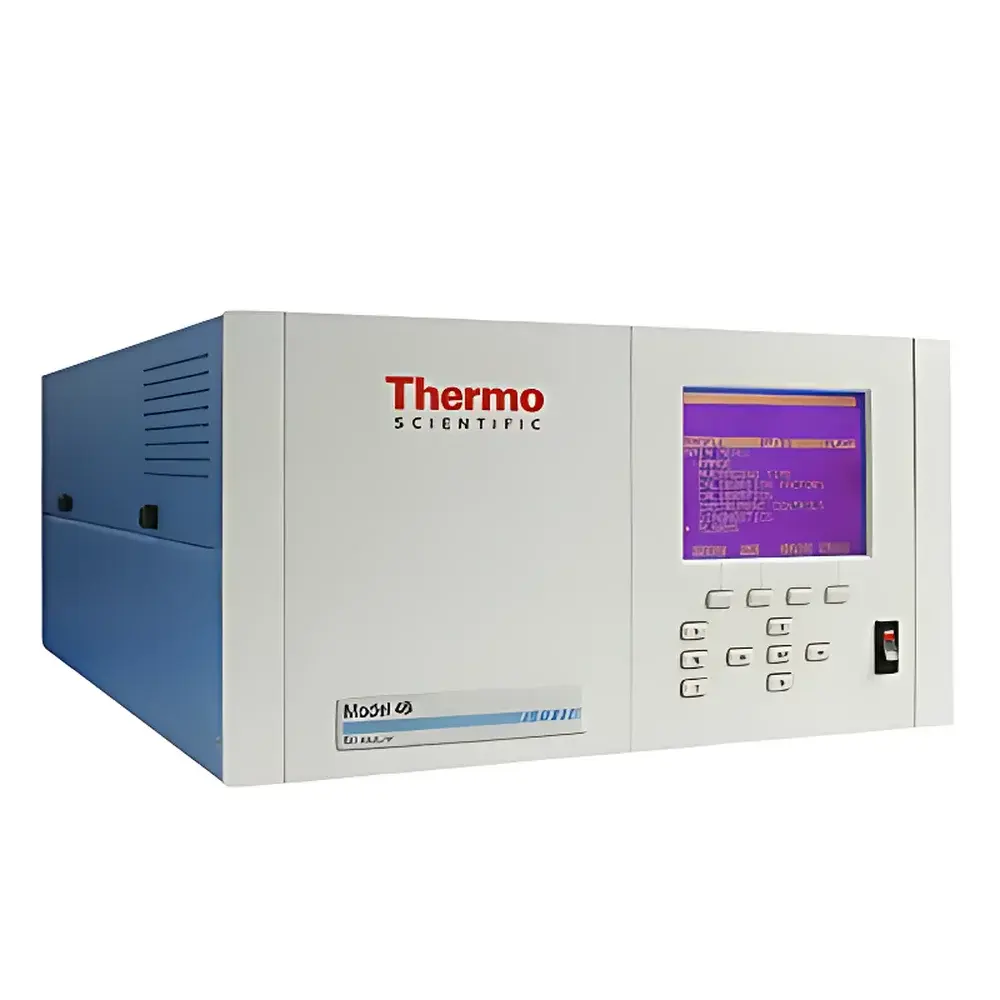
Thermo Fisher Scientific 48i Series Carbon Monoxide (CO) Analyzer
| Brand | Thermo Fisher |
|---|---|
| Origin | USA |
| Manufacturer Type | Original Equipment Manufacturer (OEM) |
| Product Origin | Imported |
| Model Variants | 48i, 48i-HL, 48i-TLE |
| Instrument Type | Online Continuous Emission Monitor |
| Measurement Principle | Gas Filter Correlation Infrared (GFC-IR) Absorption |
| Detection Target | Single-component CO gas |
| Range Options | 0–1 to 0–10,000 ppm (48i) |
| Repeatability | ±0.1 ppm |
| Resolution | 0.1 ppm |
| Response Time (T90) | ≤60 s |
| Zero Drift (24 h) | <0.1 ppm (48i/48i-TLE), <4 ppm (48i-HL) |
| Span Drift (24 h) | ±1% FS (48i/48i-TLE), ±2% FS (48i-HL) |
| Linearity Error | ±1% FS (<1000 ppm), ±2.5% FS (>1000 ppm) |
| Zero Noise | 0.02 ppm RMS (30-s avg, 48i/48i-TLE), 2.0 ppm RMS (10-s avg, 48i-HL) |
| MDL | 0.04 ppm (48i/48i-TLE), 4.0 ppm (48i-HL) |
Overview
The Thermo Fisher Scientific 48i Series Carbon Monoxide (CO) Analyzer is an online, continuous emission monitoring system engineered for regulatory-grade accuracy and long-term operational stability in ambient air quality networks, industrial stack monitoring, and urban background stations. It employs Gas Filter Correlation Infrared (GFC-IR) absorption spectroscopy—a highly selective, interference-resistant technique that isolates CO-specific absorption bands at 4.67 µm using a rotating filter wheel containing CO-filled and nitrogen-filled reference cells. This optical architecture eliminates cross-sensitivity to water vapor, carbon dioxide, methane, and other common atmospheric gases without requiring catalytic scrubbers or frequent calibration adjustments. The instrument operates unattended for extended periods, delivering traceable, NIST-traceable measurements compliant with U.S. EPA Reference Method 10 and EN 14625 for CO monitoring. Its robust thermal management, sealed optical path, and temperature-compensated detector ensure consistent performance across ambient conditions ranging from −30 °C to +50 °C.
Key Features
- GFC-IR optical design with dual-beam referencing for inherent compensation of lamp aging, window fouling, and electronic drift
- Three model variants optimized for distinct concentration regimes: standard-range (48i), high-level (48i-HL), and trace-level (48i-TLE)
- Large backlit LCD display with customizable soft-key interface for on-device configuration, diagnostics, and real-time trend viewing
- Integrated flash memory supporting ≥30 days of second-by-second data logging (configurable sampling interval)
- Modular internal layout with tool-less access to optical bench, detector assembly, and sample flow path—reducing mean time to repair (MTTR)
- RS-232, RS-485, and Ethernet (TCP/IP) interfaces enabling remote configuration, firmware updates, and secure data retrieval via HTTP or Modbus TCP
- Automatic zero/span validation capability with optional external gas standards for semi-automated QA/QC compliance
Sample Compatibility & Compliance
The 48i Series accepts sample gas streams at flow rates of 0.5–2.0 L/min, with inlet pressure tolerance of 70–106 kPa absolute. It supports both heated and unheated sampling lines and integrates seamlessly with certified sample conditioning systems (e.g., Nafion dryers, particulate filters, and heated probe assemblies) per EPA Performance Specification 2 (PS-2) requirements. All models meet CE marking directives (2014/30/EU EMC, 2014/35/EU LVD), are RoHS-compliant, and conform to IEC 61000-6-2/6-3 immunity and emission standards. Data integrity protocols align with EPA 40 CFR Part 60 Appendix B and ISO 17025-accredited laboratory practices. Optional audit trail logging satisfies FDA 21 CFR Part 11 requirements when deployed in regulated environmental compliance applications.
Software & Data Management
The analyzer operates with Thermo Fisher’s proprietary Teledyne™ Instrument Manager (TIM) software suite, supporting Windows-based configuration, alarm management, and report generation (PDF/CSV). Raw analog outputs (0–10 VDC, 4–20 mA) and digital outputs comply with ISA-84.00.01 (IEC 61511) functional safety guidelines for integration into DCS/SCADA platforms. Internal non-volatile memory retains calibration coefficients, event logs, and diagnostic histories—even during power loss. Remote firmware upgrades are authenticated via SHA-256 signatures, and all data transfers support TLS 1.2 encryption. Audit trails record user login/logout events, parameter changes, and calibration actions with timestamps and operator IDs—enabling full GLP/GMP traceability.
Applications
- Ambient air quality monitoring networks (EPA SLAMS, EU Air Quality Directive stations)
- Industrial combustion source emissions (power plants, cement kilns, waste incinerators)
- Indoor air quality assessment in parking garages, tunnels, and underground facilities
- Calibration laboratories performing CO standard generation and verification
- Research applications requiring stable, low-drift CO baselines for atmospheric chemistry studies
- Mobile monitoring platforms where vibration resistance and thermal stability are critical
FAQ
What measurement principle does the 48i Series use, and why is it preferred for CO monitoring?
It uses Gas Filter Correlation Infrared (GFC-IR) absorption, which provides superior selectivity over conventional NDIR by rejecting spectral interferences—making it ideal for complex gas matrices without chemical scrubbing.
Can the 48i operate in unheated outdoor enclosures?
Yes—the analyzer’s internal thermal regulation maintains optical alignment and detector stability across −30 °C to +50 °C ambient ranges; however, sample line heating is recommended below 0 °C to prevent condensation.
Does the 48i Series support automated zero/span checks?
Yes—when paired with an optional external gas delivery module, it performs scheduled zero air and span gas injections with full event logging and pass/fail reporting per EPA PS-2 criteria.
How is data integrity ensured during network transmission?
All remote communications use TLS 1.2 encryption; internal audit trails log every configuration change with user ID, timestamp, and parameter delta—fully compliant with 21 CFR Part 11 for regulated environments.
What maintenance intervals are recommended for routine operation?
Optical window cleaning and flow path inspection every 3 months; annual verification of zero/span response and detector linearity using certified standards; no consumables required beyond periodic filter replacement.
Related Products







